Executive Verdict: Low iron glass is not a flat percentage markup - it is a raw-substrate uplift whose percentage impact shrinks with every downstream fabrication and logistics step. If your panel is 10 mm or thicker, frameless at close viewing distance, or back-painted pure white, then paying the $8 to $29/m2 FOB delta prevents visible green-cast rejection. If your BOQ covers standard 6 mm or 8 mm upper-floor curtain wall IGUs or dark ceramic-frit spandrels, then zone-splitting standard clear cuts total low iron uplift by 45% to 65% with zero visible compromise.
Most online pricing guides quote a vague "low iron costs 30% to 100% more" range and stop there. For a B2B facade estimator, curtain wall contractor, or architectural importer building a Bill of Quantities (BOQ), a 70-point spread is unusable. Whether a low iron specification blows your glazing budget or adds a manageable 18% depends on five quantifiable variables: float furnace campaign economics, fabrication cost dilution, jumbo sheet cutting yield, heat-soak or brand riders, and export freight weight.
This breakdown uses Q4 2026 cost-stack data from our 20,000 m2 processing facility in Wuhan, China. For the optical chemistry (Fe2O3 ppm, VLT curves, and b-star color shift) behind these numbers, refer to our low iron glass complete specifier's guide.
Why Low Iron Costs More at the Float Line
The raw price premium of low iron glass is locked in upstream at the float mill before a fabricator ever scores a sheet. Standard architectural soda-lime float glass (governed by ASTM C1036-21, EN 572-2:2012, and GB 11614-2022) carries 0.10% to 0.15% ferric oxide (Fe2O3) by weight as a natural impurity in silica sand. Dropping Fe2O3 below 0.01% adds cost at three specific furnace stages:
- Silica Sand Beneficiation (+18% to 25% batch cost): Iron-bearing minerals (hematite, limonite, chromite) must be stripped from quartz sand via high-intensity magnetic separation, froth flotation, or acid leaching. Low-iron silica deposits near major float clusters are scarcer, raising raw batch transport cost.
- Tin-Bath Radiative Heat Transfer & Pull Rate (-8% to 12% output): Because iron oxide absorbs infrared radiation inside the glass melt, standard clear glass creates a steep vertical temperature gradient in the melting tank. Ultra-clear melts transmit infrared radiation much deeper to the furnace floor, requiring tighter burner profiling, higher refractory wear protection, and lower daily tonnage pull rates on thick 15 mm and 19 mm ribbons.
- Campaign Transition Cullet Loss: Float furnaces operate continuously for 10 to 15 years. Switching a 600 to 900 ton/day line from standard clear to ultra-clear (or back) requires a 3 to 5 day color-transition flush that produces off-spec green-tint cullet. Float mills amortize that transition scrap directly into the raw jumbo sheet price - especially for thinner runs (4 to 5 mm) and heavy structural thicknesses (15 to 19 mm).
2026 FOB Wuhan Price Matrix & Processing Dilution
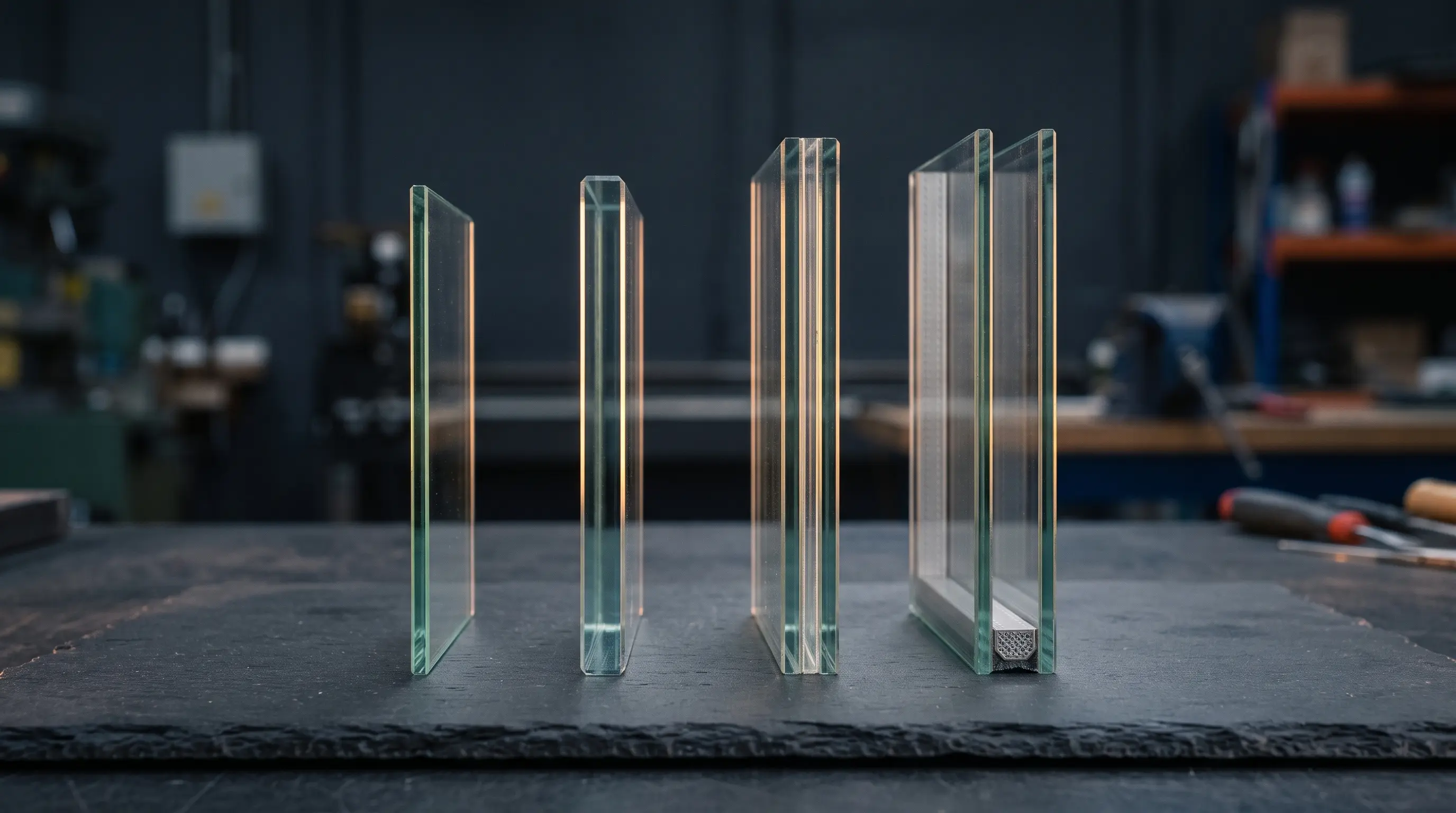
Processing dilution is the single most misunderstood dynamic in architectural glass estimating. Cutting, CNC edge polishing, furnace tempering, PVB/SGP autoclaving, and IGU dual-sealing consume the same labor, power, and consumables whether the glass contains 0.12% or 0.008% Fe2O3. Mathematically, the effective finished premium follows:
Effective Premium (%) = [ (P_LowIron - P_Standard) / (P_Standard + C_Fabrication) ] x 100
As fixed fabrication cost (C_Fabrication) grows in the denominator - from $2/m2 on raw annealed float to $52+/m2 on an SGP structural laminate or Low-E argon IGU - the absolute dollar uplift stays tied to the glass lites, while the percentage premium drops sharply.
| Build-Up & Standard | Standard Clear (USD/m2) | Low Iron Tier-1 (USD/m2) | Dollar Delta | Effective Premium | Lead Time Delta |
|---|---|---|---|---|---|
| 6 mm Annealed Float (GB 11614-2022) | $8.50 - $10.50 | $14.50 - $17.50 | +$6 - $7 | +68% - 75% | +5 working days |
| 8 mm Tempered Glass (ASTM C1048-18) | $16 - $19 | $24 - $29 | +$8 - $10 | +48% - 54% | +5-7 working days |
| 10 mm Tempered Frameless Grade | $20 - $24 | $31 - $37 | +$11 - $13 | +50% - 56% | +5-7 working days |
| 12 mm Tempered Structural / Door | $25 - $30 | $39 - $47 | +$14 - $17 | +55% - 60% | +7 working days |
| 15 mm Tempered Jumbo Grade | $35 - $42 | $57 - $68 | +$22 - $26 | +60% - 65% | +7-10 working days |
| 10+1.52 PVB+10 Laminated Glass (Both LI) | $52 - $60 | $76 - $88 | +$24 - $28 | +45% - 50% | +7-10 working days |
| 10+1.52 SGP+10 Structural Laminated (Both LI) | $82 - $94 | $106 - $122 | +$24 - $28 | +28% - 32% | +7-10 working days |
| 6T+12Ar+6T Insulated Glass (Outboard LI Only + Low-E) | $48 - $56 | $57 - $67 | +$9 - $11 | +18% - 22% | +5-7 working days |
| 6T+12Ar+6T Low-E IGU (Both Lites LI) | $48 - $56 | $66 - $78 | +$18 - $22 | +37% - 42% | +7-10 working days |
Pricing note: All figures are 2026 reference pricing, FOB Wuhan factory, subject to formal quotation. Actual prices vary with glass thickness, coatings, panel size, order volume, and USD/CNY exchange rate at time of quotation.
Interactive Cost-Stack & Dilution Builder
How the cost-stack builder works: Select single-lite thickness (6 to 19 mm), fabrication assembly (annealed, tempered, 1.52 mm PVB or SGP laminated, or double Low-E IGU with one or both lites in low iron), float tier (Chinese Tier-1 at 1.0x vs. branded Starphire/Optiwhite at 1.30x), cutting yield (70% to 88%, compared against 86% continuous clear nesting), order volume (triggering a +14% small-batch surcharge below 100 m2), and optional EN 14179-1 heat-soak testing (+$10/m2 per lite). Assemblies with effective uplift <= 28% score High Dilution; 29% to 54% score Balanced; >= 55% score Substrate-Dominated.
How Fabrication, Yield, and Brand Shift the Real Low Iron Premium
Flat polish + horizontal tempering (ASTM C1048 / EN 12150).
2026 reference modeling, FOB Wuhan factory. Subject to formal CAD nesting, coating spec, and USD/CNY rate. Data verified: 2026-11-22.
In our 20,000 m2 Wuhan plant, we run low iron glass through the exact same 4 intelligent cutting lines, 4 edge-grinding lines, 2 tempering furnaces (up to 3.3 m x 15 m), and 2 high-pressure laminating autoclaves (up to 3.3 m x 15 m) as standard clear. We do not charge a "specialty line setup fee" on low iron orders above 100 m2 - the price spread you see on a formal Sincere Glass quotation reflects actual raw jumbo sheet cost and CAD cutting yield. For a closer look at how interlayer choice interacts with substrate cost, see our SGP vs. PVB interlayer cost analysis.
Five Hidden Cost Drivers in Low Iron Quotes
Two suppliers quoting the same "10 mm low iron tempered" line item can land 25% apart. Almost all of that variance comes from five secondary drivers that rarely appear on a headline per-square-meter price sheet:
1. Dedicated-Batch Cutting Yield Loss (+8% to 18% Silent Penalty)
Standard clear float runs continuously across dozens of concurrent orders on our cutting floor, allowing optimization software to nest smaller panels into the offcuts of larger facade jobs (averaging 84% to 88% net yield). Low iron orders run in isolated batches. Chinese low iron jumbo stock typically arrives in 3,300 x 2,140 mm, 3,300 x 2,440 mm, or 3,660 x 2,440 mm master sheets (plus jumbo 3,300 x 6,000 mm+ lengths). If your curtain wall module is 1,250 mm wide, only two strips fit across a 3,300 mm sheet (2,500 mm used), leaving an 800 mm scrap ribbon - a 24.2% material loss that is billed directly into your unit price. Trimming module width by 150 mm to 1,080 mm fits three strips (3,240 mm used), slashing waste to under 4%.
2. Heat-Soak Testing (EN 14179-1:2016) on High-Rise & Overhead Glass
A persistent procurement myth is that low iron glass eliminates spontaneous nickel sulfide (NiS) breakage. It reduces the statistical incidence because purified batch sand contains less tramp nickel, but NiS inclusions can still originate from stainless steel batch-house equipment. For high-rise facades (10+ floors) and overhead balustrades, codes and engineers still mandate heat-soak testing per EN 14179-1:2016 (290 deg C hold for 2 to 4 hours), which adds $8 to $12/m2 per lite and 2 to 3 working days. Review full failure probabilities in our heat-soaked tempered glass guide.
3. Branded Float Specification Clauses (+20% to +40%)
When an architect writes "Vitro Starphire", "Pilkington Optiwhite", or "Saint-Gobain Diamant" into Division 08 without an "or approved equal" clause, substrate pricing jumps 20% to 40% over Chinese Tier-1 ultra-clear float (CSG, Xinyi, Taiwan Glass, Kibing). All sit below 0.01% Fe2O3 with 90% to 91% VLT at 6 mm. Submitting a spectrophotometer curve and mill test report for Tier-1 Chinese ultra-clear during pre-construction is the fastest way to recover 15% to 25% of total glazing spend. See the side-by-side optical and submittal breakdown in Starphire vs. low iron glass.
4. Soft-Coat Low-E Availability on Low Iron Substrate
Standard clear float is available off the shelf with dozens of pre-coated Low-E stacks (double-silver and triple-silver). Low iron Low-E stock is narrower. If your project demands a specific SHGC (e.g., 0.28 triple-silver) on 8 mm or 10 mm low iron rather than standard 6 mm, the coater may enforce a 500 to 1,000 m2 custom sputtering run minimum, delaying delivery by 10 to 14 days and adding a coating-changeover surcharge.
5. Breakage Replacement & Schedule Risk
In our Wuhan plant, low iron orders take 15 to 20 working days for tempered glass and 20 to 25 working days for laminated or IGU assemblies because non-stock thicknesses (15 mm, 19 mm, or oversized 3.3 m jumbo plates) are drawn from float mills upon deposit confirmation. Ordering a single replacement panel after job-site breakage incurs small-lot setup fees and expensive LCL or air freight. Building 2% to 3% spare lites into the initial container costs pennies on the dollar compared to a 6-week handover delay.
Never specify low iron glass for dark grey, bronze, or black ceramic-frit spandrels. Opaque dark enameled spandrel glass absorbs transmitted light and completely hides the green iron tint of standard clear float. Reserve low iron spandrels strictly for pure white (RAL 9003 / 9010), ivory, or pastel back-painted glass where iron tint visibly shifts the cured color toward mint-green.
Free PDF: Global Architectural Glass Building Codes Comparison
Compare US IBC, EU EN, China GB, and Australia AS safety, structural, and energy glazing mandates side by side before locking your BOQ.
Value-Engineering Rules & 1,200 m2 BOQ Case Study
Instead of applying low iron uniformly across an entire elevation, split your BOQ by viewing distance, thickness, and edge exposure. Apply three binary rules:
- Outboard-Lite-Only IGUs on Podiums: On a double-glazed storefront or podium curtain wall (
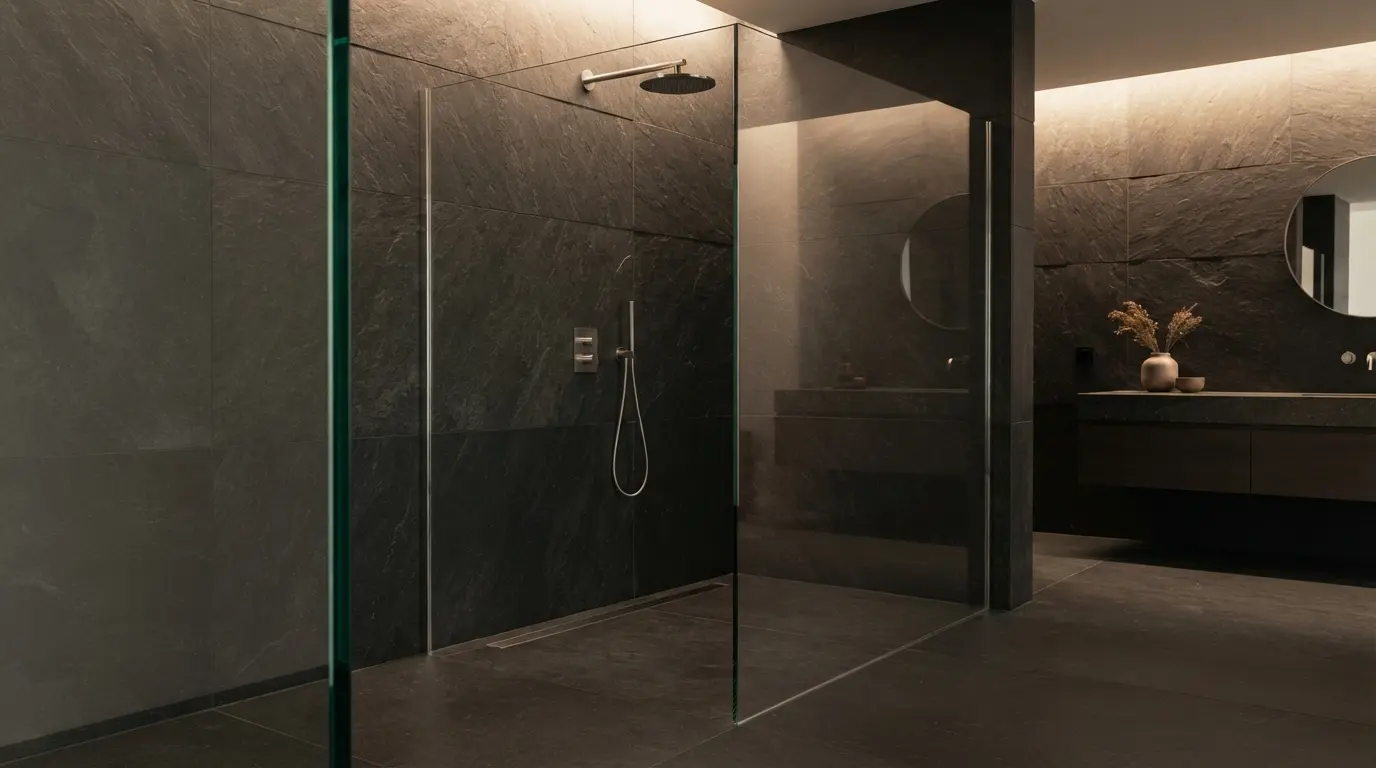
6T + 12Ar + 6T Low-E#2), using low iron on the exterior lite and standard clear on the interior lite eliminates most of the exterior green reflection while cutting the low iron substrate premium by 50% (from ~40% down to ~20%). - Floor-Height Cutoff (Ground to Floor 2 vs. Tower Floors 3+): Hold full low iron for ground-floor lobbies, retail vitrines, frameless low iron shower doors, and interior balustrades viewed within 2 meters. Switch to standard clear float from Floor 3 upward, where street-level observers cannot distinguish low iron from clear behind a Low-E coating.
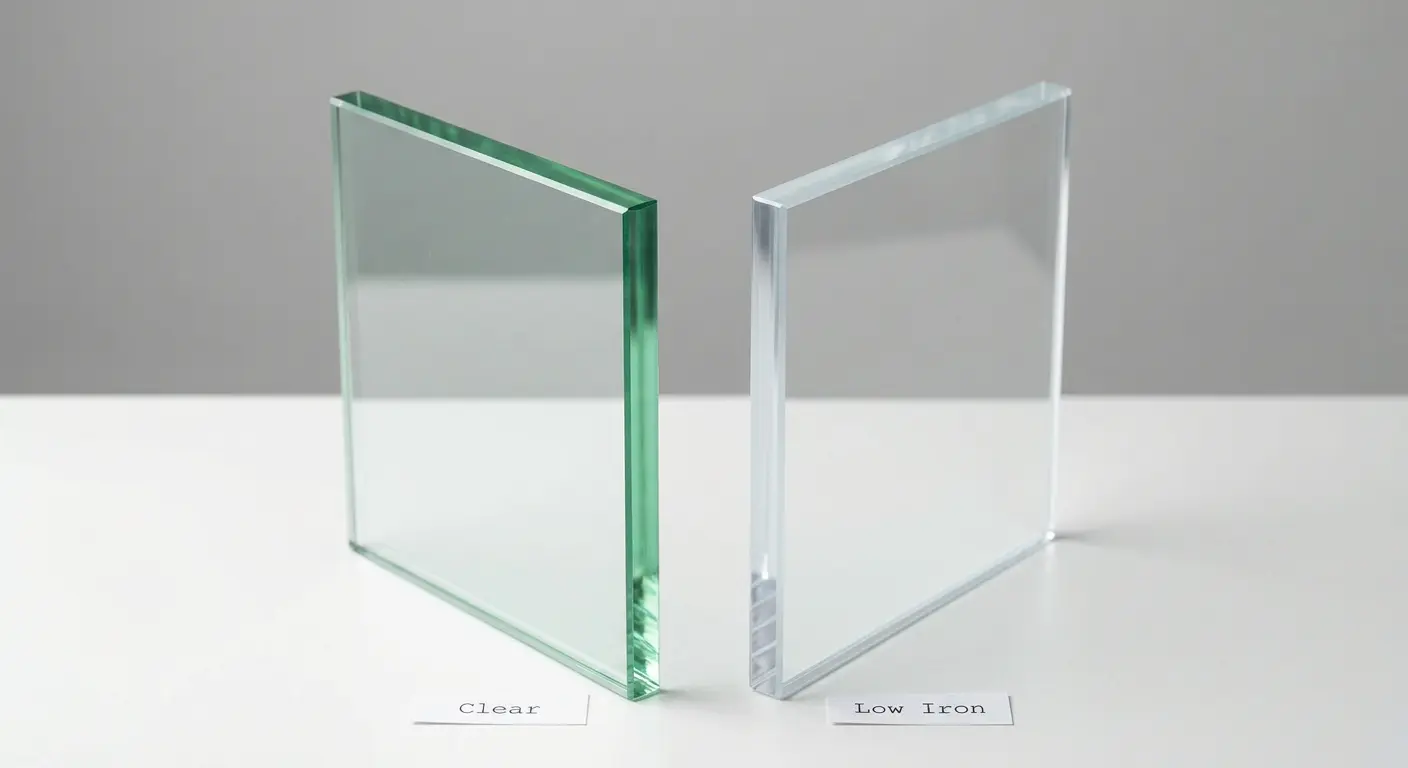
- Thickness Gate at 10 mm: At 10 mm and above, standard clear edge and body greenness becomes immediately obvious (see our side-by-side optical test in low iron glass vs. clear glass and structural sizing in low iron tempered glass specifications). Below 8 mm in framed vision openings, standard clear is usually the rational budget call.
How the BOQ value-engineering simulator works: The model simulates a 1,200 m2 commercial building across five distinct glazing zones - Ground-Floor Lobby (220 m2, $48 Clear vs. $74 LI), Frameless Balustrades/Showers (140 m2, $62 vs. $88), Podium Vision IGUs (240 m2, $52 Clear / $62 Outboard-LI / $72 Full-LI), Upper-Floor Tower IGUs (450 m2, $52 / $62 / $72), and Dark Spandrels (150 m2, $26 vs. $38). Switching from 100% Low Iron ($79,660) to the Recommended VE Split ($65,160) saves $14,500 FOB (cutting 59% of the entire low iron premium) with zero aesthetic risk flags.
Zone-Split Value Engineering Simulator (1,200 m2 Commercial Baseline)
High visual risk: thick glass viewed under 2 m shows strong green cast on merchandise and white interiors.
High visual risk: polished exposed edges show bottle-green stripe at arm's length.
Moderate: outboard-only Low Iron removes exterior green reflection while saving 50% of substrate uplift.
Low visual risk: viewed from >15 m street distance behind Low-E coating, standard clear is indistinguishable.
Zero visual risk: dark ceramic frit completely masks iron tint (only white/pastel frit requires Low Iron).
Export Landed-Cost Compression: FOB vs. Delivered
When importing glass from China to North America, Europe, the Middle East, or Australia, ocean freight, export plywood A-frame crating, and destination port handling are priced by container weight and volume - never by iron oxide content. A 20' GP container carries a maximum safe payload of roughly 20 metric tons (20,000 kg) at 2.5 kg/m2 per millimeter of glass thickness, whether the glass is standard clear or ultra-clear.
Because fixed logistics dollars sit equally in both options, the delivered percentage premium for low iron is always lower than the FOB Wuhan percentage premium. On a 600 m2 order of 10 mm tempered glass shipped to the US West Coast (4.9% MFN base duty under HTSUS 7007 per USITC HTS), a +55% FOB gap compresses to roughly +40% on a landed-at-port basis.
| Destination Lane | Est. Freight + Crating + Port | Base MFN Duty & Source | Landed Clear / LI (USD/m2) | Landed Gap (vs +55% FOB) |
|---|---|---|---|---|
| US West Coast (LA/LB) | $5,240 ($8.73/m2) | 4.9% MFN (USITC HTS 7007) | $31.81 / $44.40 | +40% (-15 pts) |
| US East Coast (NY/SAV) | $6,240 ($10.40/m2) | 4.9% MFN (USITC HTS 7007) | $33.48 / $46.07 | +38% (-17 pts) |
| EU (Rotterdam) | $5,390 ($8.98/m2) | 3.0% EU TARIC CN 7007 | $31.64 / $44.00 | +39% (-16 pts) |
| Middle East (Jebel Ali) | $4,040 ($6.73/m2) | 5.0% GCC Common Tariff | $29.83 / $42.43 | +42% (-13 pts) |
| Australia (Sydney) | $4,490 ($7.48/m2) | 0.0% ChAFTA CoO (AS/NZS 2208) | $29.48 / $41.48 | +41% (-14 pts) |
How the landed-cost compression model works: Enter your destination trade lane (US West, US East, EU Rotterdam, Middle East Jebel Ali, or Australia Sydney), order area (50 to 10,000 m2), total glass thickness (6 to 38 mm), and FOB rates for standard clear vs. low iron. The calculator multiplies area x thickness x 2.5 kg/m2/mm to size 20' GP containers (20,000 kg payload cap), adds $180 per 2-ton export crate, lane freight, port clearance, and base MFN duty, then outputs the exact percentage-point compression between FOB and delivered rates.
FOB vs. Landed-Cost Premium Compression Calculator
To check exact crate packing and container utilization for mixed panel sizes before issuing a PO, run your schedule in our standalone Glass Container Load Calculator or review Incoterms, customs clearance, and marine insurance in our guide to importing architectural glass from China. For North American glazing standards and daylighting references, consult the National Glass Association (NGA).
How to Lock Competitive Low Iron Pricing in Your RFQ
When sending an RFQ to Chinese architectural glass factories, four line-item details immediately prevent padded quotes and post-order change notices:
- Specify Optical Thresholds, Not Brand Names: Write "Ultra-clear low iron float per GB 11614-2022 / ASTM C1036-21, Fe2O3 <= 0.01%, VLT >= 91% at 6 mm (CSG, Xinyi, Taiwan Glass, or approved equal)" unless the owner contractually forbids substitutions.
- Attach a Full Panel Size Schedule (Not Just Total m2): Without exact width x height counts, factories assume worst-case 72% cutting yield and pad your quote by 10% to 15%. Sending CAD dimensions lets our Wuhan cutting engineers optimize nesting across 3,300 mm and 3,660 mm master sheets.
- Separate Low Iron & Standard Clear Marks Clearly: Split your glazing schedule into explicit marks (e.g., GL-01 Lobby Low Iron vs. GL-02 Tower Clear Low-E) so you capture zone-split savings in a single consolidated container.
- Request Dual-Option Quotes on IGUs: Always ask for both "Both Lites Low Iron" and "Outboard Lite Low Iron Only" pricing on double-glazed elevations - the side-by-side dollar delta makes owner value-engineering approvals fast.
Get a quote for this product
Buyer FAQ: Pricing, MOQ, and Sourcing
Before locking in a factory quote that looks unusually cheap, run the vendor through our low iron glass suppliers audit checklist to confirm float mill provenance, HST kiln logs, and export crating standards.
Raw low iron float glass costs 60% to 90% more than standard clear float at the mill. Once tempering, lamination, or IGU fabrication is added, the finished panel premium narrows to 30% to 60% FOB Wuhan, and drops to 20% to 35% on an outboard-lite-only IGU.
Our Wuhan facility runs a 100 m2 MOQ for stock low iron thicknesses (6, 8, and 10 mm) across tempered, laminated, and IGU lines. Non-stock thicknesses (15 and 19 mm) or jumbo panels up to 3.3 m x 15 m typically require 200 to 500 m2 to match float mill batch minimums.
Yes. Mandating branded imported float (Vitro Starphire, Pilkington Optiwhite, or Saint-Gobain Diamant) adds 20% to 40% to substrate cost and 1 to 2 weeks to lead time. Chinese Tier-1 low iron float (CSG, Xinyi, Taiwan Glass) delivers equivalent under-0.01% Fe2O3 and 91% VLT optics.
Formal quotations are valid for 15 to 30 days. Pricing moves with low-iron silica sand availability, float furnace campaign schedules, natural gas costs, and USD/CNY exchange rates. Final pricing is locked upon CAD panel-schedule verification and deposit receipt.
Yes. Always include 2% to 3% attic stock (minimum 1 to 2 lites per critical mark) in the initial container. Replacing a single broken low iron panel later triggers small-batch mill surcharges, 15 to 25 working days of lead time, and disproportionately high LCL or air freight.
Architectural Glass Lines Available in Low Iron Substrate
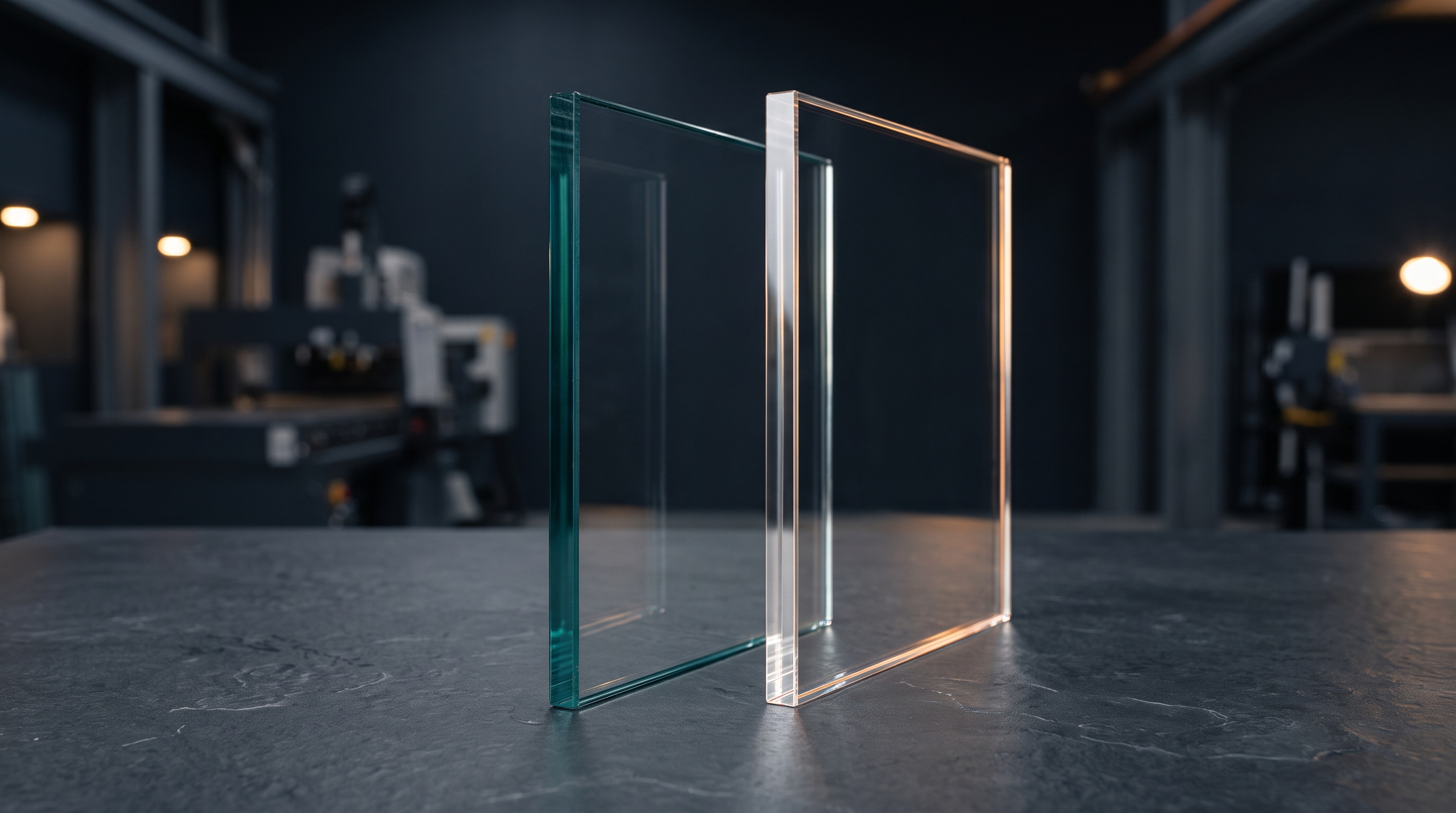
Low Iron Glass
Ultra-clear float (<0.01% Fe2O3) up to 3.3m x 15m
View product →
Tempered Glass
4–5× stronger than annealed. Jumbo panels up to 3m × 15m.
View product →
Laminated Glass
PVB or SGP interlayer. Fragment-retention safety glass.
View product →
Insulated Glass (IGU)
Low-E coated, argon-filled. Energy-efficient glazing.
View product →
Low-E Glass
Soft-coat and hard-coat options for thermal control.
View product →
Free Download: Global Glass Building Codes Comparison
A side-by-side reference for architectural glass regulations across US IBC, EU EN, China GB, and Australia AS — free PDF for architects and specifiers.

Li Cheng
CEO at Sincere Glass
CEO at Sincere Glass (欣城玻璃) with 10+ years in architectural glass. Oversees production and quality at our 20,000 m² Wuhan facility.
Technical review: Albar, Technical Lead
Need Custom Glass for Your Project?
Get a free quote from our engineering team. We'll help you choose the right glass type, thickness, and coating for your specific requirements.