Sourcing architectural glass from China can cut a project's glazing budget by 30–50% versus local supply in North America, Europe or the Gulf — but only if the import process is run with the same discipline the project itself demands. The savings disappear fast when a container of tempered panels arrives with the wrong hardware cut-outs, when a laminated glass unit fails EN testing at port of entry, or when a "jumbo" order gets split across three factories because the first one lied about its furnace size.
This guide is written from inside a 20,000 m² Wuhan glass plant. It walks through the five stages every serious buyer runs — shortlisting, capability verification, quoting, logistics, and QC — plus the paperwork, Incoterms and container-loading math that decide whether the glass arrives at your site intact and on budget.
Who this is for
This playbook assumes you fall into one of four roles:
- Project architects or specifiers who have decided the glass make-up (e.g. 6-1.52-6 PVB laminate, Low-E #2) and need to source the actual panels from an export market.
- Glazing contractors comparing a direct China buy against a local distributor markup for jobs where panel count exceeds roughly 200 m² — the volume where direct import begins to beat local pricing after freight.
- Developers or facade consultants running early budgets who need realistic FOB and landed numbers to defend the glass line item.
- First-time importers at trading firms who have a buyer lined up but have never run a glass container before.
If you need a refresher on glass product selection before sourcing, start with our architectural glass types guide. If you're weighing a specific application, our curtain wall glass specification walk-through covers the spec side before this covers the buy side.
The 5-stage import journey
A direct import from a Chinese glass factory takes between 6 and 14 weeks from first contact to glass on site, depending on panel count, make-up complexity, and sea freight transit time. The steps are the same whether you buy ten panels or ten containers:
- Shortlist suppliers — 3 to 5 candidates vetted against a credentials + capability + communication scorecard.
- Verify capability — paper credentials in hand, physical samples ordered, factory audit (video or on-site) scheduled.
- Specify and quote — a disciplined RFQ that leaves no interpretation room, cross-compared on apples-to-apples terms.
- Logistics and Incoterms — the Incoterm choice determines who pays for what and, more importantly, where risk transfers.
- QC and container loading — pre-shipment inspection, vessel booking, VGM declaration, bill of lading.
Buyers who try to compress Stage 1 and 2 into one email thread ("send me a quote and your certs") end up with cheap bids from factories that can't actually produce the specification. Spend two weeks on supplier vetting; the four weeks of production will go faster for it.
Stage 1 — Shortlist suppliers
Alibaba.com, Made-in-China, and trade-show directories (Guangzhou Fair, Fenestration China, Vitrum) will each give you between 20 and 200 candidate factories for a given glass type. That list has to be cut to 3–5 before any serious conversation starts. The scorecard below is the one we recommend buyers run on us and our competitors alike.
How the scorecard works: ten verification items are grouped into three dimensions — Credentials (40 points: ISO 9001, 3C/CCC, EN tests, business license, export rights), Capability (35 points: furnace or autoclave envelope match for your largest panel, monthly capacity at least 3× your order volume, three or more reference projects in the same product category), and Communication (25 points: 24-hour technical response in your working language, willingness to send a paid sample before PO). Tick what you have verified in writing. The resulting score sits in one of four tiers: 81–100 Preferred Supplier (proceed to RFQ), 61–80 Qualified (resolve open items before PO), 31–60 Caution (only proceed with factory audit and payment safeguards), 0–30 High Risk (walk away). Weightings are deliberately heaviest on equipment-envelope match and technical communication speed — the two attributes most predictive of execution risk.
For the deep-dive playbook on supplier vetting — the 5-risk threat model, cert verifier, and the 90-minute video audit script — see how to vet a china glass supplier.
Interactive
Supplier Verification Scorecard
Tick what you have verified in writing. The score updates live and the tier changes at 31, 61 and 81.
Walk away or restart due diligence from the credentials row.
A supplier below 61 points is not a candidate — move on. A supplier at 61–80 is a candidate with specific open items; those items go on your Stage 2 verification list. Only suppliers scoring above 81 skip ahead to RFQ.
The weighting isn't arbitrary. "Furnace or autoclave can handle your largest panel" carries 15 points because the single most common failure mode in a China glass buy is the factory accepting a drawing it cannot physically produce, then outsourcing the oversize pieces to a plant you've never audited. In our Wuhan plant, our 3m × 15m tempering furnace and matching 3m × 15m lamination autoclave let us keep jumbo panels in-house end-to-end — a specific capability the scorecard is designed to force into the open before you quote.
Stage 2 — Verify capability
Credentials on a brochure are not credentials. For each shortlisted supplier, you want to see:
- ISO 9001:2015 certificate — issued by a recognised certification body (SGS, TÜV, BV, Intertek, DNV). Verify the certificate number on the certifier's website, not just the PDF the factory emails. See the ISO 9001 overview for what the standard actually covers.
- China 3C (CCC) certificate under GB 15763.2-2005 for tempered glass, GB 15763.3-2009 for laminated. Legally required for architectural safety glass sold or exported from China. No CCC = the factory is not a legal safety-glass producer.
- EN 12150-1:2015 and EN 14449:2005 test reports if you are shipping into Europe and need CE marking. The test report must name your factory, not a parent group or a "similar" plant.
- Project reference list with photos, project name, and glass make-up. Three real projects beats a glossy portfolio of unlabelled renders.
- A physical sample. This is the step most buyers skip and most regret. A 300×300 mm sample costs USD 20–40 to produce and 60–120 to air-freight. It confirms coating orientation, PVB clarity, edge quality, and whether what the factory calls "Low-E" is actually Low-E. For a six-figure order, this is the cheapest insurance you'll ever buy.
For technical articles that explain what you're verifying, our deep dives on how tempered glass is made and how laminated glass is made walk through the production steps the factory audit should cover.
Free Download: Global Glass Building Codes Comparison
A side-by-side reference for architectural glass regulations across US IBC, EU EN, China GB, and Australia AS — free PDF for architects and specifiers.
The video factory audit
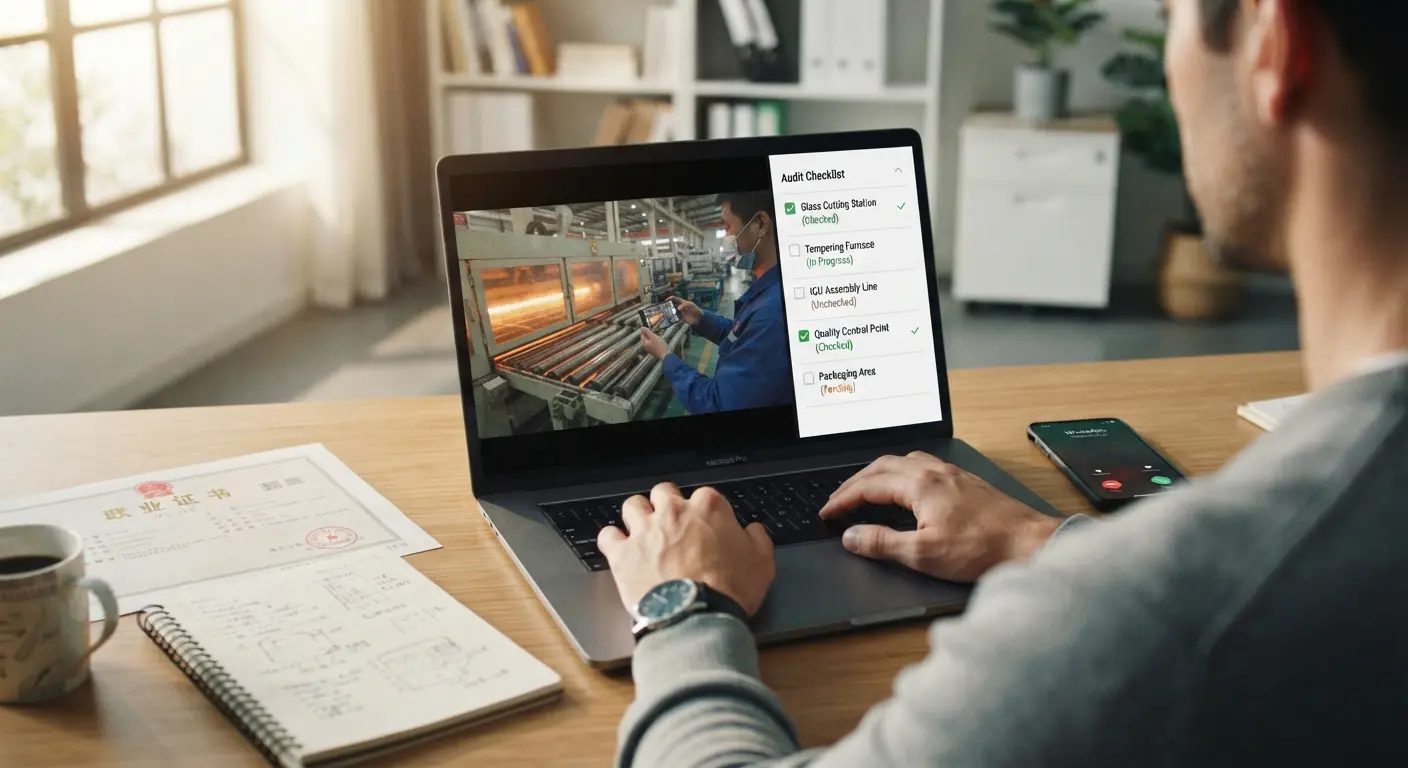
An on-site audit by a third-party inspector (SGS, Intertek, QIMA) costs USD 300–600 per factory and is worth it for orders above USD 50,000. For smaller orders, a live video walk-through — scheduled an hour at a time, with the factory contact carrying a phone through specific stations — gets you 80% of the signal at 10% of the cost. Insist on seeing:
- The glass-cutting line and edge-grinding station — asking the operator to measure a cut sample with calipers in front of you catches tolerance issues immediately.
- The tempering furnace nameplate (confirms the oven envelope matches what you were told).
- The lamination autoclave and the clean assembly room (lamination defects are 90% a dust-and-humidity story).
- The IGU line, if ordering insulated glass — argon fill station, sealant dispenser, dew-point tester on the QC bench.
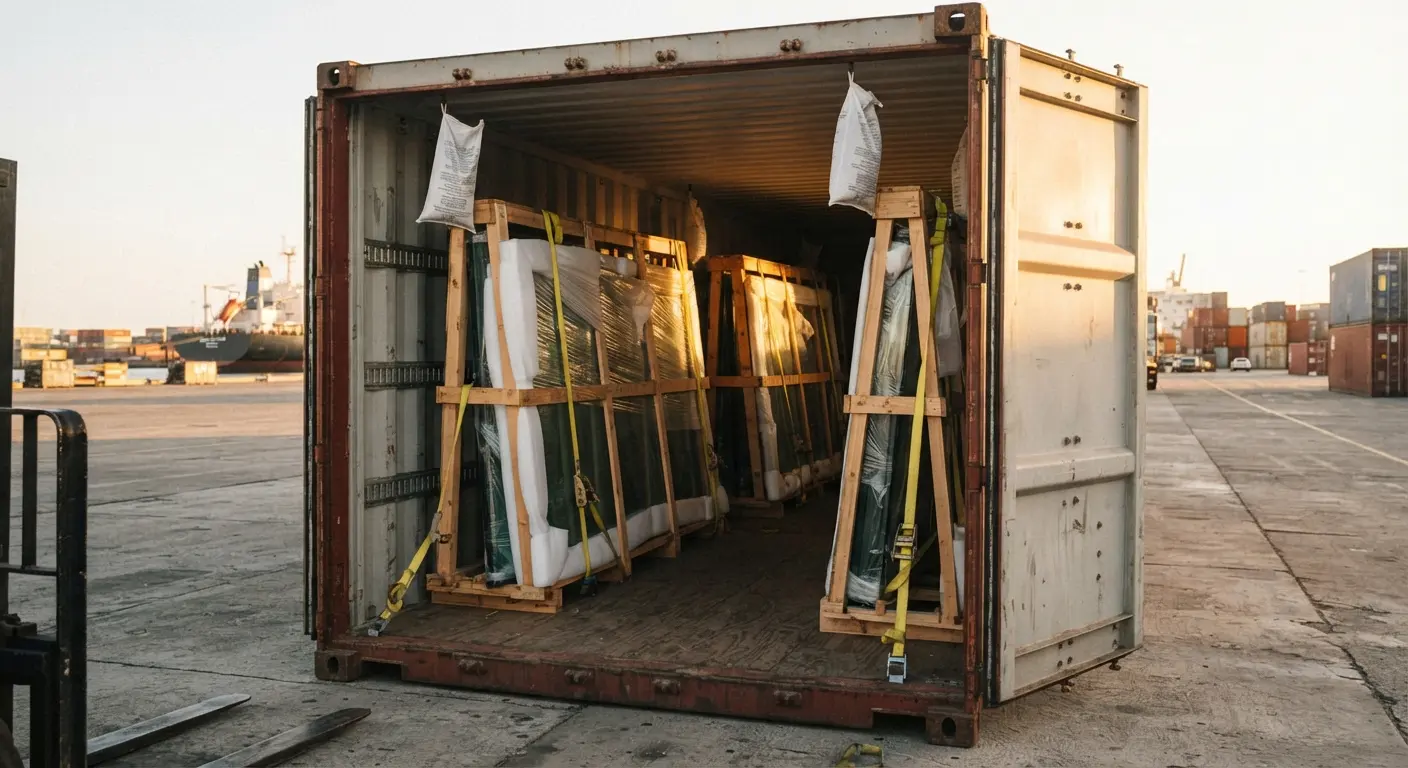
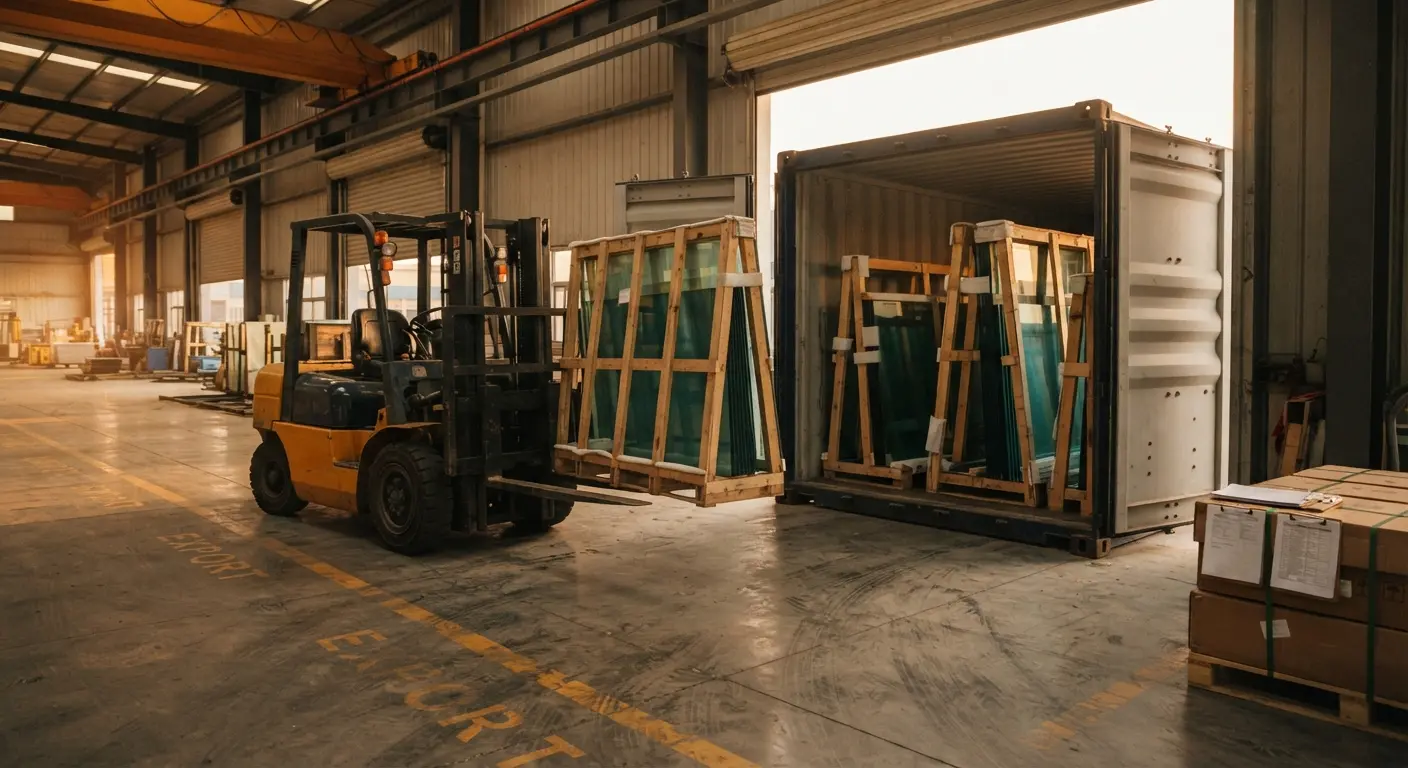
- The finished-goods crating area — bad crates destroy more glass than bad production ever will.
Stage 3 — Specify and quote
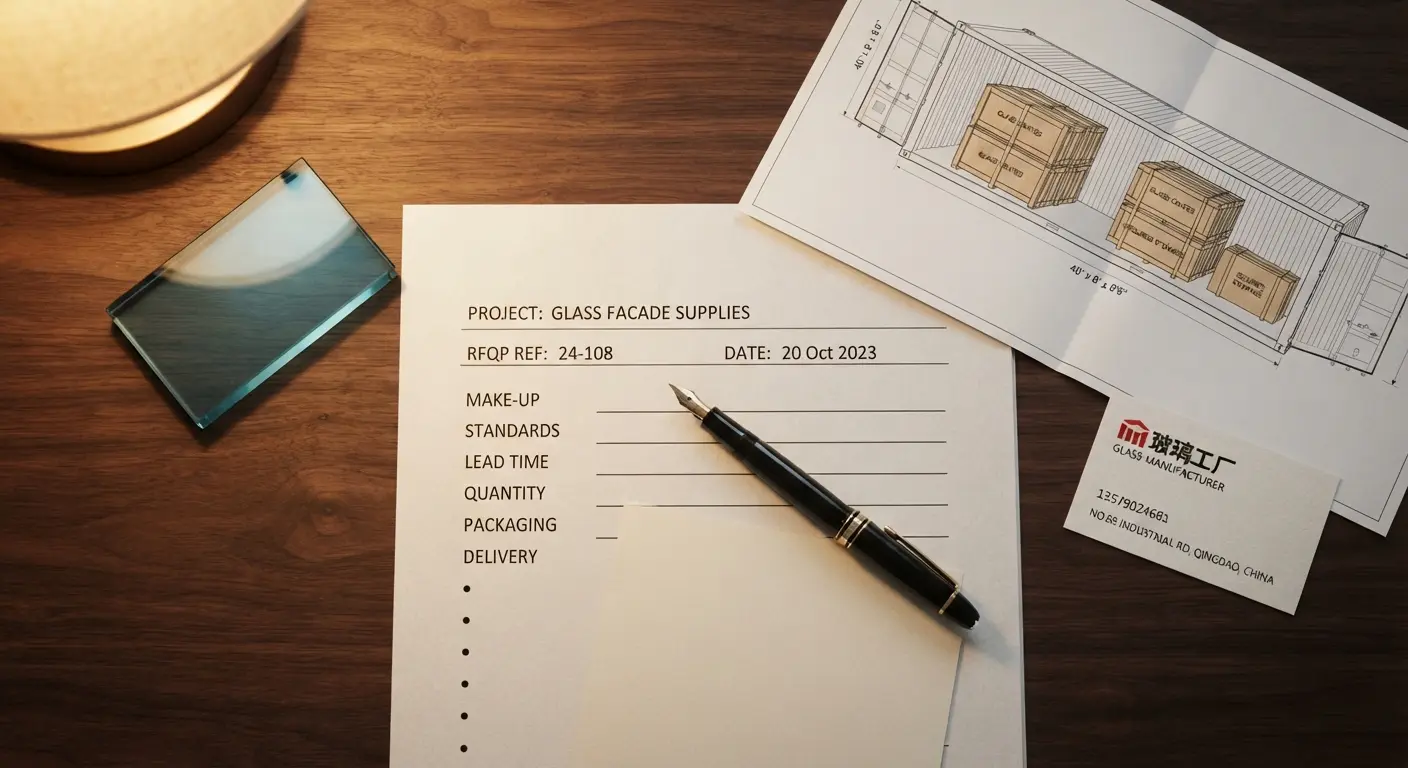
A loose RFQ invites loose quotes. Every quote you receive should be built from the same specification sheet so that the three or four returned prices are directly comparable. A production-ready specification includes:
- Glass make-up written out in standard notation, not prose. "6T + 1.52 PVB + 6T, Low-E on #2" is unambiguous. "Laminated tempered glass with Low-E coating" is three questions in a trench coat.
- Panel schedule: for each unique size, the quantity, dimensions (W × H in mm), and any hardware cut-outs or holes with coordinates.
- Edge finish: flat-ground + arrissed, flat polished, or pencil polished.
- Hardware pre-prep: holes drilled, hinge cut-outs, patch fitting notches — all with a dimensioned drawing per panel.
- Standards to be met: cite the clause, not the standard family. "Impact tested per ANSI Z97.1-2015, Class A", not "ANSI tested."
- Delivery requirements: Incoterm (see next section), delivery address or port, latest acceptable arrival date.
- Required documentation: commercial invoice, packing list, certificate of origin, mill test report, 3C or CE certificate copy, bill of lading.
Three quotes at USD 42, 46, and 58 per m² sound simple. They usually aren't. Check whether each quote includes crating, inland trucking to the port, export clearance, and what Incoterm it is quoted under before you compare prices. The USD 42 quote is often EXW; the USD 58 is sometimes CIF — which can mean the USD 58 supplier is cheaper landed.
Standard lead time from our Wuhan plant for a mixed order of tempered and laminated glass is 25–35 days from PO confirmation to ex-works ready. Low-E coated insulated glass units run 30–45 days because the Low-E coating lead time and the IGU dual-seal cure window stack sequentially. Add 1–2 weeks for pre-shipment inspection and container loading. Add transit time per the Incoterm section below.
Stage 4 — Logistics and Incoterms
Incoterms 2020 — the International Chamber of Commerce rules that govern who pays, who carries risk, and who clears customs — are the single most-misunderstood part of a China glass buy. The explorer below walks through the four Incoterms you will actually see on a glass invoice.
How the four terms differ: each successive Incoterm expands the seller's scope along the shipment chain. EXW (Ex Works) ends at the factory gate — the seller crates and the buyer handles everything else. FOB (Free On Board) adds inland trucking, export customs clearance and loading at a Chinese port. CIF (Cost, Insurance, Freight) further adds ocean freight and minimum marine insurance through arrival at the destination port, but the buyer still clears import customs and handles delivery. DDP (Delivered Duty Paid) extends all the way to the project site including import duty and local trucking. One critical nuance: under both FOB and CIF, risk of loss transfers at the Chinese port of loading — not at the destination port — a common buyer misunderstanding that becomes painful when a container is damaged mid-ocean under a CIF quote.
Interactive
Incoterms 2020 for Glass Shipments
Free On Board (FOB Shanghai / Ningbo)
Seller gets the goods onto the vessel at a named Chinese port. Most common Incoterm for container glass out of China.
Production, packing, inland trucking to port, export clearance, port handling, loaded onto vessel.
Ocean freight, insurance, import clearance, destination port fees, inland delivery.
Once goods are on board the vessel at the port of loading.
Buyers who already have a freight forwarder quoting ocean rates and want apples-to-apples factory comparisons.
For most architectural glass buyers moving one to five containers, FOB is the right default. It gives you an apples-to-apples factory price, lets your own forwarder shop ocean rates (which can swing 30% between carriers in a single week), and keeps the paperwork simple. CIF is useful when you need a single landed-at-port number for budgeting but can be more expensive than FOB plus your own freight. DDP sounds attractive — one invoice, done — but it buries freight, duty, and clearance costs into a price you cannot verify, and few serious glass exporters have the import-side infrastructure to deliver it reliably.
Under SOLAS Chapter VI, Regulation 2 (as amended by the IMO 2016 VGM rules), the shipper is legally required to declare the Verified Gross Mass of every packed container before the vessel sails. For glass containers, the factory calculates VGM from the panel weights and crate tare and submits it to the forwarder. If this isn't done, the container doesn't load. A competent exporter handles it silently; a disorganised one causes last-minute delays. Ask about VGM procedure during supplier vetting.
Stage 5 — QC and container loading
Pre-shipment inspection is the last chance to catch a problem before glass is at sea. Two options exist:
- Self-inspection by the factory QC team — the default. The factory issues an inspection report with coverage of flatness, edge quality, dimensional tolerance, coating orientation, laminated interlayer clarity, and IGU seal integrity. Request this report in writing before the goods leave the plant.
- Third-party inspection — SGS, Intertek, QIMA, Bureau Veritas. Costs USD 300–500 per inspection day for a glass factory. Independent and highly recommended on orders above USD 30,000 or for first-time buyers.
Either way, the inspection checklist for architectural glass should cover: panel count against packing list; dimensional tolerance (typically ±2mm for cut sizes, ±1mm for toughened); visual defects per NGA (National Glass Association) or EN 572-8 limits; edge chipping; laminated interlayer bubbles or delamination; IGU edge seal integrity and desiccant check; coating-orientation verification using a Low-E detector pen; crate integrity and corner-protection presence.
Container loading math
The formula: each square metre of glass weighs approximately thickness (mm) × 2.5 kg (soda-lime float density = 2500 kg/m³, so 1 mm of glass over 1 m² weighs 2.5 kg). Add roughly 18% to total glass weight to account for A-frame crates, dunnage, moisture bags and corner protection. Divide the resulting shipped weight by the container's road-legal payload cap to get container count: approximately 24,000 kg for a standard 20' Dry Container, 26,000 kg for a 40' High Cube in most jurisdictions. For architectural glass, the 20'DC fills to its weight cap long before its 33 m³ cube — so container count is driven by kilograms, not panel geometry, and 20'DC is the default except when panel height exceeds roughly 2.6 m.
Interactive
Container Load & Freight Estimator
A rough budget tool. Glass crates travel at weight limits, not cube — adjust panel size and count to see how many 20' containers your order needs.
Sum of all lites (e.g. 6+6 laminate = 12)
Preferred for heavy glass: payload is the limit, not volume.
Only chosen when panels are very large and fit poorly in a 20'.
Indicative only. Rates fluctuate weekly with capacity, bunker fuel, and seasonal peaks (Chinese New Year, pre-holiday US volumes). Request a live rate from your forwarder before quoting.
For the operational pack side of this — crate types, loading protocol, damage prevention, insurance, and the pre-seal photo checklist — see our deep dive on glass container shipping.
A 20' container is almost always the right choice for architectural glass because the limit is weight, not cube — a loaded 20' of 10mm tempered will hit the 24-tonne payload cap long before it fills the 33 m³ of interior volume. 40' High Cube containers earn their place only when panel heights exceed roughly 2.6 m, where a 20' A-frame crate won't fit the panels standing up.
Full landed-cost build-up
A worked example makes the pieces concrete. Assume you're importing 100 panels of 6-1.52-6 clear laminated glass, 1500 × 2500 mm, destined for Los Angeles. Using the container calculator above the shipment is approximately 2,650 kg of glass + crate overhead = 3,100 kg, well under one 20' container (which can carry up to ~24 tonnes of glass).
| Cost line | USD (indicative) | Note & source |
|---|---|---|
| Glass FOB Shanghai | 8,250 | 100 panels × 3.75 m² × USD 22/m² (Sincere Glass Q4 2026 export reference) |
| Export crating | 450 | A-frame, dunnage, moisture bags (usually in FOB) |
| Ocean freight (20' to LAX) | 2,400 | All-in; varies USD 1,700–3,400 by season — verify live with your forwarder |
| Marine insurance (0.3% of CIF value) | 35 | Buy it. The savings vs a broken-container claim is lopsided. |
| US import duty (HTSUS 7005 / 7007) | 410 | 4.9% MFN rate per 2026 USITC HTS; verify current classification at hts.usitc.gov |
| Customs broker + port fees | 650 | Entry, bond, THC, chassis, pre-pull — US West Coast Q4 2026 market |
| Inland trucking to site (50 miles) | 550 | Container drayage + flatbed if needed |
| Landed cost at site | 12,745 | = USD 34.0 / m² delivered |
How we calculated this: line items are built bottom-up from the factory ex-works price. FOB adds inland trucking, export clearance and loading, typically absorbed into the per-m² FOB quote for routine lanes. Ocean freight is a per-container all-in rate from the Chinese FOB port to the named destination port, sourced from current forwarder quotes rather than published tariff — rates fluctuate roughly 30% between carriers in a single week and move seasonally with Chinese New Year and pre-US-holiday peaks. Marine insurance is calculated at 0.3% of CIF value (= FOB + freight). Import duty uses the current MFN rate for HTSUS heading 7005 (float glass) or 7007 (safety glass) — verify current classification at hts.usitc.gov. Broker, port fees and inland drayage are standard US West Coast market rates for a 20' container in Q4 2026. For a specific project, replace each line with a live quote from the party quoting it; this table is a budget check, not a quotation.
By comparison, the same specification sourced from a North American distributor typically runs USD 55–80 per m² delivered, depending on volume. The 40–60% delta is real and reproducible on orders above roughly 200 m² — below that threshold, freight and clearance fixed costs eat the saving.
Pricing note: All figures are 2026 reference pricing, FOB Wuhan factory, subject to formal quotation. Actual prices vary with glass thickness, coatings, panel size, order volume, and USD/CNY exchange rate at time of quotation.
7 red flags that signal problems
These are patterns we've seen on the Chinese side of the market over 15 years of domestic sales and a growing export pipeline. If you see two or more on the same supplier, walk.
- "We can do any size" without naming equipment. Legitimate factories cite furnace envelope and autoclave size. A supplier that can't name the equipment is reselling.
- Quote arrives in 10 minutes with no questions asked. A real production quote requires at least one clarification round on edge finish, hardware, Low-E orientation, or packing. An instant quote is a guess.
- No willingness to issue a Pro-Forma Invoice. A Pro-Forma is a 30-minute document. Refusal usually means the quoted price is unstable or the entity on the invoice is not the entity on the certificate.
- Payment terms demand 100% T/T in advance. Industry norm is 30% deposit on PO, 70% against copy of bill of lading. 100% T/T is a cash-flow problem the factory is trying to make you solve.
- Certificates in a different company name than the invoice. This is the single most common export-fraud pattern. The entity that holds the CCC must be the entity that invoices and ships.
- Vague on the Incoterm. "All-in price" and "delivered price" are not Incoterms. If the supplier won't commit to EXW, FOB, CIF or DDP, they do not know what they are selling.
- No pre-shipment inspection permitted. A factory that refuses third-party inspection access is a factory you cannot ship from.
Frequently asked questions
Frequently Asked Questions
A worked example: one 20-foot container of 6-1.52-6 clear laminated glass from Shanghai (approximately 375 m², or 100 panels of 1500×2500 mm) lands in Los Angeles at roughly USD 12,500–13,500 total — about USD 33–36 per m² delivered. The build-up: glass FOB (~USD 22/m²), ocean freight (~USD 2,400 per 20'), 4.9% MFN duty under HTSUS 7007, 0.3% marine insurance, customs broker and port fees, plus ~50-mile inland drayage. The same specification sourced from a US distributor typically runs USD 55–80 per m² delivered — a 40–55% delta that only scales above roughly 200 m² where freight and clearance fixed costs are absorbed. Verify current duty rates at hts.usitc.gov and get a live ocean freight quote before committing to a budget.
Most Chinese glass factories, Sincere Glass included, accept orders starting at one 20-foot container (approximately 200–400 m² depending on glass thickness and panel size). Below that volume, per-m² freight and clearance costs climb sharply and local supply usually wins. For specialty or small-batch orders, a trading company can consolidate but at a markup.
The baseline is ISO 9001:2015 and the China 3C (CCC) certificate under GB 15763.2-2005 (tempered) or GB 15763.3-2009 (laminated). For Europe, you additionally need EN 12150-1:2015 and EN 14449:2005 test reports to support CE marking. For North America, ANSI Z97.1-2015 or CPSC 16 CFR 1201 test reports where safety-glazing categories apply. Always verify the certificate number on the issuing body's website rather than trusting a PDF.
From our Wuhan plant, standard tempered glass runs 25–35 days from PO to ex-works ready. Laminated and Low-E coated glass runs 30–45 days because the coating lead time and interlayer cure window stack sequentially. Insulated glass units with Low-E are similar. Add 1–2 weeks for pre-shipment inspection and container loading, then transit time (18–35 days by sea depending on destination).
FOB (Free On Board) means the seller gets the goods onto the vessel at a Chinese port; the buyer handles ocean freight, insurance, destination clearance and delivery. CIF (Cost, Insurance, Freight) adds ocean freight and minimum marine insurance to the seller's scope, through arrival at the destination port. Risk still transfers to the buyer at the Chinese port of loading under both — a common misunderstanding. FOB is the default for buyers with their own forwarder; CIF simplifies budgeting but can be more expensive than FOB plus independent freight.
DDP service for architectural glass is possible for specific destinations but introduces significant risk the seller cannot always manage well — local permits, customs classification disputes, destination trucking variability. For most buyers we recommend FOB Shanghai or Ningbo with your preferred forwarder, or CIF to a named port if you want a landed-at-port number. We're happy to quote DDP for established destinations; email the contact page to request a specific lane.
Industry norm for first orders is 30% T/T deposit on PO confirmation, 70% T/T balance against a copy of the bill of lading (or against pre-shipment inspection report, if third-party inspection is used). L/C at sight is accepted for larger orders. 100% advance payment is a red flag — a serious factory should not need it. For repeat business some suppliers extend to 20/80 or offer OA (open account) terms after 2–3 successful shipments.
Products referenced in this article

Tempered Glass
4–5× stronger than annealed. Jumbo panels up to 3m × 15m.
View product \u2192

Laminated Glass
PVB or SGP interlayer. Fragment-retention safety glass.
View product \u2192

Insulated Glass (IGU)
Low-E coated, argon-filled. Energy-efficient glazing.
View product \u2192

Low-E Glass
Soft-coat and hard-coat options for thermal control.
View product \u2192
Free Download: Global Glass Building Codes Comparison
A side-by-side reference for architectural glass regulations across US IBC, EU EN, China GB, and Australia AS — free PDF for architects and specifiers.

Li Cheng
CEO at Sincere Glass
CEO at Sincere Glass (欣城玻璃) with 10+ years in architectural glass. Oversees production and quality at our 20,000 m² Wuhan facility.
Technical review: Albar, Technical Lead
Need Custom Glass for Your Project?
Get a free quote from our engineering team. We'll help you choose the right glass type, thickness, and coating for your specific requirements.