"What type of glass should I use?" is a question with no universal answer — it depends on what the glass needs to do. A shower screen, a curtain wall, a skylight, and a decorative spandrel panel all have different failure modes, different code requirements, and different performance economics. Choosing wrong wastes money at best and risks lives at worst.
This guide is the entry point for architectural glass selection: a map of the 5 functional families, an interactive selector that asks the right questions, deep-dive links to our full comparison articles, and a procurement checklist you can hand to your supplier. It is written from the perspective of a mid-size Chinese float-glass converter that produces all 5 families in one facility — not from a product-brochure perspective of "every glass is premium."
Start Here: Interactive Glass Selector
If you want the fastest answer without reading the full guide, use the selector below. It walks through three questions and recommends a glass type based on your primary concern. Each result links to the relevant product page and deep-dive article.
Glass Selector — Interactive Decision Tree
What is the primary concern for this application?
The three top-level branches — safety, energy, appearance — correspond to the three dominant engineering goals in architectural glazing. Nearly every real project is dominated by one of these, with the other two as secondary constraints. Starting there, rather than at "what thickness do I need?", avoids 90% of specification mistakes.
The 5 Families of Architectural Glass
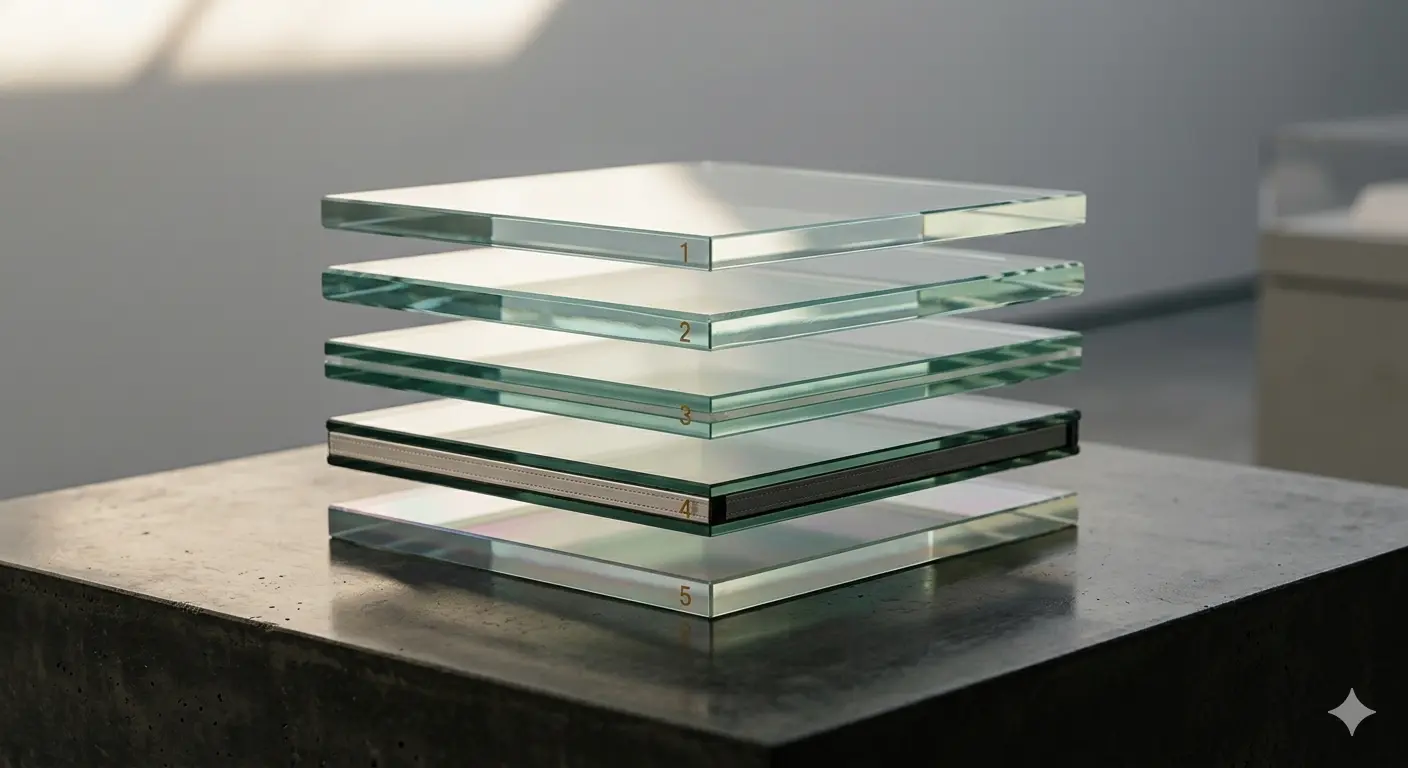
All architectural glass products descend from one of these five families. Hover each circle below for a brief description and a link to go deeper:
The 5 Families of Architectural Glass
Hover any circle to see details and drill-down links
The connections in the map above are not arbitrary. Annealed at the top is the raw material — every other family starts life as an annealed float glass sheet. Tempered and laminated are the two safety-glass upgrades, each addressing a different failure mode. Insulated units are built from tempered or laminated lites (never annealed, for safety reasons). Coated glass is a surface treatment that can be applied to any of the other families but is most commonly deployed as Low-E inside an IGU.
1. Annealed Float Glass — The Raw Material
Annealed glass is the direct output of a float glass line: molten glass drawn across a bed of molten tin, cooled slowly through an annealing lehr, and shipped as flat sheets. It has essentially zero residual stress, which makes it easy to cut and process — but also means it breaks into large, dangerous shards on impact.
Annealed glass is the correct choice for interior framed artwork, upper-story windows above code-defined hazardous locations, greenhouse glazing (where thermal cycling would stress tempered glass to spontaneous breakage), and any application where the buyer needs to cut or drill the glass after purchase.
Deep dive: Tempered Glass vs Annealed Glass: Why "Regular" Glass Isn't Safe Enough for Most Modern Buildings
2. Tempered Glass — The Safety Workhorse
Tempered glass is annealed glass that has been reheated to approximately 620°C and then quenched with high-pressure air jets. This creates compressive stress on the surface (~180 MPa) and tensile stress in the core, giving the glass 4-5× the strength of annealed and — more importantly — a safe granular breakage pattern instead of large shards.
Our 3m × 15m tempering furnace is among the largest in Hubei province, which allows us to supply tempered glass for jumbo curtain walls and oversized facades that smaller factories cannot handle. Tempered is the mandatory specification for doors, shower enclosures, low windows, and railings in nearly every building code worldwide.
Product page: Tempered Glass product details and specifications
3. Laminated Glass — Fragment Retention
Laminated glass is two or more glass lites permanently bonded by a polymer interlayer — most commonly PVB (Polyvinyl Butyral) or SGP (SentryGlas, DuPont's structural interlayer). The interlayer provides a dual function: it dampens airborne sound (improving STC rating by 3-5 points vs plain glass) and it holds broken glass fragments in place after impact.
Laminated glass is code-required for overhead glazing (IBC §2405.5), hurricane and cyclone-prone regions, structural glass floors, and most storefronts. The SGP variant resists forced entry well enough to be classified as burglar-resistant glazing.
Deep dive: Tempered Glass vs Laminated Glass: 7 Differences Buyers Must Know · Product page: Laminated Glass details
Free Download: Global Glass Building Codes Comparison
A side-by-side reference for architectural glass regulations across US IBC, EU EN, China GB, and Australia AS — free PDF for architects and specifiers.
4. Insulated Glass (IGU) — Energy Performance
An insulated glass unit (IGU) is two or more glass lites separated by a sealed cavity filled with inert gas (typically argon) and bounded by a warm-edge spacer. The engineering problem it solves is heat transfer: a basic 6+12A+6 IGU achieves U-value of 2.6-2.8 W/m²·K; with Low-E coating, this drops to 1.4-1.8 — a 70% improvement over single-pane glazing.
IGUs are the baseline specification for commercial office towers, residential windows in temperate and cold climates, and any building where HVAC costs are a significant operating expense. For premium facades combining IGU with laminated safety glass, the result is a "laminated IGU" — the configuration we recommend for high-end projects.
Deep dive: Insulated Glass vs Laminated Glass: Which One Does Your Project Actually Need? · Product page: Insulated Glass details
5. Coated Glass — Low-E and Enameled
Coated glass is a category defined by surface treatment rather than structural method. The two most important categories for architectural buyers are:
- Low-E (low-emissivity) coating — a microscopically thin metallic layer (sputtered soft-coat or pyrolytic hard-coat) that reflects infrared heat while transmitting visible light. Used almost exclusively as surface #2 or #3 of an IGU to boost thermal performance.
- Enameled (ceramic frit) glass — ceramic ink baked onto the glass surface at tempering temperature, creating a permanent decorative color or pattern. Used for spandrel panels (opaque areas of a curtain wall hiding floor slabs), feature walls, and decorative applications.
Product pages: Low-E Glass · Enameled Glass
By Application: What to Spec Where
Reverse-mapped from the 5 families: here is what architects and specifiers typically choose for common building applications. These are our recommendations based on production experience — they align with code requirements but go beyond the minimum where quality warrants.
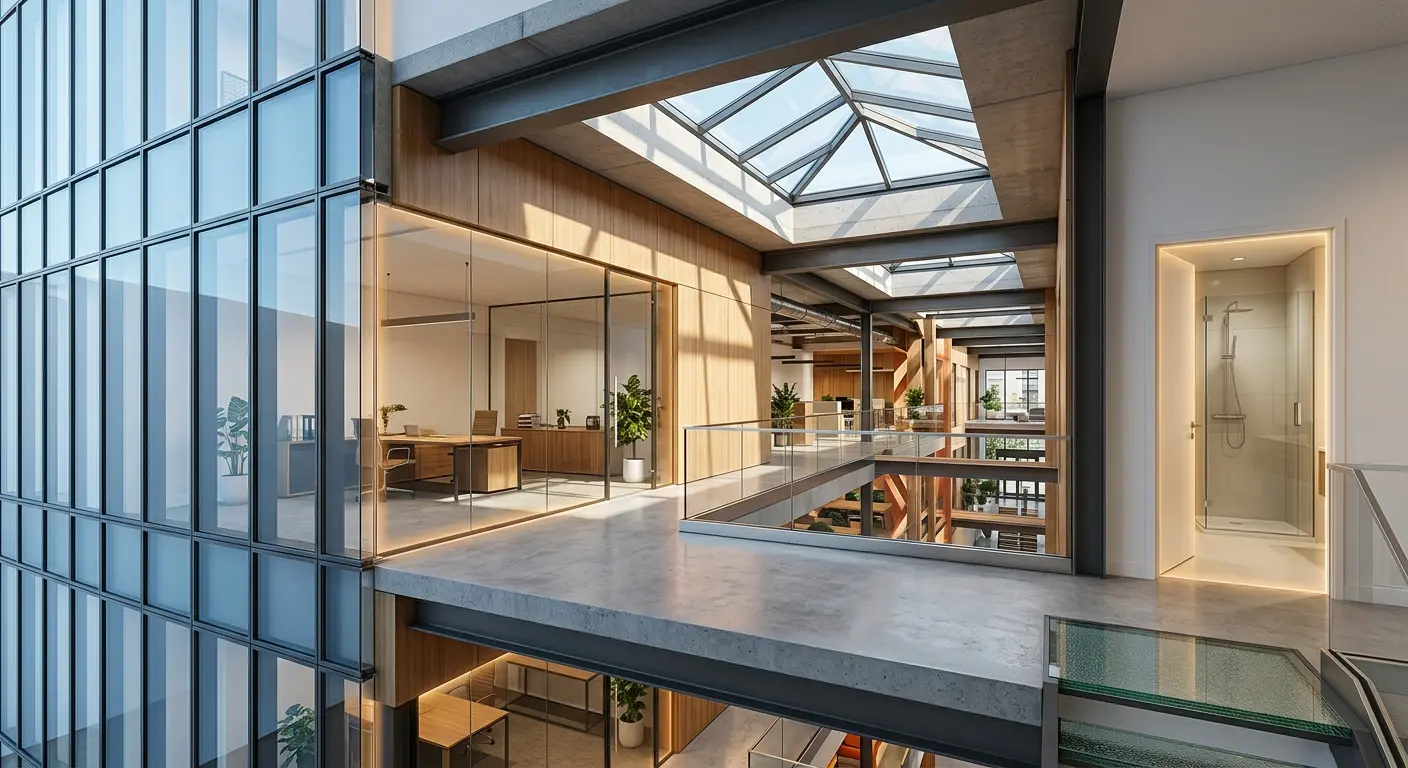
- Curtain walls (high-rise commercial): Laminated IGU with Low-E coating. Thermal performance for HVAC savings; laminated outer lite for fall-arrest safety and wind-load reserve.
- Residential windows (temperate climate): Insulated glass with Low-E coating. Argon fill if budget allows. No laminated layer unless street noise is a specific issue.
- Shower enclosures and glass doors: Tempered glass, minimum 8mm, with polished edges. Laminated upgrade adds UV protection and shatter-stay for frameless designs.
- Skylights and overhead glazing: Laminated glass (mandatory per IBC §2405.5) — typically laminated tempered for both impact strength and fragment retention.
- Railings and balustrades: Laminated tempered glass is the standard. Code requires both safety strength and fragment retention for structural glazing.
- Spandrel panels (opaque facade areas): Enameled tempered glass with ceramic frit on surface #2 (interior-facing). Color-matched to facade design.
- Storefronts and retail glazing: Laminated glass with SGP interlayer for security; tempered as cost-conscious alternative in low-crime areas.
- Interior partitions (non-safety): Annealed glass if location is above code-defined hazardous zones; tempered if partition includes a door or is within 24in of a traffic path.
Buyer's Procurement Checklist
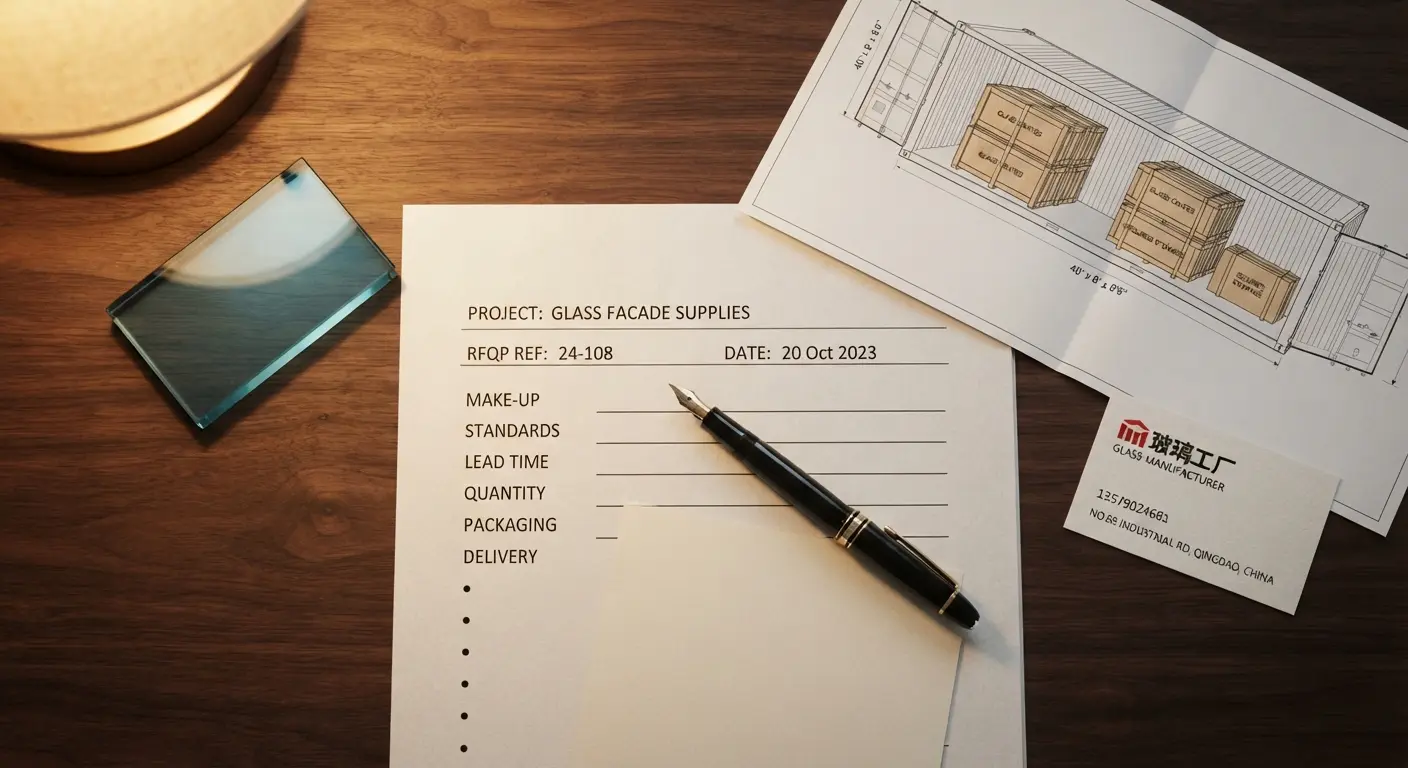
When you request a quote for architectural glass — from Sincere Glass or any supplier — these are the specifications your drawings should include. Missing any of these typically leads to a quote based on assumptions, which creates problems at delivery:
- Glass type — annealed / tempered / laminated / IGU / combined configuration (e.g., "tempered laminated IGU: 6mm Low-E tempered + 12mm argon + 6mm clear tempered + 1.52mm PVB + 6mm clear tempered")
- Thickness per lite — each glass lite in the assembly separately
- Overall dimensions — W × H per panel, and total quantity
- Edge treatment — polished / ground / arrissed / exposed
- Hole locations and sizes — if any; must be specified before tempering
- Coating specification — Low-E type (soft-coat / hard-coat), coating surface (#2 or #3), U-value and SHGC targets
- Interlayer specification — PVB / SGP / acoustic PVB; thickness in mm
- Gas fill — air / argon / krypton (for IGUs)
- Spacer type — aluminum / warm-edge (TPS, Super Spacer, etc.)
- Compliance target — which standard (IBC, EN, GB, AS) and which clauses
- Delivery terms — FOB / CIF / DDP; port of destination
- Packaging — pine crate standard; A-frame or L-frame for jumbo panels
For first-time buyers of any architectural glass product, we strongly recommend ordering a small sample (typically 500mm × 500mm, 2-4 pieces) before placing a production order. This verifies dimensional accuracy, edge quality, coating uniformity, and visual appearance match your expectations. Sample orders ship in 5-7 days at nominal cost.
Frequently Asked Questions
Tempered glass is the most commonly specified architectural glass worldwide because most building codes require safety glass in doors, shower enclosures, low windows, railings, and other impact-prone locations. For commercial facades and energy-efficient buildings, insulated glass units (IGUs) with Low-E coating are now the baseline specification.
Yes — the most common combinations are tempered laminated (impact strength + fragment retention) and laminated IGU (safety + thermal). Our 20,000 m² Wuhan facility runs both tempering and lamination lines in parallel, so we can produce combined units in one production flow. This is standard for high-end facades and overhead installations.
Most national building codes (IBC in the US, GB 50210 in China, EN 12600 in EU, AS 1288 in Australia) define "hazardous locations" where safety glass is mandatory — doors, shower enclosures, low windows, railings, overhead glazing. Our free "Global Architectural Glass Building Codes Comparison" PDF covers all four systems side by side (link in the article above).
Our two Wuhan facilities (武汉欣城 and 湖北欣之城) have 15+ years of domestic market experience and are now building export capability. We produce 3C-certified glass per Chinese national standards, with test reports available for ASTM C1048, EN 12150, and AS/NZS 2208 compliance review. MOQ for export orders is 50 m².
Our standard production cycles from order confirmation: annealed cuts 3-7 working days, tempered 7-12 days, laminated 10-15 days, insulated glass units 10-15 days, combined laminated IGU 15-20 days. Low-E coating availability can add 5-7 days for specialty coatings. All lead times exclude ocean freight transit.
Products referenced in this article

Tempered Glass
4–5× stronger than annealed. Jumbo panels up to 3m × 15m.
View product \u2192

Laminated Glass
PVB or SGP interlayer. Fragment-retention safety glass.
View product \u2192

Insulated Glass (IGU)
Low-E coated, argon-filled. Energy-efficient glazing.
View product \u2192

Low-E Glass
Soft-coat and hard-coat options for thermal control.
View product \u2192

Enameled Glass
Ceramic frit for color, pattern, and solar control.
View product \u2192
Free Download: Global Glass Building Codes Comparison
A side-by-side reference for architectural glass regulations across US IBC, EU EN, China GB, and Australia AS — free PDF for architects and specifiers.

Li Cheng
CEO at Sincere Glass
CEO at Sincere Glass (欣城玻璃) with 10+ years in architectural glass. Oversees production and quality at our 20,000 m² Wuhan facility.
Technical review: Albar, Technical Lead
Need Custom Glass for Your Project?
Get a free quote from our engineering team. We'll help you choose the right glass type, thickness, and coating for your specific requirements.