"What's the difference between tempered and regular glass?" is one of the most common questions we get from first-time buyers. The short answer: regular glass is annealed glass — the raw sheet product that comes off a float line without any strengthening treatment. Tempered glass is that same product after a secondary heat treatment. The difference matters because building codes in nearly every country draw a hard line between the two for safety reasons.
This guide walks through what each product actually is, how they fail, where code forces your hand, and when annealed is still the right pick despite being "weaker." If you've already read our comparisons of tempered vs laminated or insulated vs laminated, this one goes back one step — to the question of whether you need any safety glass at all.
What "Annealed Glass" Actually Means
Annealed glass is the direct output of the float glass process: molten glass is poured onto a bed of molten tin, drawn to thickness, and then slowly cooled through an annealing lehr. That slow cooling is what makes it "annealed" — the controlled temperature descent allows internal stresses to equalize, leaving a glass sheet that is flat, optically clear, and mechanically unremarkable.
In our 20,000 m² Wuhan facility, we don't make float glass ourselves — we purchase it from upstream float plants and use it as the input to every other product we produce. Tempered, laminated, Low-E coated, enameled: all of them start life as plain annealed glass. In that sense, annealed glass isn't a competitor to tempered — it's the raw material that tempered is made from.
"Annealed glass," "float glass," "ordinary glass," and "regular glass" all refer to the same product in commercial contexts. "Plate glass" is an older term that technically describes a pre-1960s manufacturing method but is still used loosely to mean annealed float glass. If a spec sheet says "6mm clear glass" without qualifying it, assume it means 6mm clear annealed float.
The Strength Gap: 1× vs 4-5× vs 10×
The simplest way to understand the difference is through surface compressive stress — the pressure "baked into" the surface of the glass that any external force must overcome before the glass breaks. Hover each bar below:
Surface Compressive Stress
Higher = harder to break
Measured in
MPa
Why the gap matters: annealed glass fractures at the lowest stress — a dropped tool, a thermal shock, or wind load on a large pane can exceed its 40 MPa threshold. Tempered glass handles roughly 4-5× that stress andbreaks into harmless granules instead of sharp shards.
Reference: ASTM C1048 and GB 15763.2 for tempered glass surface stress requirements.
Annealed glass has essentially zero compressive stress — around 40 MPa breaking threshold, which is only the inherent strength of the glass bonds themselves. A tempered glass pane has been heated to ~620°C and then quenched with high-pressure air jets, creating 180+ MPa of surface compression. The glass is literally "pre-loaded" against failure.
Our 3m × 15m tempering furnace can handle jumbo panels at these stress levels — the largest in Hubei province — which is why we can supply tempered glass for curtain walls and oversized facades that smaller factories cannot.
How They Break — The Real Difference
The strength number matters, but it's not what makes tempered glass "safety glass." The decisive factor is what happens when it finally does break. Toggle below:
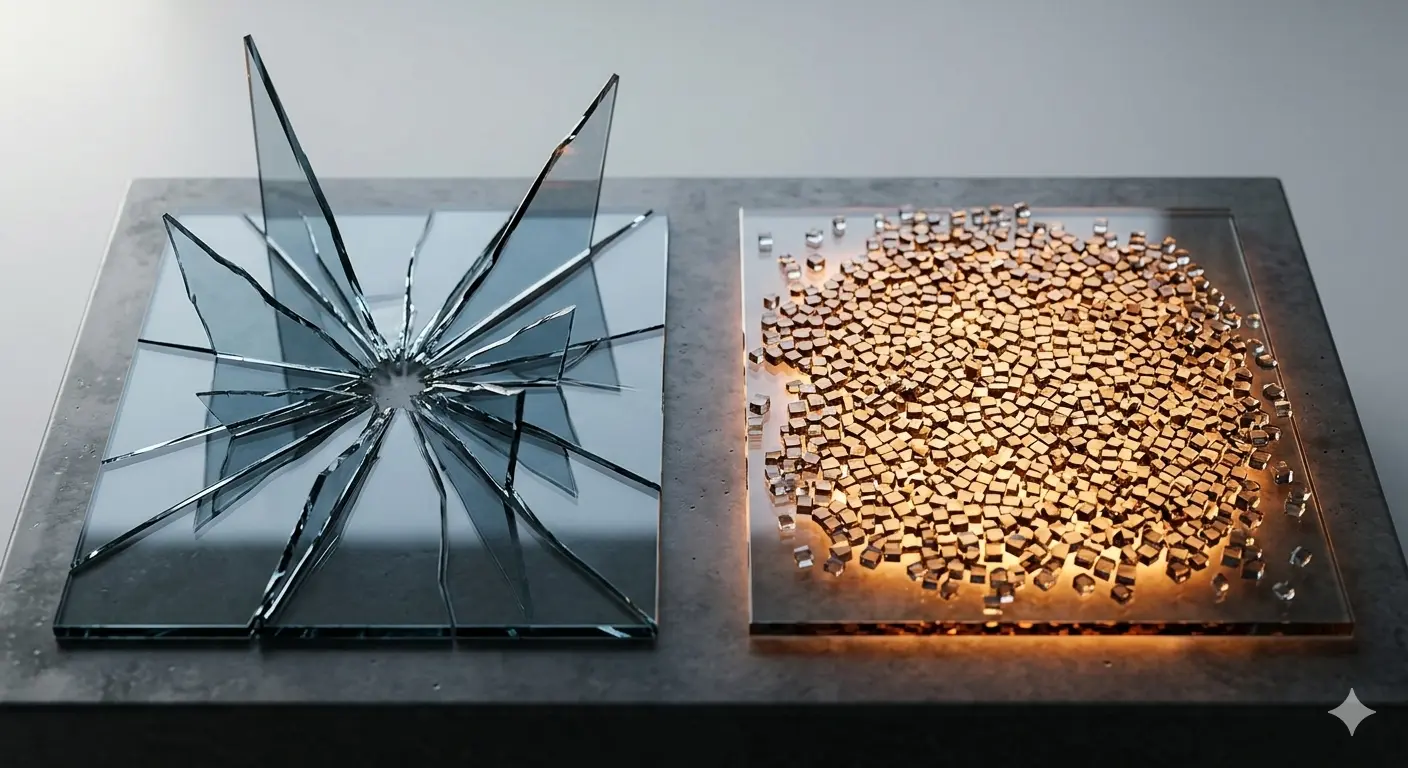
Annealed glass fails open
Residual stress is near zero. Breakage releases crack energy into large shards (typically >50cm²) with dagger-sharp edges. Code prohibits annealed in "safety glazing" locations.
Tempered glass dices
Compressive surface stress inverts the fracture pattern. GB 15763.2 §6.6 requires 40+ granules in any 50mm×50mm square. Granules are blunt and relatively harmless.
This is why code calls tempered glass "safety glass" and annealed glass is explicitly not safe for most building applications. An adult walking into a glass door made of 6mm annealed glass is likely to sustain serious lacerations; the same impact on 6mm tempered produces granules that are not dangerous. IBC 2021 §2406.4 enumerates the "hazardous locations" where safety glass is required.
Free Download: Global Glass Building Codes Comparison
A side-by-side reference for architectural glass regulations across US IBC, EU EN, China GB, and Australia AS — free PDF for architects and specifiers.
Where Code Forbids Annealed
Nearly every modern building code includes a list of "safety glazing hazardous locations" where annealed glass is prohibited. These are places where human impact is likely and failure consequences are severe. The main categories:
- Doors and sidelights — any glass in or within 24 inches (610mm) of a door edge (IBC §2406.4.1)
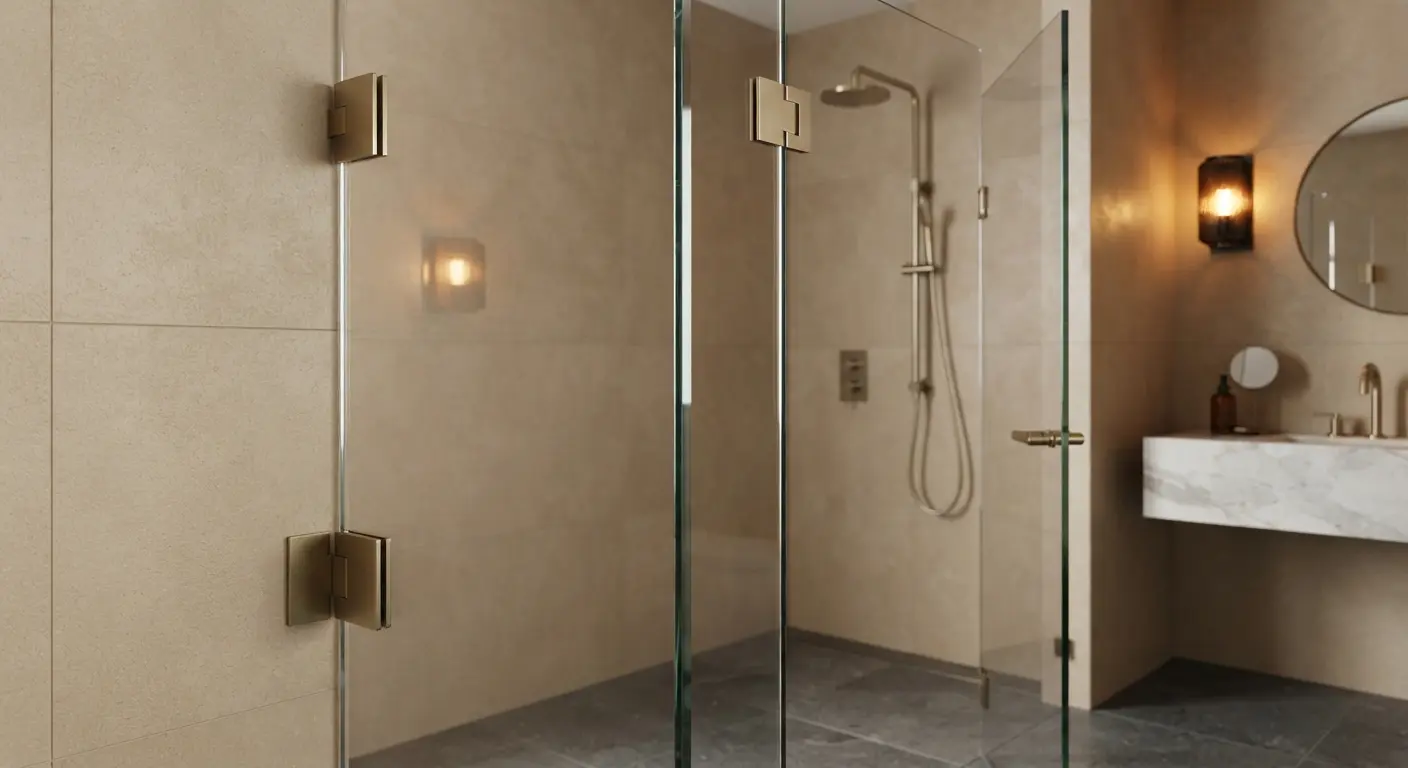
- Shower and bathtub enclosures — all glazing, no exceptions (IBC §2406.4.5)
- Low windows — glass panes larger than 9 sq ft (0.84 m²) whose bottom edge is within 18 inches (457mm) of the floor (IBC §2406.4.3)
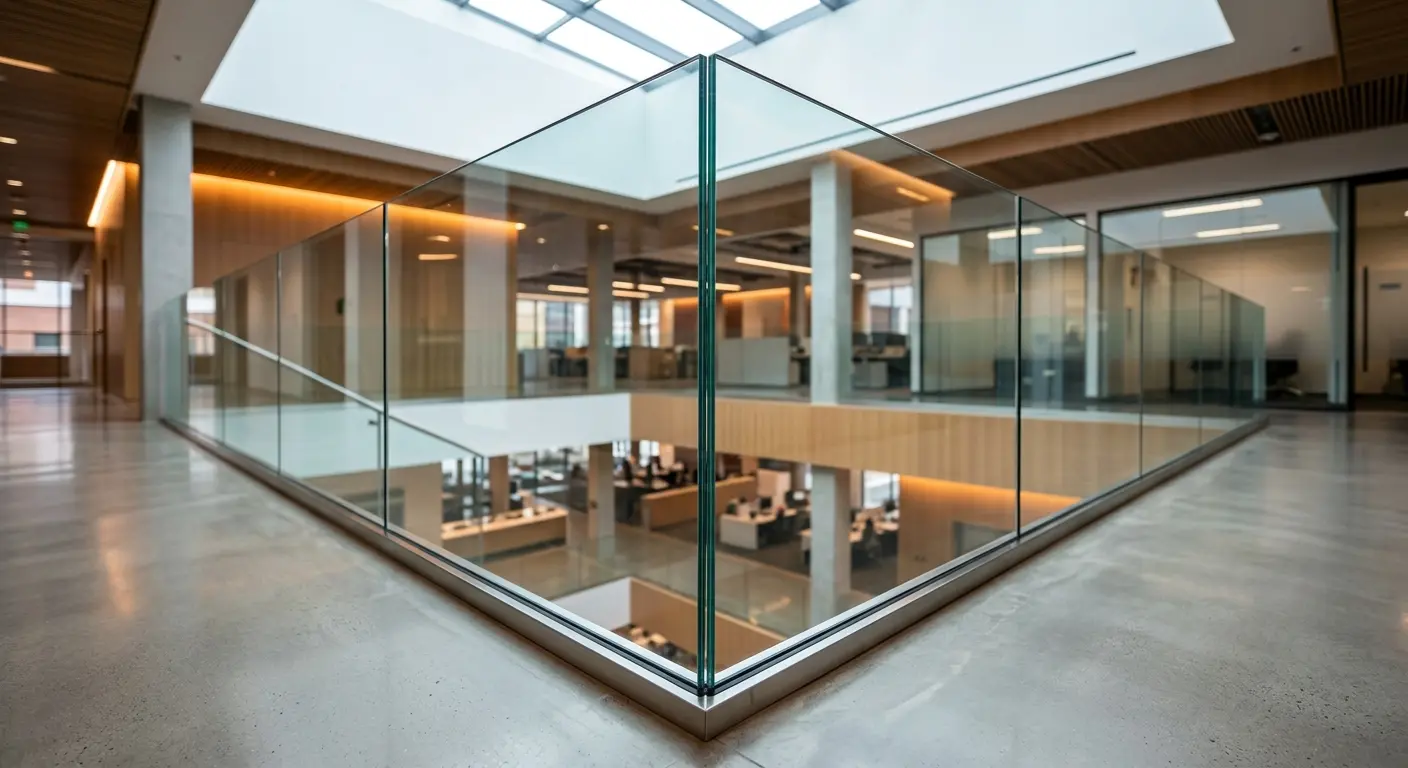
- Railings, guards, balustrades — all structural glazing (IBC §2407)
- Stair treads and landings — all walking surface glazing
- Overhead glazing — skylights, canopies (usually requires laminated, but tempered-only is permitted in limited cases per IBC §2405)
China's equivalent is GB 50210-2018 §15.6 and the national safety glazing standard GB 15763.2-2005. European code uses EN 12600 (impact classification) in combination with national building regulations. Australia uses AS 1288. The specific thresholds vary, but the categories of required locations are nearly identical across all these codes — codes converge on the same hazard logic.
Specifying annealed glass in a code-defined safety location is not just risky — it can invalidate building permits, void insurance coverage, and expose the specifier to personal liability if someone is injured. If you aren't sure whether a location qualifies as "hazardous," default to tempered or laminated. The cost difference is trivial compared to the risk.
When Annealed Is the Right Choice
Annealed glass is still appropriate — and often preferable — in these cases:
- Interior framed artwork and picture frames — low impact risk, often requires anti-reflective coating that is easier to apply to annealed
- Upper-story windows above 18in from the floor — if the location doesn't qualify as hazardous per IBC §2406, annealed is permitted and significantly cheaper
- Buyer wants to cut/drill the glass themselves — tempered cannot be cut after tempering; if your fabricator needs to make modifications, order annealed
- Non-safety interior partitions — fixed interior walls in non-impact locations
- Greenhouse and horticultural glazing — thermal cycling exceeds what tempered glass can tolerate without spontaneous NiS breakage; annealed is often preferred
- Mirrors — residential and commercial mirror backing is typically annealed; silvering process is incompatible with tempered glass
Spec Sheet Comparison
| Property | Annealed | Tempered |
|---|---|---|
| Surface compressive stress | ~0 MPa | ≥90 MPa (per GB 15763.2) |
| Breaking strength (bending) | ~40 MPa | ~180 MPa |
| Thermal shock resistance | 40°C differential | ~200°C differential |
| Breakage pattern | Large shards | Small granules |
| Can be cut after processing | Yes | No |
| Can be drilled after processing | Yes | No |
| Code-compliant for doors/showers | No | Yes |
| Spontaneous breakage risk | None | Rare (NiS inclusions) |
| Typical lead time (Wuhan) | 3-7 days | 7-12 days |
| FOB price, 6mm clear | $5-8/m² | $18-22/m² |
Cost & Lead Time
Reference pricing for 6mm clear baseline, FOB Wuhan factory:
- Annealed float glass, 6mm: ~$5-8 /m²
- Tempered glass, 6mm: ~$18-22 /m²
- Heat-strengthened glass, 6mm: ~$14-17 /m²
- Tempered laminated, 6+1.52+6: ~$42-50 /m²
Pricing note: All figures are 2026 reference pricing, FOB Wuhan factory, subject to formal quotation. Actual prices vary with glass thickness, coatings, panel size, order volume, and USD/CNY exchange rate at time of quotation.
Annealed glass ships faster because it skips the tempering furnace — typical lead time is 3-7 working days for standard cuts versus 7-12 days for tempered. For projects where most glass can be annealed and only safety-critical locations need tempered, splitting the order can save both money and time.
Adjacent Options Worth Knowing
Between annealed and tempered sits a middle option, and above both sits a stronger one. Worth knowing when speccing:
- Heat-strengthened glass — ~2× the strength of annealed (vs 4-5× for tempered), but it breaks into larger pieces than tempered. It's not legally "safety glass" but it resists thermal stress and wind load better than annealed. Used where safety glass isn't required but thermal performance matters — spandrel glazing, heat-soaked facades.
- Chemically strengthened glass — ion exchange in a potassium salt bath creates up to 500 MPa surface compression. Common in smartphone screens (Gorilla Glass) and specialty applications. Rare in architectural glass because the process is expensive and the strengthening layer is thin.
- Laminated annealed glass — annealed glass + PVB interlayer. The interlayer provides the safety retention (broken shards stay stuck to the PVB), so laminated annealed can be used in some safety locations where plain annealed cannot. See our tempered vs laminated comparison for when to prefer each.
- Tempered laminated glass — the combination: tempered strength plus PVB fragment retention. The default spec for high-end structural glazing and overhead installations. See our insulated vs laminated glass guide for the "both" configuration.
Frequently Asked Questions
We produce both. Annealed float glass is our raw material for all tempered, laminated, and coated products. We also sell annealed glass directly for applications where tempering is unnecessary or counterproductive — framed artwork, interior partitions in non-safety locations, and buyers who want to cut, drill, or process the glass themselves. Minimum order 50 m² for custom cuts.
Our standard MOQ for tempered glass orders is 50 square meters. We can accept smaller trial orders at a nominal setup fee for new buyers. Our 3m × 15m tempering furnace is one of the largest in Hubei province, so we can handle both jumbo architectural panels and smaller volume runs on the same production line.
No. Tempered glass must be cut, drilled, edge-finished, and have any holes made BEFORE it goes into the tempering furnace. Any attempt to cut or drill tempered glass causes it to shatter. This is one of the main reasons spec drawings must be finalized before order placement — field modifications are not possible.
All tempered glass we produce is 3C (CCC) certified under China's mandatory product certification system, tested per GB 15763.2-2005. For export orders, we provide third-party test reports suitable for ASTM C1048 compliance review (US), EN 12150 (EU), and AS/NZS 2208 (Australia/NZ). We cannot ship CE-marked product directly — buyers requiring CE must coordinate with an EU-based assessment body.
This article is one of three deep-dives in our architectural glass comparison series. For the full decision framework across all 9 architectural glass products — with an interactive 3-click selector — see our complete architectural glass types buyer's guide.
Products referenced in this article


Free Download: Global Glass Building Codes Comparison
A side-by-side reference for architectural glass regulations across US IBC, EU EN, China GB, and Australia AS — free PDF for architects and specifiers.

Li Cheng
CEO at Sincere Glass
CEO at Sincere Glass (欣城玻璃) with 10+ years in architectural glass. Oversees production and quality at our 20,000 m² Wuhan facility.
Technical review: Albar, Technical Lead
Need Custom Glass for Your Project?
Get a free quote from our engineering team. We'll help you choose the right glass type, thickness, and coating for your specific requirements.