The real question is not curved vs flat
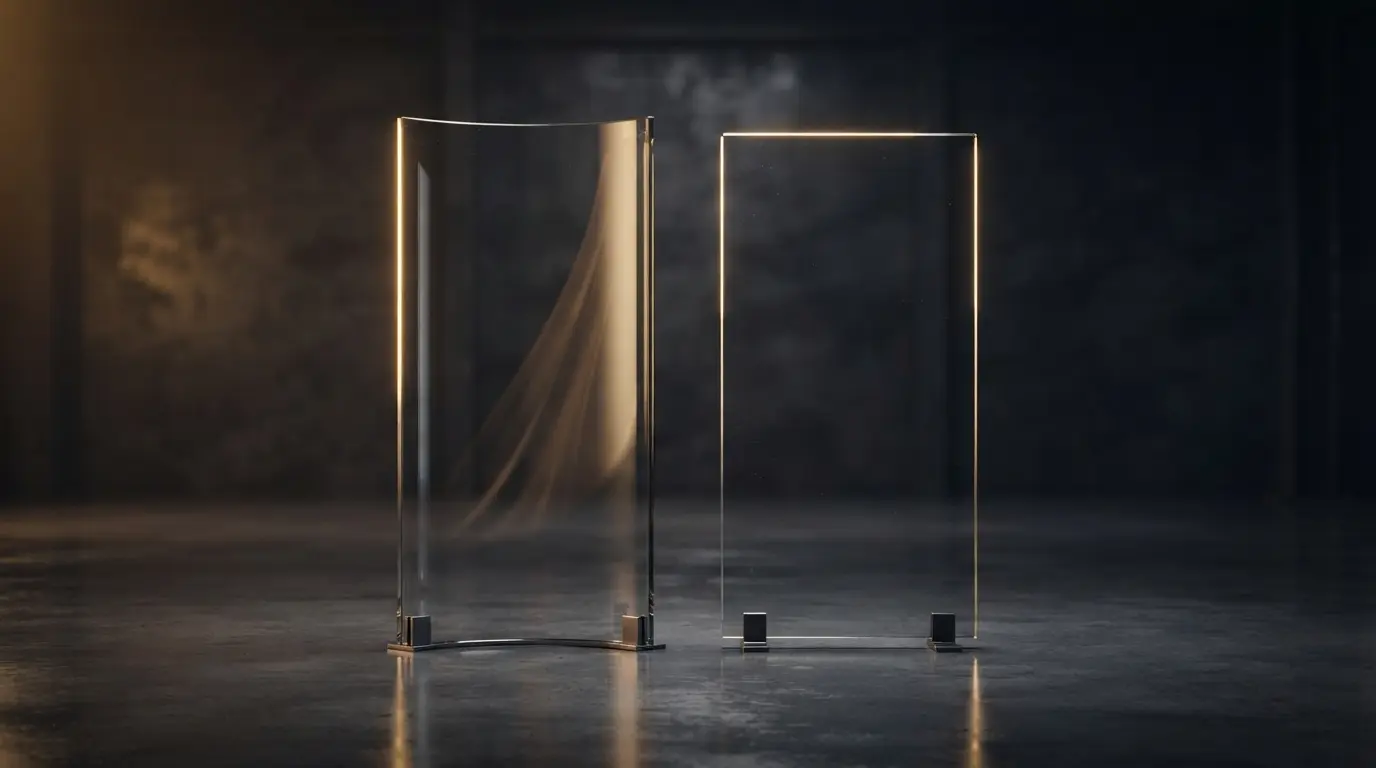
Most buyers come to this comparison asking the wrong question. "Should I use curved glass or flat glass?" frames it as a stylistic choice between two equivalents. In practice it is not. Flat tempered glass is the default architectural product in every modern code and every price list on earth; it is what gets specified unless the project forces a reason to deviate. Curved glass is what you reach for when a specific constraint — geometric, functional, or brand-driven — makes flat unworkable.
That reframing matters because it clarifies the burden of proof. The right question is not "which looks better here" but "does my project have a reason to pay 60 to 200 percent more per square meter of glass?" If the answer is yes, this article walks through how to specify curved correctly and what the real cost delta looks like. If the answer is no — or you are not sure — the first two sections and the decision checker below will save you a conversation with your architect you probably want to have before going into procurement.
Everything that follows is written from our export line in Wuhan, where we produce both flat tempered glass and curved tempered glass on the same two furnaces. The economics and the trade-offs are what we quote to architects and contractors every week.
Where flat glass still wins
Flat glass is not just cheaper. It has structural, logistical, and procurement advantages that compound at scale, and understanding them is what makes the curved decision honest rather than aspirational.
Cost per square meter. At the FOB-China export line, flat tempered 10 mm runs around $75-90/m² in container quantities for 2026 Q4. The same spec curved at a standard 1,500-3,000 mm radius runs $140-180/m². That delta is the entry ticket; it holds across lamination and IGU variations in the same proportion.
Panel-size envelope. Our tempering furnace handles flat panels up to 3.3 m × 15 m — among the largest in Hubei province. A curved panel at the same furnace cap faces practical constraints: at very large sizes the sag during hot-bending becomes harder to control, so the working envelope for jumbo curved is tighter than for jumbo flat. If the design calls for genuinely jumbo single-piece panels, flat gives you more size to work with than curved.
Standards and testing. Flat tempered glass has decades of test data behind it under GB 15763.2 (China), EN 12150 (Europe), ANSI Z97.1 (US), and AS 1288 (Australia). Curved tempered is covered under the same base standards but the test regime is less uniform across markets — not a problem for architectural specification, but it means more back-and-forth with the project's certification consultant on export jobs.
Repair and replacement. A flat panel that breaks after commissioning is replaceable off-the-shelf. A curved panel means re-ordering with mold specs; if the mold has been archived, it is a 25-45 day lead; if the mold has been scrapped, longer. For high-risk applications (ground-floor retail, public circulation) buyers sometimes order spare panels at the time of original production — a small cost line that is cheaper than an emergency re-order.
Shipping efficiency. Flat panels ship vertically in A-frame crates at 650-800 m² per 40-foot container. Curved panels need custom nested cradles and container loading drops to 350-550 m². On large orders this logistics delta is often a bigger cost line than the per-panel premium itself.
What curved glass unlocks
Everything above is the case for flat. Here is what flat cannot do, which is why curved glass exists as a product line at all.
True continuous curvature. At viewing distances under 10-15 m — which is where ground-floor facades, retail shopfronts, and interior installations live — the human eye reads mitred flat panels as what they are: a series of flat facets with visible joints. A single hot-bent panel reads as a continuous surface. For projects where that read matters (hospitality, museum, flagship retail, luxury residential), flat is not a cost-saving alternative; it is a visual compromise.
Geometry that flat cannot approximate. A cylindrical lift shaft inside a hotel atrium cannot be built from flat facets without making the lift car look like it is inside a polygon. Dome skylights, observation enclosures, and spherical sculptural glazing have no flat equivalent that reads correctly. The geometry physically demands a curve, and the only decision is which curved production method to use (hot-bend for tight radii, cold-bend for shallow curves).
Smaller joint count on long sweeping facades. A 40 m sweeping curtain wall built from 3 m-wide flat panels needs about 13 vertical joints visible from ground level. The same facade built from 3 m-wide curved panels needs the same joint count — but each joint follows the curve rather than kinking at a facet break. The visual continuity is subtle but reads as higher-quality architecture at any viewing distance.
Geometric stiffness. This one surprises buyers. A curved panel has flexural stiffness that a flat panel of the same thickness does not — the curvature acts structurally. On overhead glazing and point-supported facades, this often lets us thin a curved panel by one step (12 mm flat replaced by 10 mm curved) while meeting the same deflection target. It does not eliminate the cost premium, but it reduces it. Worth modeling with your structural glass consultant.
The real cost delta, calculated
How the calculator works: three inputs — radius in millimeters, finished panel area in square meters, and geometry type (single-axis cylindrical, double-axis spherical, or free-form). The model multiplies our empirical radius-penalty curve (3.5x below the 500 mm floor, 2.6x at tight radii under 800 mm, 2.1x in the standard 800-1,500 mm range, 1.75x at 1,500-3,000 mm, 1.5x at 3,000-5,000 mm, 1.25x in cold-bend territory above 5,000 mm) by a geometry multiplier (1.0 single-axis, 1.5 spherical, 1.95 free-form) and adds mold amortization that drops as order area rises. The output is a per-m² price and a project-total delta against the flat baseline you set. Values come from our Wuhan plant's export quote history 2023-2026 and are planning estimates, not quotation-grade.
Try your spec
Curved cost premium estimator
Drag radius and area, pick geometry. The calculator returns a per-m² and project-total cost delta against flat tempered of the same thickness.
Default $80/m² reflects FOB-China 10 mm clear tempered, 2026 Q4. Adjust for your actual spec.
Curved per m²
$170
Flat baseline: $80/m²
Project total (curved)
$8,500
Flat equivalent
$4,000
Premium over flat
+$4,500 (+113%)
Shape penalty: 1.75x
Geometry multiplier: 1.00x
Mold amortized: $30/m²
Planning estimate from Sincere Glass export quote history. Actual contract pricing depends on specific drawings, lamination/IGU build-ups, and current float-glass markets. Data verified: 2026-10-26.
Pricing note: All figures are 2026 reference pricing, FOB Wuhan factory, subject to formal quotation. Actual prices vary with glass thickness, coatings, panel size, order volume, and USD/CNY exchange rate at time of quotation.
Do you actually need curved glass?
How the checker works: four binary yes/no questions probing the four pressure factors that justify curved glass — geometric necessity (would mitred flat panels achieve the shape), visual continuity (does reflection and sightline continuity matter at the viewing distance), panel scale (are the panels large enough that facet joints would be visually prominent), and budget headroom (can the project absorb a 60-200 percent glass premium). The rule tree combines all four answers into one of three verdicts: "flat suffices" (no geometric or visual pressure), "curved justified" (all four align), or "mixed strategy" (some factors push to curved but not all). Reset and re-answer to see how changing one factor shifts the recommendation.
Decision check
Do you actually need curved glass?
Four honest questions. If you cannot answer "yes" to the geometry and visual questions, flat probably solves your problem.
1Does the architectural geometry require a curve, or could it be built from mitred flat panels?
Six project types, six verdicts
How the advisor works: six common architectural scenarios where the curved-vs-flat question comes up most often in our export inbox — panoramic lifts, multi-story curved curtain walls, entrance canopies, boutique retail shopfronts, standard office perimeter facades, and sculptural free-form features. Each returns a curved/flat/hybrid verdict with the specific build-up we quote, the cost delta range against the flat baseline from our 2023-2026 export quote history, and the reasoning for why the verdict comes out that way. Pick the scenario closest to yours; it is often the fastest way to a defensible first-pass recommendation.
Project fit
Six scenarios, six verdicts
Pick the project type closest to yours. The panel updates with the recommended build-up and the cost delta range from our export quote history.
Fully-glazed lift shaft in a hotel atrium or office lobby.
Panoramic lift / glass elevator
Recommendation
Curved tempered, single-axis cylindrical.
Typical build-up
10 mm or 12 mm curved tempered, R = 1,500-2,500 mm
Cost delta
+90-130% vs flat
Why this verdict
- ▸The shaft geometry physically demands cylindrical panels — no mitred-flat approximation reads correctly from inside the lift car.
- ▸A single panel can span up to 15 m vertically on our line, eliminating horizontal joints.
- ▸This is one of the few applications where curved is almost always the right answer regardless of budget.
Cost delta ranges from Sincere Glass export quote history 2023-2026 on comparable projects. Specific project pricing requires drawing review. Data verified: 2026-10-26.
Lead time, MOQ, and container economics
Procurement differences between curved and flat matter as much as the per-m² price on real projects. Three areas to budget for:
Lead time delta. Flat tempered export orders ship 20-30 days from PO. Curved cylindrical at standard radius: 25-35 days (reusable mold, no new tooling). Curved spherical: 35-55 days because of custom-cast refractory molds. Free-form: 45-70 days driven by CNC mold machining from the architect's 3D model. On time-critical projects we reserve the curved panels at PO signing and start molds in parallel with the flat production.
MOQ. Flat tempered: no hard minimum, cost steps up at small volumes. Curved cylindrical: single-panel orders possible because the mold is reusable, but per-m² cost is higher at low volume. Curved spherical and free-form: 4-panel minimum per unique profile is typical to keep per-unit mold cost reasonable. Mixing curved marks with flat marks in the same PO is standard — most of our export orders are hybrid.
Container economics. Flat panels ship vertically at 650-800 m² per 40-foot container. Curved panels require custom nested cradles and typical loading drops to 350-550 m² — a significant freight cost delta on large orders. We provide loading diagrams at RFQ for every curved order so the volumetric impact is visible before PO.
Mold storage. We archive customer molds for 24 months by default. For projects likely to need replacement panels beyond that horizon (public ground-floor retail, hotel entrances) we recommend either extending the mold archive agreement or ordering 1-2 spare panels at original production. Both are small cost lines compared to an emergency re-order at year 3.
If you want to see the full curved tempered specification page with interactive feasibility checker and curvature visualizer, head to our curved tempered glass product page. The three interactive tools there confirm radius, thickness, and panel-size feasibility in real time against our 500 mm minimum radius and 3.3 m × 15 m envelope.
Free: Global Architectural Glass Building Codes Comparison
A side-by-side 11-page PDF covering US IBC, EU EN, China GB, and Australia AS requirements for tempered and laminated glass across all common applications. Free for architects, specifiers, and procurement teams.
Frequently Asked Questions
Neither — same base glass, same tempering process, same surface compressive stress (90-110 MPa in our Wuhan furnace), same safe-fragmentation pattern on break. The curve itself does not change structural performance. What does change is how the panel resists wind and point loads in service, because a curved panel has geometric stiffness that a flat panel of the same thickness does not. In practice this often lets specifiers thin a curved panel by one step compared to the flat equivalent.
For single-axis cylindrical panels (the most common geometry) we have no hard MOQ because the hot-bending mold is reusable — single-panel orders are possible, though per-m2 cost is higher at low volumes. For spherical and free-form panels, a 4-panel minimum per unique profile is typical because the mold cost gets amortized across the order. Standard PVB and SGP laminated variants of curved panels follow the same minimums as their flat equivalents (100 m2 for PVB, 200 m2 for SGP).
At our export line, cylindrical panels in the standard R = 1,500-3,000 mm range run 70-110 percent more per square meter than flat tempered of the same thickness. Tight-radius panels (R < 800 mm) run 120-200 percent more. Spherical adds roughly 50 percent on top of cylindrical for the same radius. Free-form adds another 30 percent. The exact number depends on panel area (mold cost amortizes), so use the calculator in this article for your specific spec.
Yes, and we recommend it for most projects over 500 m2 of glass. The sightline logic: at viewing distances over 15 m the human eye reads mitred flat panels as effectively curved — the facet joints disappear. Reserving curved glass for ground-floor focal zones (entrance, street-facing retail, anywhere the viewer stands within 5-10 m of the facade) and using flat panels for upper floors typically keeps the glass premium under 25 percent of a pure-curved budget while preserving the visual impact where it matters.
Flat tempered export orders ship 20-30 days from PO at our Wuhan line. Curved tempered: 25-35 days for standard radius cylindrical (reusable mold, no new tooling), 35-55 days for spherical (custom-cast refractory mold required), and 45-70 days for free-form (CNC mold machining from the architect's 3D model). The lead-time delta on cylindrical is modest; on spherical and free-form the mold casting dominates the schedule and the first-order cost.
Yes. Flat panels ship vertically in standard A-frame crates at about 650-800 m2 per 40-foot container depending on thickness and spacing. Curved panels require custom nested cradles — the curvature prevents efficient stacking — and typical container loading drops to 350-550 m2 depending on radius and panel size. For projects on tight shipping budgets this is a cost line worth modeling explicitly. We provide loading diagrams at RFQ for any curved order to make the volumetric impact visible.
Yes to both. Curved insulated glass units (IGU) use two or more curved panes with a flexible aluminum or stainless spacer bent to match the curvature; dual-seal (PIB + structural silicone) same as flat IGU. Curved laminated glass uses curved tempered panes bonded with PVB or SGP in a shape-matched autoclave cycle. The combinations are common on premium facades: curved + Low-E coated + IGU for thermal, or curved + SGP laminated for structural overhead and safety-critical applications.
500 mm minimum radius, limited to 6 mm panel thickness. For 10 mm panels the floor rises to approximately 900 mm; for 19 mm, around 2,500 mm. Tighter radii require thinner glass or a two-piece faceted build. Our 500 mm minimum sits well below the 800-1,000 mm floor most Chinese and Southeast Asian plants publish, and is one of the capabilities we built the curved tempered line specifically to deliver.
Products referenced in this article


Li Cheng
CEO at Sincere Glass
CEO at Sincere Glass (欣城玻璃) with 10+ years in architectural glass. Oversees production and quality at our 20,000 m² Wuhan facility.
Technical review: Albar, Technical Lead
Need Custom Glass for Your Project?
Get a free quote from our engineering team. We'll help you choose the right glass type, thickness, and coating for your specific requirements.