A buyer sends us drawings and asks: "Do I need insulated or laminated glass here?" This is the most common question we get after "what thickness?" — and the right answer almost never comes from a spec sheet. It comes from the problem the glass is solving: cold weather, street noise, impact risk, an overhead code requirement, or some combination of them. This guide walks through how to decide — not with a feature checklist, but with the five scenarios most buyers actually fit into.
If you've already read our comparison of tempered vs laminated glass, you've seen the strength and safety dimension. This article is the complementary cut: insulation vs lamination, with the "do I need both?" question answered honestly.
Five Buyers, Five Different Answers
Pick the scenario that most resembles your project. Our recommendation changes with the problem — the same specification table does not fit a Beijing office tower, a Parisian apartment facing a busy boulevard, and a Miami beachfront villa.
Pick your scenario
The problem
Heating bills eat 40% of operating budget; staff complain of window drafts.
Recommendation
Insulated Glass (IGU)
U-value is the dominant performance metric. A double-pane IGU with argon fill and Low-E coating cuts heat loss by 60-70% vs single pane. Laminated glass alone changes U-value negligibly.
View Insulated Glass →Insulated glass wins when the envelope performance matters most — cold climates, HVAC-sensitive buildings. Laminated glass wins when human safety and user comfort matter most — overhead, street-facing, high-traffic. When both matter, you combine them. The decision is rarely about the glass itself; it's about which failure mode you can't accept.
What Each Glass Actually Is (Anatomy View)
Specs lie about structure. Toggle the cross-section below to see what you're actually buying when you spec an IGU versus a laminated unit. Note that these are different categories of product — not alternatives in the sense that tempered and heat-strengthened are. One addresses energy; the other addresses impact and sound.
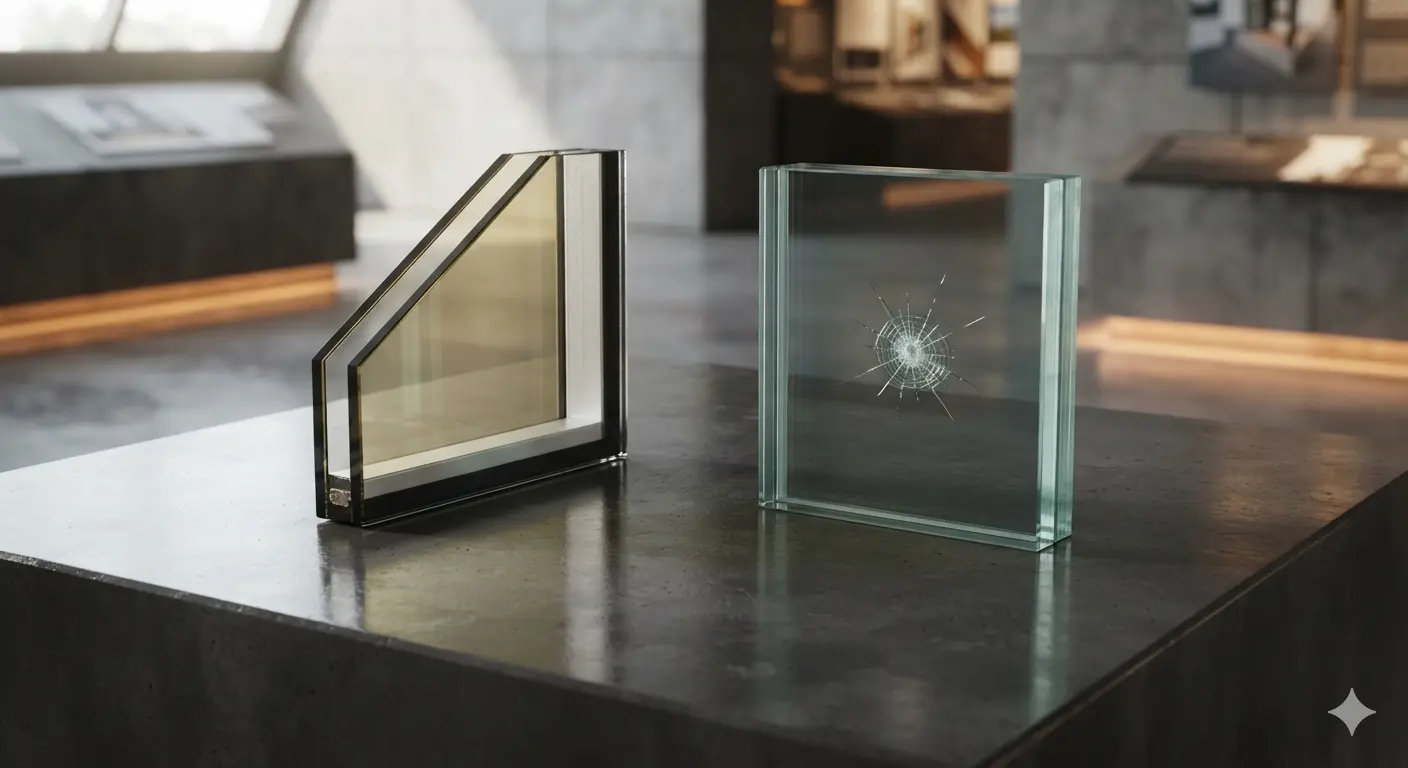
Insulated Glass Unit (IGU) — two panes bonded around a sealed gas-filled cavity. Thermal performance is the engineered priority.
An IGU is a system: two or more glass lites, a sealed cavity with gas fill (argon is standard; krypton for premium), warm-edge spacers to minimize thermal bridging at the perimeter, and typically a Low-E coating on the inner surface of one lite. The engineering problem it solves is heat transfer. Governed by EN 1279 (Europe) and GB/T 11944-2012 §5.3 (China).
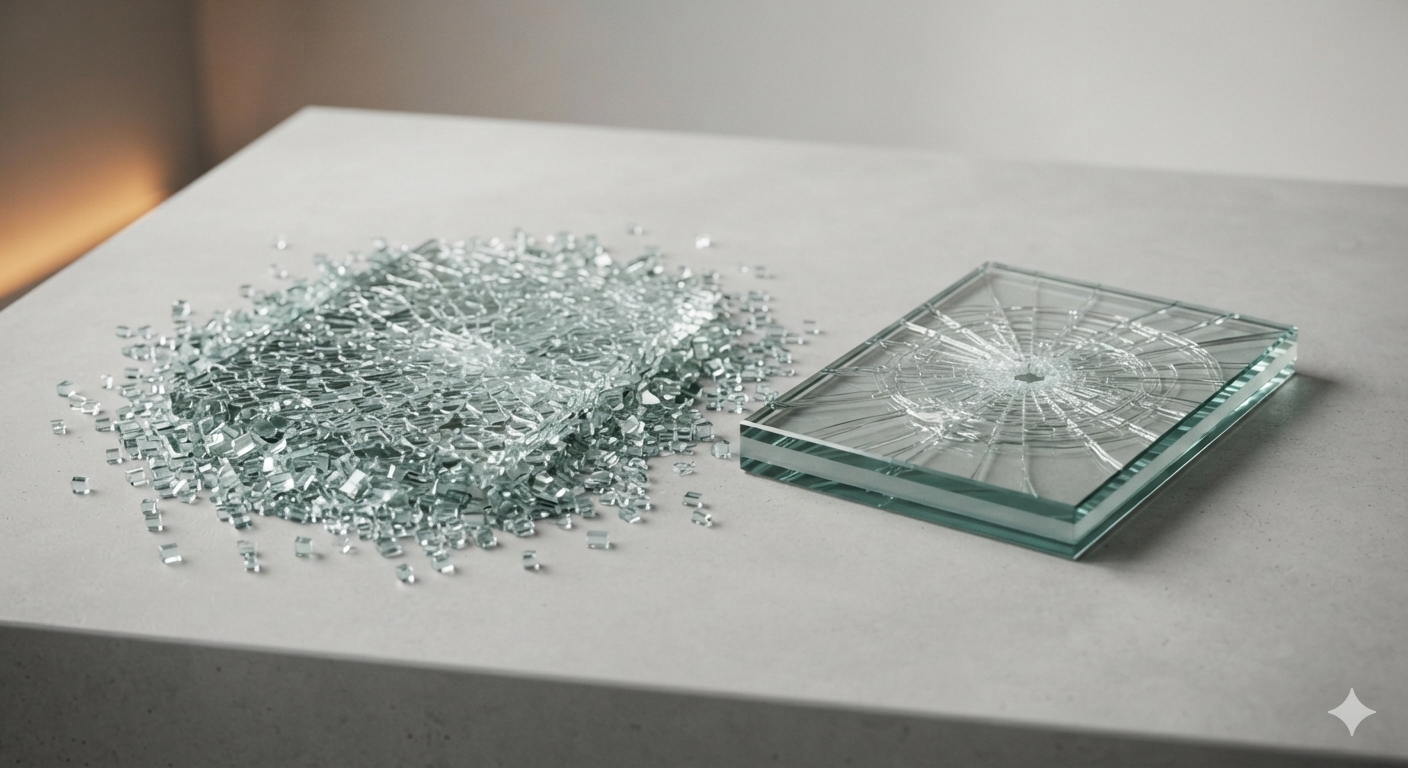
Laminated glass is a bonded assembly: two or more glass lites permanently joined by a polymer interlayer (PVB is standard; SGP for structural/hurricane; EVA for decorative inclusions). The engineering problem it solves is what happens on impact: broken glass remains adhered to the interlayer instead of becoming airborne shards. Governed by IBC 2021 §2406.4.1 and GB 15763.3-2009 §5.2.
In our 20,000 m² Wuhan facility, we produce both on parallel lines — two insulated glass lines (one is an ultra-large automatic argon-fill line) and two high-pressure laminating autoclaves (one 3m × 15m, among the largest in Hubei province). This matters because a combined laminated-IGU unit requires both processes to run in sequence on compatible lites, and few mid-tier factories can do this in one shop.
Performance Head-to-Head: 5 Metrics
Hover any metric below to see what it measures and why one product dominates. Note that no single product wins all five — this is why the "combined" option exists.
Three honest observations about this chart:
- Thermal (U-value): A standard IGU achieves U-value of 2.6-2.8 W/m²·K (6+12A+6 clear); with Low-E coating and argon fill, this drops to 1.4-1.8. A single laminated unit sits at ~5.6 — essentially the same as single glazing. There is no shortcut around physics here.
- Acoustic (STC): A plain 6mm IGU rates ~STC 29. A 6.38mm acoustic laminated unit rates ~STC 36. The PVB interlayer is a mechanical damper; the air gap is a mass-air-mass system that behaves differently across frequencies.
- Cost efficiency: This isn't absolute low price — it's performance per RMB. A laminated IGU scores lower because you're paying for both processes, but if your project genuinely needs both, splitting the specification into two separate products costs more and performs worse at the interfaces.
Free Download: Global Glass Building Codes Comparison
A side-by-side reference for architectural glass regulations across US IBC, EU EN, China GB, and Australia AS — free PDF for architects and specifiers.
The "Both" Answer: Laminated IGU
For premium architectural projects — luxury residential, high-end hospitality, coastal/hurricane zones, acoustic-critical urban buildings — the answer is often "both," configured as a laminated IGU: a laminated outer lite + air gap + Low-E coated tempered inner lite. The outer lite handles impact and acoustic duty; the IGU cavity handles thermal duty.
Outer lite: 6mm clear + 1.52mm SGP + 6mm clear laminated.
Cavity: 12mm, argon-filled, warm-edge spacer.
Inner lite: 6mm Low-E tempered, coating on surface #3.
Total build-up: ~31.52mm. U-value ~1.5 W/m²·K. STC ~38. Hurricane-rated. Low-E reflects IR heat without reducing daylight.
If you are specifying a facade for a project that will outlive its building management team, this is the configuration we recommend — not because it's the most expensive, but because it addresses every failure mode a glass envelope can have simultaneously. See our insulated glass product page for build-up options and our laminated glass page for PVB vs SGP interlayer selection guidance.
Cost & Lead Time Reality
Approximate 2026 FOB Wuhan reference pricing for a 6mm clear baseline:
- Monolithic tempered 6mm: ~$18-22 /m²
- Insulated glass 6+12A+6 (clear): ~$42-50 /m²
- Insulated with Low-E: ~$55-68 /m²
- Laminated 6.38mm (PVB): ~$38-45 /m²
- Laminated IGU (6+1.52+6/12A/6 Low-E): ~$95-120 /m²
Pricing note: All figures are 2026 reference pricing, FOB Wuhan factory, subject to formal quotation. Actual prices vary with glass thickness, coatings, panel size, order volume, and USD/CNY exchange rate at time of quotation.
Lead times from our facility: IGU-only or laminated-only orders ship in 10-15 working days from order confirmation. Combined laminated IGU orders run 15-20 working days, with Low-E coating availability the typical bottleneck (we stock standard soft-coat Low-E glass but hard-coat and specialty coatings may add 5-7 days).
Other Paths Buyers Consider
Not every project needs IGU or laminated. A few adjacent options worth knowing:
- Monolithic tempered glass — the cheapest safety glass. Appropriate for shower enclosures, interior partitions, furniture, non-overhead balustrades. See our tempered vs laminated comparison for the safety-glass selection logic.
- Low-E glass alone (monolithic) — rare in architectural applications because the coating must be protected inside a cavity to maintain emissivity. If a spec calls for "Low-E glass," it almost always means Low-E as part of an IGU. See our Low-E glass product page for coating details.
- Enameled or ceramic frit glass — a surface treatment, not an alternative to IGU/laminated. Can be applied to either as spandrel treatment or decorative pattern. See our enameled glass page.
- Triple-glazed IGU (6+12A+6+12A+6) — pushes U-value to ~0.8 but adds weight, cost, and makes handling difficult. Common in Passive House construction; rare elsewhere.
Frequently Asked Questions
Our standard MOQ for custom IGU orders is 50 square meters, with no restriction on panel size up to our furnace maximum of 3m × 15m. For small boutique projects, we accept trial orders at reduced MOQ with a nominal setup fee. Contact our team for a quote.
Yes. Our 20,000 m² Wuhan facility runs both a 3m × 15m tempering furnace and a 3m × 15m high-pressure laminating autoclave, which means we can produce the laminated outer lite and bond it into an IGU in the same production flow. This is the configuration we recommend for premium facades.
All insulated and laminated glass we produce is 3C (CCC) certified under China's mandatory product certification system — GB 15763.3-2009 for laminated glass, GB/T 11944-2012 for insulated glass. For export orders, we can also provide test reports suitable for CE, SGCC, or local-market compliance review on request.
For a custom laminated IGU order, our standard production cycle is 15-20 working days from order confirmation, depending on coating availability (Low-E) and the complexity of edge treatments. Simple IGU-only or laminated-only orders ship in 10-15 working days.
Starting further back in your decision? Our tempered vs annealed glass comparison covers why "regular" float glass is unsuitable for most modern building applications.
This article is one of three deep-dives in our architectural glass comparison series. For the full decision framework across all 9 architectural glass products — with an interactive 3-click selector — see our complete architectural glass types buyer's guide.
Products referenced in this article


Free Download: Global Glass Building Codes Comparison
A side-by-side reference for architectural glass regulations across US IBC, EU EN, China GB, and Australia AS — free PDF for architects and specifiers.

Li Cheng
CEO at Sincere Glass
CEO at Sincere Glass (欣城玻璃) with 10+ years in architectural glass. Oversees production and quality at our 20,000 m² Wuhan facility.
Technical review: Albar, Technical Lead
Need Custom Glass for Your Project?
Get a free quote from our engineering team. We'll help you choose the right glass type, thickness, and coating for your specific requirements.