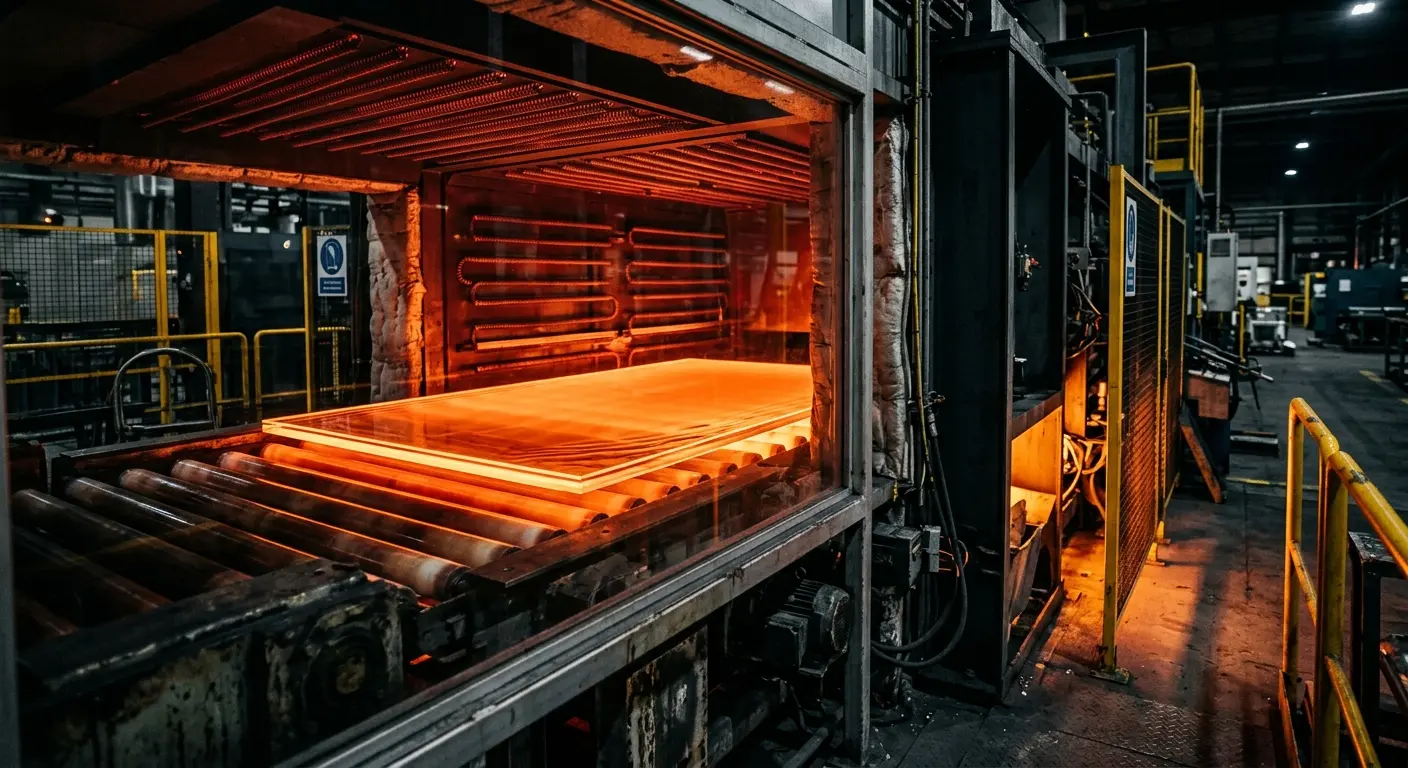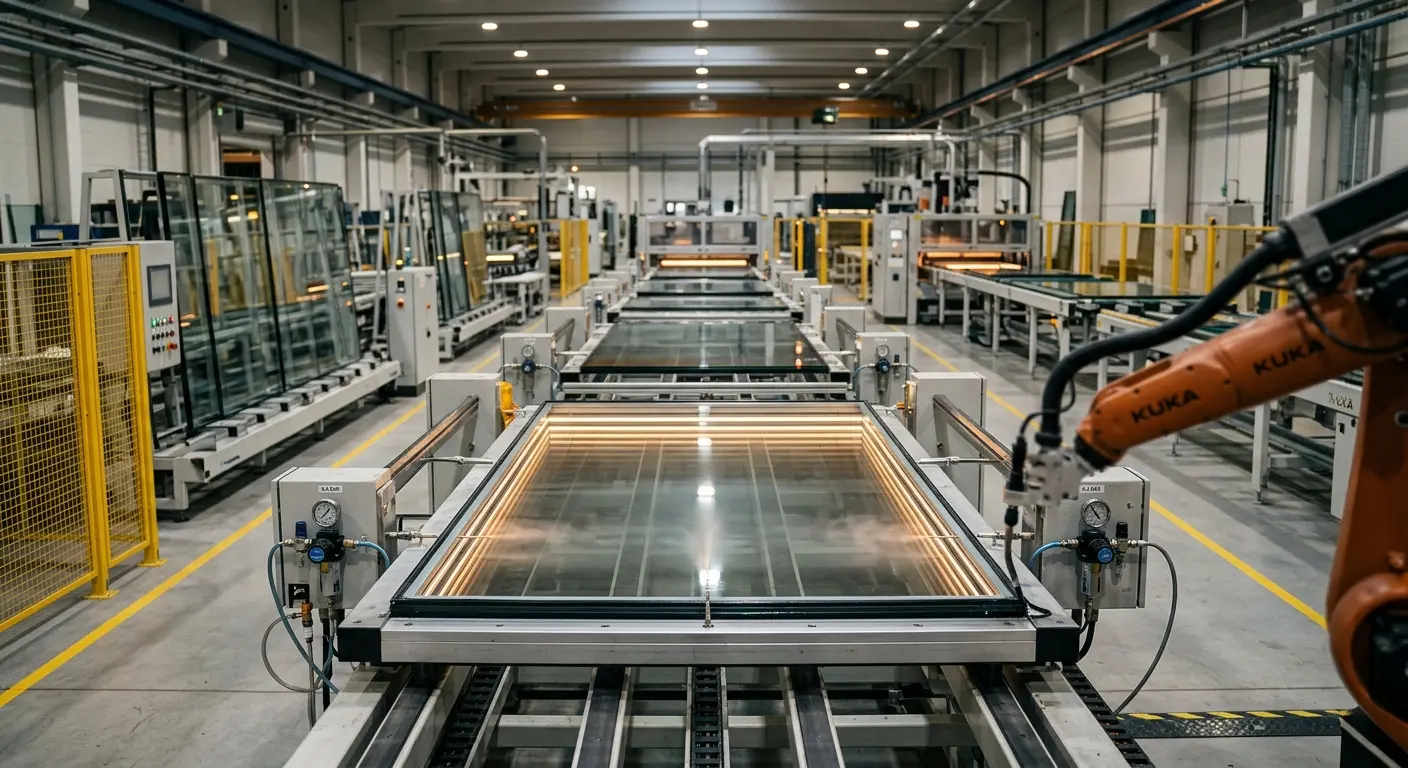
"Laminated glass is just two panes with plastic in between" — this is technically true and almost completely wrong. The plastic interlayer is a precisely engineered thermoplastic that must be processed under exact temperature and pressure to form a permanent molecular bond with glass. Get the process wrong and you get bubbles, haze, or edge delamination that only shows up months later in the field.
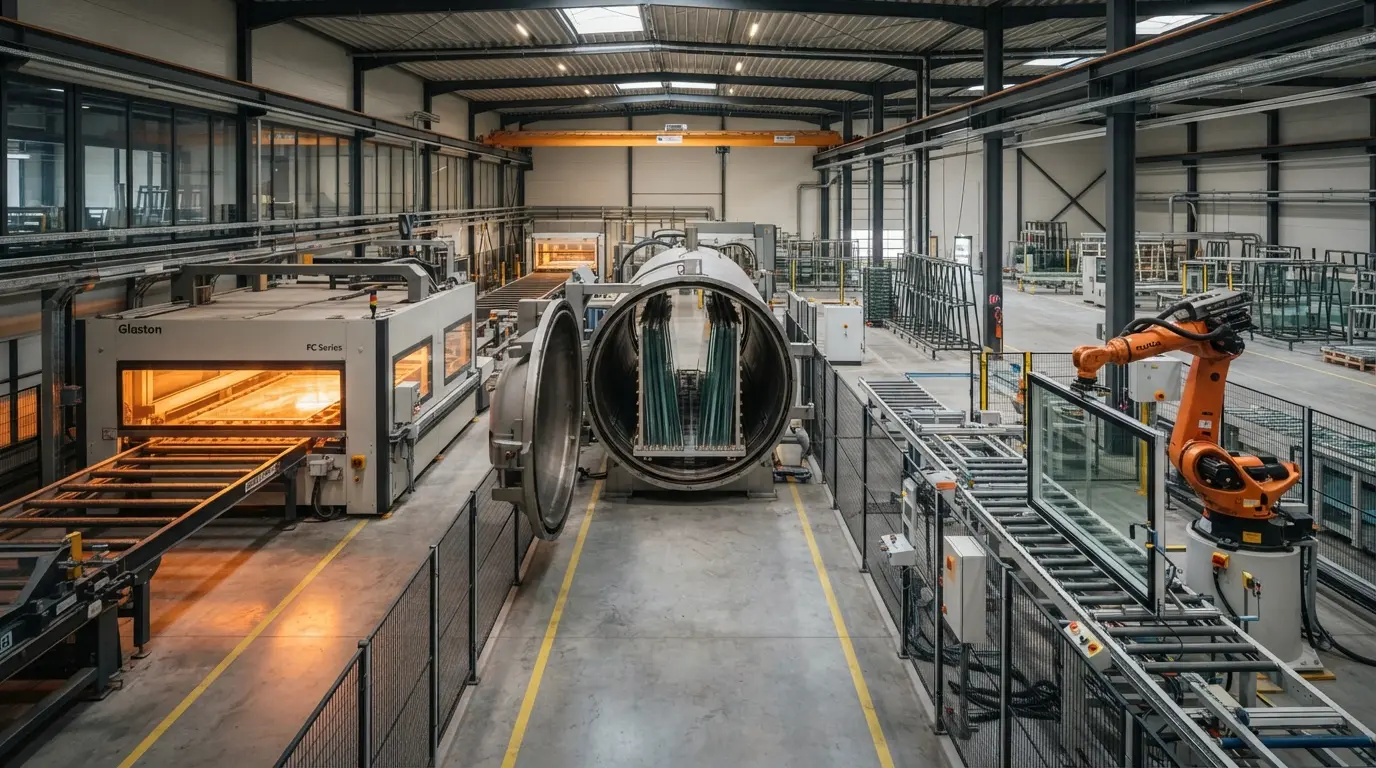
This article walks through what actually happens on a working lamination line — specifically ours in Wuhan, with our 3m × 15m autoclave (among the largest in Hubei province). It's the companion to our tempered glass production walk-through — many of our customers specify laminated-tempered glass, which combines both processes. For a broader framework, see our complete architectural glass types guide.
Lamination Is Not Just "Gluing Two Panes"
Lamination is a chemical fusion, not a mechanical adhesive. The interlayer (most commonly polyvinyl butyral, PVB) is a thermoplastic sheet that, under the right heat and pressure, forms covalent and hydrogen bonds with the hydroxyl groups on the glass surface. Done correctly, the bond is as strong as the glass itself — a lamination failure is almost always a glass failure, not a delamination.
The safety value of laminated glass comes from this bond. When the glass breaks, fragments stay stuck to the interlayer rather than becoming airborne shards. For overhead glazing, hurricane zones, and storefront security, this is what building codes require (IBC 2021 §2405.5, §2406.4.4). The acoustic and UV-blocking benefits are secondary.
PVB is the default — it was invented for automotive windshields in the 1930s and is still ~95% of the market by volume. But three other interlayers exist for specialized applications: SGP for structural and hurricane work, EVA for decorative inclusions, and acoustic PVB for noise-critical environments. The next section compares them.
The Four Interlayer Technologies
Pick any 1-3 interlayers below to compare their specifications side-by-side:
Interlayer Technology Comparison
Click any 1-3 interlayers to compare (click a selected one to deselect).
| Property | PVB | SGP |
|---|---|---|
| Full Name | Polyvinyl Butyral | SentryGlas (Ionoplast) |
| Stiffness (post-break) | Low (soft, flexible) | Very high (near-structural) |
| Edge Stability | Must be dry-glazed; moisture degrades | Edge-stable, works wet-glazed |
| Standard Thickness | 0.38 / 0.76 / 1.52 mm | 0.89 / 1.52 / 2.28 mm |
| Material Cost (relative) | 1.0× (baseline) | ~3-5× PVB |
| Process | Autoclave (140°C, 12 bar) | Autoclave (135°C, 12 bar) |
| UV Blocking | 99%+ inherent | 99%+ inherent |
| Primary Use | Automotive, standard safety glass | Hurricane, structural, bomb-blast |
The practical decision usually comes down to PVB vs SGP. PVB is the default workhorse for safety glazing in doors, shower enclosures, overhead canopies, and standard automotive windshields. SGP enters the picture when you need the laminated panel to continue carrying load after glass breakage — hurricane zones (per Miami-Dade TAS 201), structural glass floors, bomb-blast rated glazing, and railings where fall-arrest matters.
EVA and acoustic PVB are niche — EVA for decorative projects with fabric or metal mesh inclusions (requires vacuum-oven processing instead of autoclave), acoustic PVB for premium residential facing busy streets where STC ratings above 36 are required.
Free Download: Global Glass Building Codes Comparison
A side-by-side reference for architectural glass regulations across US IBC, EU EN, China GB, and Australia AS — free PDF for architects and specifiers.
The Full Production Line
Compared to tempering, lamination is a longer, more environmentally sensitive process. The key difference: tempering is a single thermal shock event; lamination is a sustained chemical bonding under tightly controlled humidity, cleanliness, and temperature. The production sequence:
- Glass preparation — Both lites are cut to final dimensions, edges finished, and washed with deionized water. For tempered-laminated panels, both lites are fully tempered before entering the lamination line.
- PVB sheet preparation — PVB arrives from suppliers (Kuraray, Eastman Saflex, Trosifol, DuPont) in moisture-sealed rolls. Climate-controlled prep room (~20°C, 25% RH max) prevents moisture absorption. Sheet is cut slightly oversized and inspected for wrinkles, inclusions, debris.
- Assembly — Glass+PVB+Glass sandwich is assembled in a dust-free clean room. Alignment matters — misalignment causes edge delamination later. Any single speck of debris between layers becomes a permanent visible defect.
- Pre-press (nip roller) — The sandwich passes through heated rubber rollers (~90°C, modest pressure) that squeeze out most of the trapped air and give the PVB initial tackiness. This step is what prevents large bubble formation in the autoclave.
- Autoclave cycle — The actual lamination event. 2.5 hours at peak 140°C and 12 bar. See the next section for the detailed cycle.
- Edge finishing + QC — Trimming of PVB overhang, final optical inspection, packaging in A-frame crates.
The dust-free assembly room is where most mid-tier factories fail. A single cleaning crew mistake, a fiber from a worker's clothing, or an unfiltered air vent can contaminate dozens of panels before anyone notices. We run our assembly room with HEPA-filtered positive pressure and dedicated clean-room garments — overhead for a small factory, but necessary for consistent output.
The Autoclave: Where Lamination Actually Happens
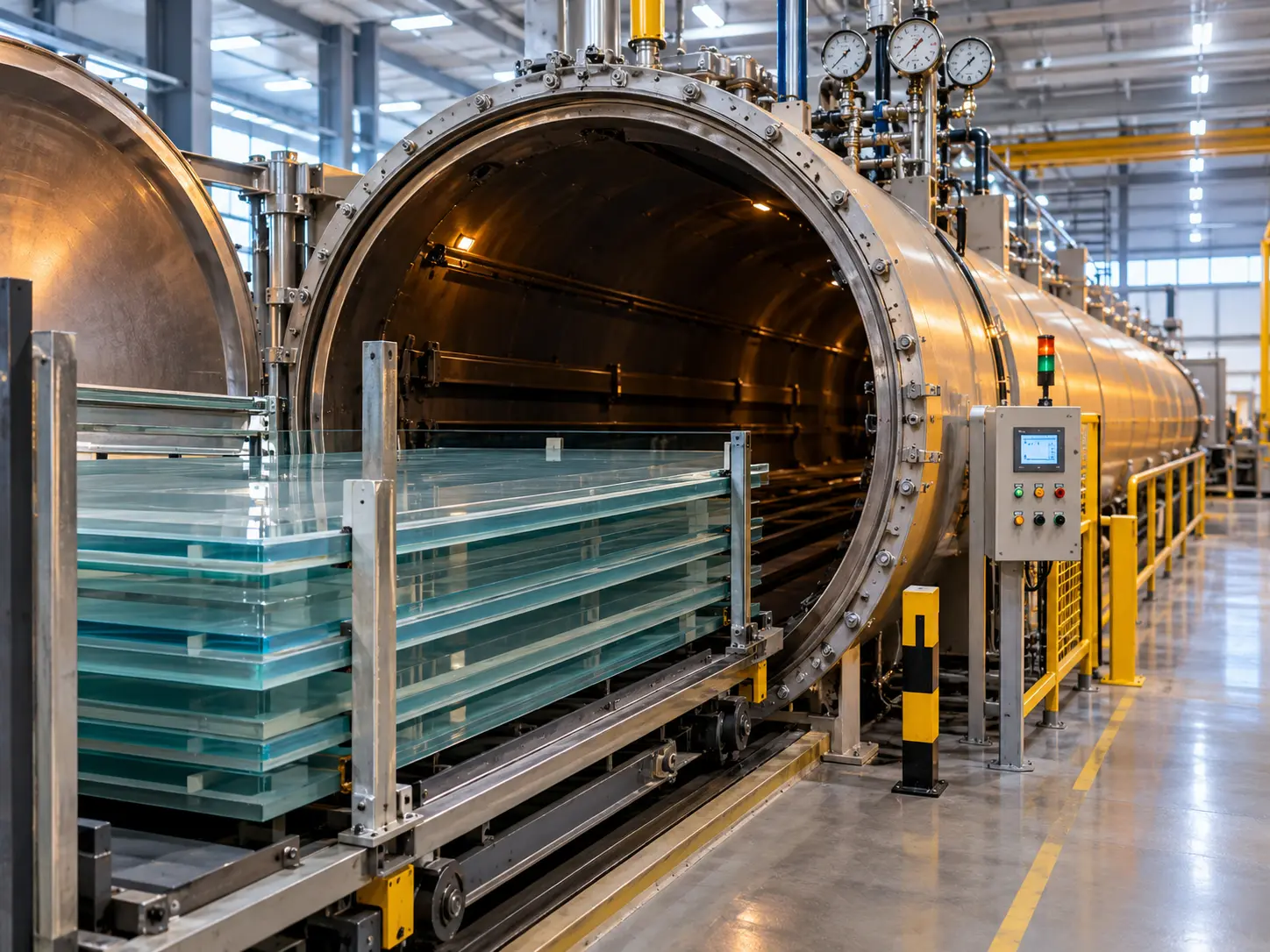
The autoclave is a large pressure vessel that heats and pressurizes the loaded panels together. The cycle is a precisely controlled temperature-pressure curve that forces the PVB to flow into every micro-cavity between the glass surfaces, then holds it there while the chemical bond forms.
Autoclave Temperature + Pressure Cycle
Standard PVB lamination cycle, ~2.5 hours total
Hold
t = 75 min · 140°C · 12 barFull dwell at 140°C / 12 bar for 30+ minutes. PVB fully fuses with glass surfaces — the chemical bond that gives laminated glass its strength forms during this hold.
The three most critical phases:
- De-airing (0-45 min): Pressure comes up beforetemperature reaches PVB flow point. This forces trapped air back into solution in the PVB where it can diffuse out, rather than remaining as permanent bubbles. Insufficient pressure here is the #1 cause of bubble defects.
- Dwell (75-110 min): Full temperature + pressure held for 30-40 minutes. This is when the chemical bond forms. Too short a dwell → weak bond, future delamination. Too long → unnecessary energy cost and PVB degradation.
- Cool-down (110-140 min): Must remain at high pressure until temperature drops below PVB flow point (~90°C), or trapped air can re-emerge as bubbles. Rushing this step is false economy.
Our autoclave is a 3m × 15m unit with programmable cycle control calibrated for each interlayer type (PVB, SGP, acoustic PVB) and glass build-up. For combined laminated-IGU production, the laminated outer lite comes off this autoclave and feeds directly into our insulated glass line for assembly into the final IGU.
Why Laminated Glass CAN Be Cut (Unlike Tempered)
A crucial difference from our tempered glass article: laminated glass can be cut after lamination, if the glass lites inside are annealed. The process:
- Score the glass on both surfaces with a conventional glass cutter wheel
- Snap along the score lines (both lites snap simultaneously)
- Cut the PVB interlayer with a sharp knife or heated nichrome wire
- Refinish the exposed glass edges
Laminated glass with tempered glass lites inside cannot be re-cut — tempering locks the glass permanently. Any attempt will shatter the tempered lite into granules. For modifications to tempered-laminated panels, new raw materials must be ordered and the entire lamination process repeated.
This cuttability is why laminated annealed glass is often preferred for fabrication-heavy projects where field adjustments are expected, while laminated-tempered is reserved for applications where the final dimensions are fixed at design time.
Common Failures: Bubbles, Delamination, Haze
Click through the common defects below to see what they look like, what causes them, and how a reputable factory prevents them:
Common Lamination Defects — What They Look Like, Why They Happen
Perfect Lamination
Root cause
Clean process, proper autoclave cycle, correct PVB handling.
Prevention
No defects visible. Glass is uniformly clear with no interlayer artifacts.
For buyers evaluating a lamination supplier, the question is not "do defects happen?" (they occasionally do, in every factory) but "are defects traceable to a specific batch, autoclave cycle, or raw material lot?" We maintain complete batch records with autoclave cycle logs, PVB lot numbers, and glass source lot numbers for every production run. Field issues can be investigated and traced to root cause within 24 hours.
When to Spec Each Interlayer
A practical decision guide based on common buyer scenarios:
- Standard safety glazing (shower, overhead, railing): PVB 0.76mm or 1.52mm. The default, lowest cost, meets all residential and most commercial safety codes.
- Hurricane-prone region (Florida, Caribbean, coastal Asia): SGP 1.52mm minimum, Miami-Dade NOA certified. Required for coastal commercial and residential construction in cyclone zones.
- Structural glass (floors, bridges, walkable surfaces): SGP 2.28mm, with careful engineering of post-break load capacity. Not a DIY decision — requires structural engineer sign-off.
- Acoustic-critical (street-facing residential, hospitals, hotels): Acoustic PVB 0.76mm. Boosts STC by 2-3 points over standard PVB. Pair with IGU for maximum acoustic performance.
- Decorative inclusions (fabric, mesh, dried flowers): EVA, processed in vacuum oven. Only for interior applications — not weather-resistant.
- Bomb-blast or forced-entry resistant: Multi-layer SGP build-up (3+ glass lites, 2+ interlayers). Specialty application, requires security-rated specification.
For most architectural buyers, the choice is PVB (default) or SGP (upgraded). See our laminated glass product page for standard build-ups and spec sheet, or our insulated vs laminated selection guide for the broader "do I need lamination at all?" decision.
This article is the second in our Technical Guides series — a companion to our tempered glass production walk-through. For the broader framework of all 5 architectural glass families, see our complete architectural glass types buyer's guide.
Frequently Asked Questions
The autoclave cycle itself is about 2.5 hours. Including cutting, cleaning, pre-press, and quality inspection, our standard production cycle is 10-15 working days from order confirmation. Combined laminated-IGU (laminated + insulated glass unit) runs 15-20 working days because it involves both the lamination autoclave and the IGU production line in sequence.
Our 3m × 15m autoclave is among the largest in Hubei province, matching our tempering furnace capacity. This lets us produce jumbo laminated panels (and combined tempered-laminated panels) for structural glazing, large curtain walls, and ultra-wide canopies that smaller factories cannot handle.
Yes, if the glass lites inside are annealed. The interlayer is cut with a knife or heated wire after scoring and snapping the glass. However, laminated TEMPERED glass cannot be re-cut — tempering locks the glass permanently (see our tempered glass production guide for why). For modifications to tempered-laminated panels, new raw materials must be ordered.
SGP (SentryGlas / Ionoplast) is the standard for hurricane and cyclone zones. It is ~100× stiffer than PVB post-break, which lets the broken panel continue to carry wind load until replaced. Minimum thickness 1.52mm SGP for Miami-Dade hurricane rating per TAS 201/202/203 test protocols. We produce SGP-laminated panels on the same line as PVB — specify "SGP" in your drawings.
This is usually not post-production bubble formation — it is pre-existing micro-bubbles that gradually expand due to interlayer stress. Caused by inadequate autoclave pressure during the de-airing phase. A properly produced laminated panel should remain bubble-free for the lifetime of the installation. Our batch records trace every panel back to specific autoclave cycle data, so field failures can be investigated and traced to root cause.
See the third fabrication process in our Technical Guides series: how insulated glass units (IGUs) are made — many of our customers specify laminated-IGU combined units, which run through both the lamination autoclave and the IGU assembly line in sequence.
This article is one of three deep-dives in our Technical Guides series. For the buyer-level overview of all 3 fabrication processes and how they map to supplier capabilities, see our complete architectural glass manufacturing guide.
Products referenced in this article


Free Download: Global Glass Building Codes Comparison
A side-by-side reference for architectural glass regulations across US IBC, EU EN, China GB, and Australia AS — free PDF for architects and specifiers.

Li Cheng
CEO at Sincere Glass
CEO at Sincere Glass (欣城玻璃) with 10+ years in architectural glass. Oversees production and quality at our 20,000 m² Wuhan facility.
Technical review: Albar, Technical Lead
Need Custom Glass for Your Project?
Get a free quote from our engineering team. We'll help you choose the right glass type, thickness, and coating for your specific requirements.