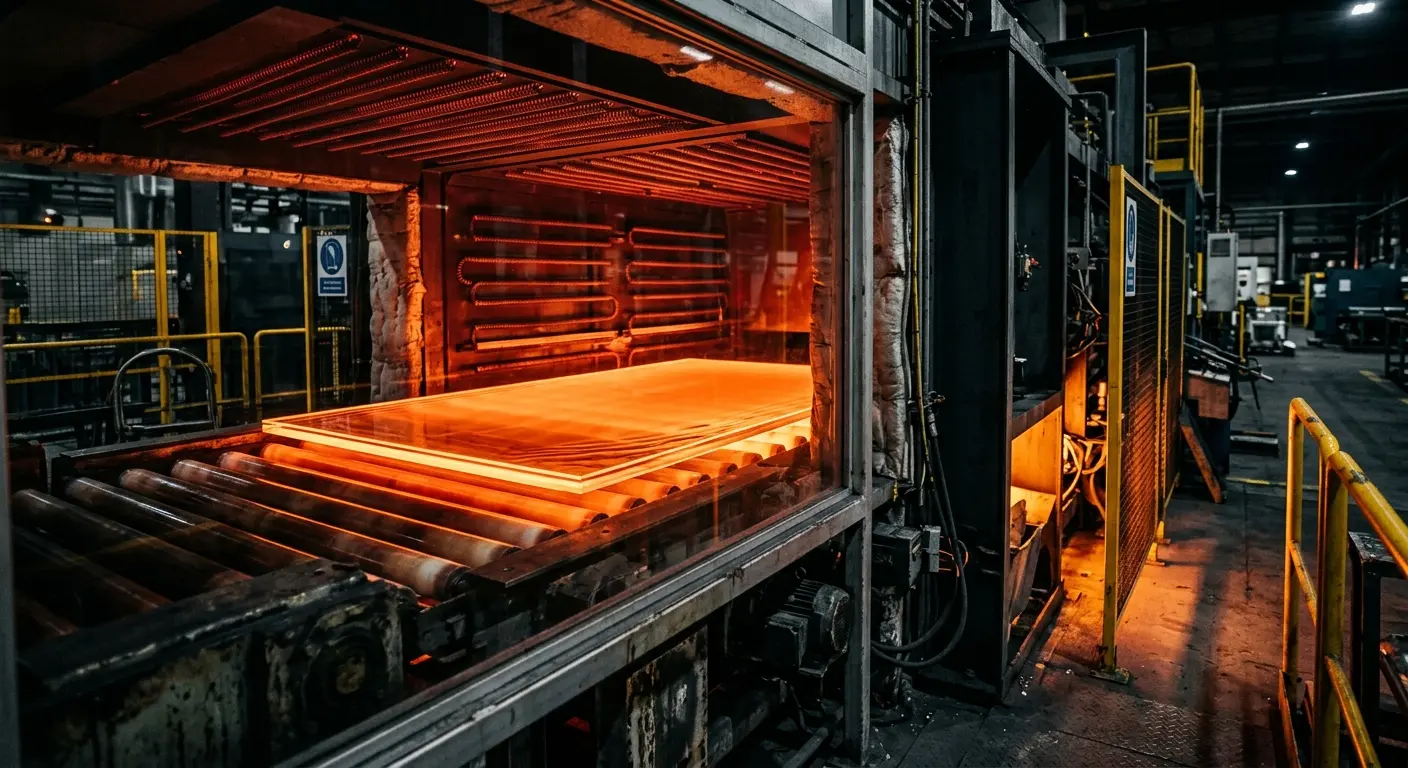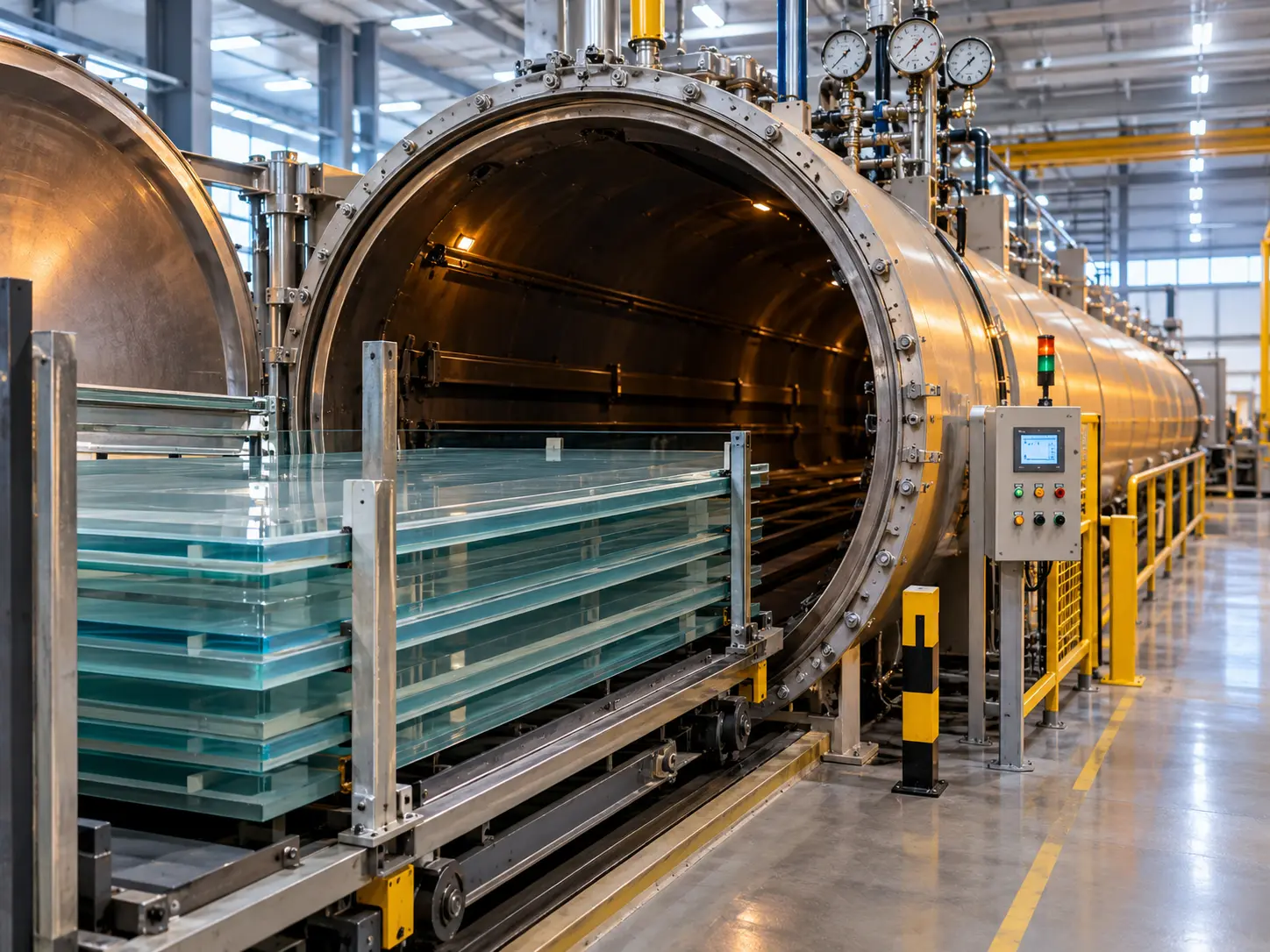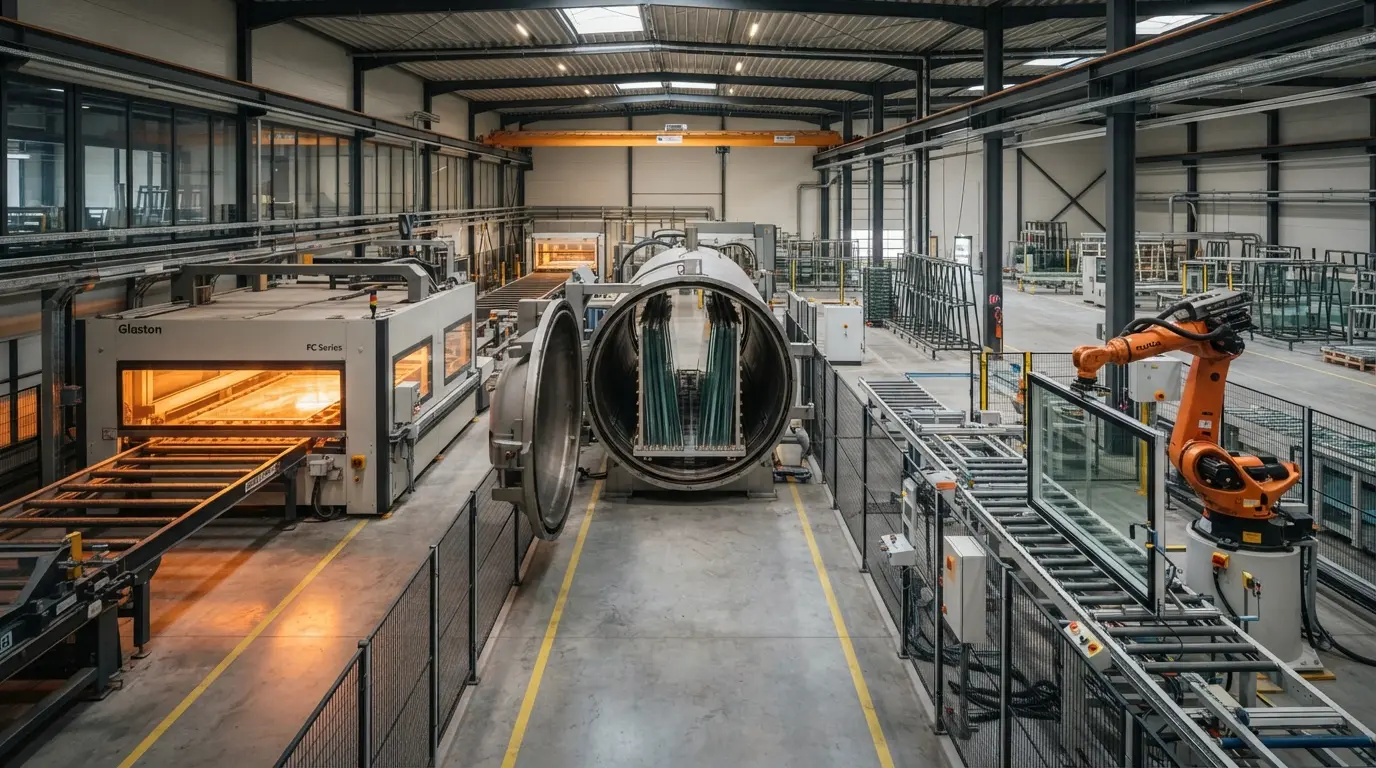
Of the three major glass fabrication processes — tempering, lamination, and IGU assembly — IGU production is the most system-engineering-oriented. Tempering is a thermal event; lamination is a chemical bonding; IGU production is an assembly discipline where five components must work together over 25+ years in a sealed system that can never be opened for maintenance.
This article walks through what happens on an IGU production line — specifically ours, which includes an ultra-large automatic argon-fill line among our 2 IGU lines. It's the companion to our tempered glass production walk-through and laminated glass production walk-through, completing the trilogy on how modern architectural glass is actually fabricated. For a broader framework on glass selection, see our complete architectural glass types guide.
An IGU Is Not Just "Two Panes With a Gap"
The intuition "insulated glass is two panes with air between" is like saying "a car engine is pistons that go up and down." Technically correct, operationally misleading. The sealed cavity is what makes the system work — not the gap itself. Once air can freely move in and out, the thermal insulation collapses and condensation forms. The entire production discipline exists to create and maintain that seal.
Three things must be true for an IGU to function:
- The cavity must stay sealed for decades, surviving UV exposure, thermal cycling, and building movement.
- The gas fill must stay in — argon escapes 1-2× faster than air through any seal defect, so poor seals degrade thermal performance before visible fog appears.
- Internal humidity must stay low — residual moisture in the cavity causes condensation at the first cold morning, visible as fog between the panes.
Each requirement maps to a specific component of the IGU, which we'll walk through next.
The 5 Components of an IGU
Click any component in the diagram below to see what it does, what options exist, and what we specify as our standard:
IGU Anatomy — Click any component
Outer Lite
Function
Faces the exterior environment. Takes the primary thermal and solar load. Low-E coating is typically applied here on surface #2 (interior-facing side of outer lite).
Options & Specification Notes
Clear, tinted (bronze/grey/blue/green), reflective, or coated with Low-E. Usually 6mm minimum for architectural IGUs; 8-10mm for structural glazing.
Most buyers focus on the glass itself (outer lite, inner lite, Low-E coating) and treat the spacer and seals as commodity items. This gets the priorities exactly backwards. The glass is the easy part — any float glass supplier can give you clear 6mm with a Low-E coating. The spacer, desiccant, and seal system determine whether that glass is still performing as designed in 25 years or has fogged up by year 8.
Free Download: Global Glass Building Codes Comparison
A side-by-side reference for architectural glass regulations across US IBC, EU EN, China GB, and Australia AS — free PDF for architects and specifiers.
The Full Production Line
Unlike tempering (a continuous furnace) or lamination (a batch autoclave), IGU assembly is a sequential station line. Each unit moves through 8 stations in sequence, typically completing in about 2 hours per unit (though the full line runs continuously):
- Glass preparation — Both lites arrive from upstream (tempering or lamination lines). Washed with deionized water, air-knife dried, inspected for surface defects. For Low-E glass, coating orientation is verified (coating must face into the cavity, surface #2 or #3).
- Spacer frame assembly — Spacer bars are cut to length, bent at corners (or butt-joined for warm-edge composites), and filled with fresh desiccant. The frame perimeter must be dimensionally accurate within 1mm or glass alignment fails downstream.
- Primary seal application — Hot-melt butyl (PIB) is applied as a continuous bead on both faces of the spacer frame. This is the gas and moisture barrier.
- Assembly press — The sandwich (outer lite + spacer frame + inner lite) is pressed together under light pressure to seat the PIB without squeeze-out. The spacer must be perfectly parallel to both lites — any skew compromises the seal.
- Gas fill (if specified) — Argon or krypton is injected through two holes in the spacer corner, displacing air through a second hole. On our automatic line, this is a controlled process that targets 90%+ fill rate.
- Fill hole sealing — The injection holes are plugged with butyl and the exterior sealed over. This is the single most common failure point if production quality is weak.
- Secondary seal — Silicone (our standard) or polysulfide is injected around the entire perimeter in the channel between the glass edges and the exterior face of the spacer. This provides structural strength and UV protection to the primary seal.
- Cure + QC — Secondary seal cures for 24-48 hours. QC tests dew point, gas fill percentage, and dimensional accuracy before packaging.
The Spacer Decision: Aluminum vs Warm-Edge
The spacer bar is the biggest thermal bridging element in an IGU. In a 1.4 W/m²·K Low-E IGU, the edge seal can account for 15-25% of total heat loss through the window. The spacer material choice is therefore a significant performance decision:
- Aluminum spacer (standard): Highest thermal conductivity (~220 W/m·K), creates the largest thermal bridge. Cheapest option. Appropriate for budget residential glazing in mild climates. Edge temperature in winter can drop below dew point, causing visible condensation on the glass near the spacer.
- Stainless steel spacer: Middle option (~16 W/m·K). Modest improvement over aluminum at modest cost premium. Common in European residential markets.
- Warm-edge composite (TPS, Super Spacer, Swiggle): Lowest thermal conductivity (~0.1-0.3 W/m·K). The industry's premium option for high-performance glazing. Can improve center-of-glass U-value by 0.1-0.2 W/m²·K and dramatically reduce edge condensation risk.
For any IGU with Low-E coating, warm-edge spacer is strongly recommended — the thermal bridging of an aluminum spacer undoes much of the Low-E benefit at the perimeter. We specify warm-edge composite spacers as our standard for all Low-E IGU orders.
The Argon Fill: Why It Matters and How It's Done
Argon costs less than $2-3/m² to add during production and reduces U-value by about 20% compared to dry air. This is one of the best cost/performance upgrades in all of architectural glazing. Click through the gas options to see why:
Gas Fill Options — Thermal Impact
Argon
Added cost: ~$2-3/m² addedIndustry-standard upgrade. ~30% lower thermal conductivity than air. Fills about 90-95% of the cavity (small fraction remains air). The best cost/performance ratio for commercial glazing.
The physics is straightforward: thermal conductivity through a gas depends on the mean free path of molecules between collisions. Argon atoms are heavier and larger than air (N₂ and O₂), so they collide more frequently and transfer less energy. Krypton and xenon are even larger and more effective, but the cost escalates dramatically.
Our fill process uses a two-port method: an injection port and a vent port located at diagonal corners of the spacer. Argon enters at ~5-10 L/min while displaced air exits the vent. The process typically runs 30-60 seconds per IGU and achieves 90-95% argon concentration verified by oxygen sensor at the vent. Both ports are then sealed with butyl followed by secondary silicone.
For projects at elevation (Denver, Mexico City, Johannesburg) or anywhere the IGU will be shipped by air freight across significant pressure change, we recommend specifying capillary tubes — small vent tubes embedded in the spacer that allow pressure equalization during transit, then get crimped shut after installation. Without them, the pressure differential can stress the seal and cause premature failure. Not needed for ocean shipping or installations below 1500m.
Dual Seal: The 25-Year Lifespan Question
The seal system is why an IGU lasts 10 years or 30 years. Toggle the systems below to see the lifespan projections:
Seal System Lifespan — % of IGUs Still Sealed Over Time
Dual Seal — PIB + Polysulfide
Primary: PIB (polyisobutylene) · Secondary: Polysulfide
The baseline commercial IGU seal. PIB provides the gas and moisture barrier; polysulfide provides structural strength. Cost-effective for most commercial applications. Standard for mid-tier curtain walls.
Dual Seal — PIB + Silicone
Primary: PIB (polyisobutylene) · Secondary: Structural silicone
The premium seal system. Silicone is UV-stable and remains flexible across wide temperature ranges, making it ideal for structural glazing and high-rise curtain walls where facade replacement is costly. Our standard spec.
Single-seal IGUs still exist in the budget residential window market but should not be considered for any commercial project. Among dual-seal systems, the choice between polysulfide and silicone secondary is driven by application:
- Polysulfide secondary: Lower cost, 20-25 year expected life. Suitable for standard commercial glazing. Not UV-stable — must be protected from direct sunlight by framing.
- Silicone secondary: Higher cost, 30+ year expected life. UV-stable, suitable for structural glazing where the seal may be exposed. Required for structural silicone glazing (SSG) where the IGU is bonded to the curtain wall frame via the secondary seal itself.
Our standard is PIB primary + silicone secondary. For projects where cost sensitivity is high and the IGU will be inside standard aluminum framing, we can quote PIB + polysulfide as an alternative.
QC: Dew Point, Gas Content, Seal Integrity
IGU quality control is unusual because the critical performance characteristics are invisible. A finished IGU looks exactly like a non-functional IGU to the naked eye — both are two panes with a gap. Testing is required:
- Dew point test — A small IGU sample from each lot is frozen to -40°C and inspected for internal frost formation. Properly dried desiccant should keep the dew point below -40°C. Any visible frost means desiccant was spent or moisture penetrated during assembly.
- Gas content measurement — Spark emission spectroscopy or oxygen-sensor sampling verifies argon fill percentage. We test every 20th unit in a run and provide fill-rate certificates for high-performance specifications.
- Seal continuity inspection — Visual + probe inspection of the primary and secondary seal around the full perimeter. Discontinuities or voids are flagged for repair or rejection.
- Dimensional accuracy — Overall thickness, spacer squareness, and offset between the two glass lites are measured. Tolerances per EN 1279-6 or GB/T 11944-2012.
- Visual optical inspection — No scratches, no debris in the cavity, no spacer defects visible through the glass. Any contamination inside the cavity is a reject — cannot be cleaned once sealed.
Our product page for insulated glass covers the standard build-up options and spec sheet: Insulated Glass product details. For project-specific quotes, use the Request Quote button in the header.
This article completes our Technical Guides trilogy on glass fabrication — see also our walk-throughs of tempered glass production and laminated glass production. For a broader framework of all 5 architectural glass families, see our complete architectural glass types buyer's guide.
Frequently Asked Questions
Our standard IGU production cycle is 10-15 working days from order confirmation, matching our laminated glass line. For IGUs that require Low-E coated glass or laminated outer lites, the lead time extends to 15-20 working days because the lites must be fully processed before IGU assembly can begin.
A properly sealed dual-seal IGU with PIB + silicone seals should maintain its gas fill and remain condensation-free for 25-30 years. Our standard IGUs ship with a 10-year seal warranty; 15-year warranty is available for projects using premium silicone secondary seals. Lifespan is dominated by seal quality, not by the glass itself.
Yes, if the production quality is correct. Properly sealed dual-seal IGUs are stable in sea transit; the pressure change at altitude (for air freight) is actually more stressful than ocean shipping. We package IGUs in pine A-frame crates with corner protection and desiccant packs. For destinations above 1500m elevation (Denver, Mexico City, La Paz), we recommend specifying pressure-equalizing capillary tubes to prevent seal stress.
Industry standard "argon-filled" means approximately 90-95% argon concentration at time of manufacture, with the remaining 5-10% being residual air that could not be fully displaced during the fill process. Over 25 years, slow permeation through the seal typically reduces this by about 1% per year, so a 25-year-old argon IGU may have 65-70% argon remaining. We test fill percentage at QC and provide fill-rate certificates for high-performance specifications.
Standard MOQ is 50 square meters per order, with no restriction on panel sizes within our 3m × 15m line capacity. For high-performance IGUs (laminated outer lite + Low-E + argon + warm-edge spacer), we recommend ordering in whole facade sets rather than small batches to maintain consistent production parameters across the project.
This article is one of three deep-dives in our Technical Guides series. For the buyer-level overview of all 3 fabrication processes and how they map to supplier capabilities, see our complete architectural glass manufacturing guide.
Products referenced in this article


Free Download: Global Glass Building Codes Comparison
A side-by-side reference for architectural glass regulations across US IBC, EU EN, China GB, and Australia AS — free PDF for architects and specifiers.

Li Cheng
CEO at Sincere Glass
CEO at Sincere Glass (欣城玻璃) with 10+ years in architectural glass. Oversees production and quality at our 20,000 m² Wuhan facility.
Technical review: Albar, Technical Lead
Need Custom Glass for Your Project?
Get a free quote from our engineering team. We'll help you choose the right glass type, thickness, and coating for your specific requirements.