"How is tempered glass made?" is a question with a one-sentence answer and a twenty-page answer. The one-sentence version: heat glass to 620°C, then cool its surface fast while the core is still hot. The twenty-page version involves CNC cutting tolerances, edge micro-crack theory, roller-wave distortion, air-jet nozzle geometry, and nickel sulfide inclusion risk.
This article walks through what actually happens, step by step, in a working tempering line — specifically ours in Wuhan, Hubei province. Not a textbook explanation; a factory-floor walk-through. If you've read our tempered vs annealed glass comparison, you know what the end result is; this is how it gets there. For a broader selection framework, see our complete architectural glass types guide.
It Starts With Ordinary Glass
Every piece of tempered glass starts life as a plain annealed float glass sheet — the standard output of a float glass line. Molten glass is poured onto a bed of molten tin, drawn across to thickness, cooled slowly through an annealing lehr, and shipped out as flat sheets to downstream processors like us.
We don't make float glass ourselves. We buy it from certified upstream float mills in large lots, inspect each lot for optical defects and NiS inclusion indicators, and feed it into our production line. Everything described below is what we do to convert that raw annealed glass into a tempered, safety-rated final product.
Float glass production requires a continuous 24/7 furnace running at ~1500°C with a tin bath, consuming the energy of a small town. The economics only work at massive scale (minimum ~500 tons/day output). Mid-size downstream factories like ours — and most tempering operations worldwide — source raw float from a handful of specialized mills, then focus on the value-added processing: cutting, tempering, laminating, coating.
The Full 7-Phase Production Line
Click through the phases below. Each click shows what happens at that stage, how long it takes, what temperature the glass is at, and where our specific facility capabilities fit in.
Production Line Walk-Through
Phase 04 · The Furnace (Heating)
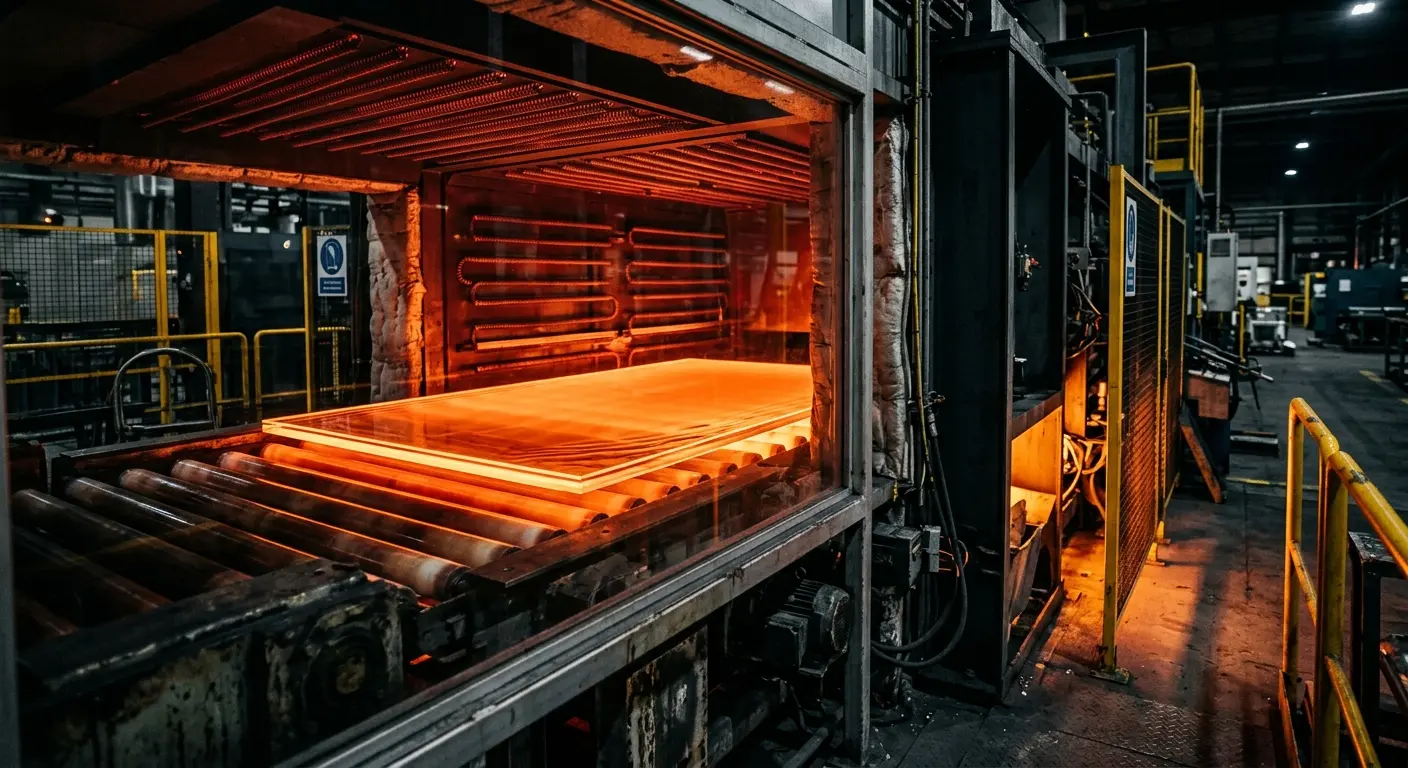
Glass rides through a horizontal roller furnace, heated to its softening point by overhead and underside radiant elements.
- ▸Temperature target: ~620°C (just below the softening point of 650-700°C)
- ▸Must heat uniformly — hot spots cause distortion, cold spots cause failed tempering
- ▸Rollers rotate continuously; sitting still creates "roller wave" distortion
- ▸Furnace length determines throughput: our furnace handles panels up to 15m long
In our Wuhan facility
We operate 2 tempering furnaces; the larger one accepts panels up to 3.3.3 m × 15 m — among the largest in Hubei province.
Most people think of "tempering" as just the furnace step (Phase 04) and the quench (Phase 05). In reality, the preceding four phases determine whether those two will succeed. A badly ground edge, a smudge from Phase 03 washing, or a non-uniform load spacing in Phase 04 — any of these can cause a sheet to crack inside the furnace, or produce distorted output that fails QC. The furnace is the dramatic step, but the preparation is where quality is won or lost.
Free Download: Global Glass Building Codes Comparison
A side-by-side reference for architectural glass regulations across US IBC, EU EN, China GB, and Australia AS — free PDF for architects and specifiers.
The Temperature Journey
The entire thermal cycle, visualized. Hover any point on the curve to see what's happening to the glass at that temperature:
Temperature-Time Curve
What the glass goes through, moment by moment
Hover any point
Exit furnace
580°C · t = 305sCore and surface at ~same high temperature
Three details that matter for buyers understanding this chart:
- The target is 620°C, not higher. Pushing closer to the softening point (~650-700°C) increases distortion risk without improving temper quality. Our furnace is calibrated for ~620°C sustained temperature.
- The quench is a seconds-level event. From exit (580°C) to surface freeze (300°C) in roughly 15 seconds. This is the moment that creates the "temper." Everything else is preparation and recovery.
- The cooling-to-ambient phase matters too. Rapid handling while the core is still hot can cause secondary stresses or warping. Finished panels sit on the output conveyor until they're truly below 100°C.
Why the Stress Pattern Matters
Here's what the quench actually does, at the material level. Toggle between plain annealed glass and tempered glass to see the difference in internal stress distribution:
Annealed glass has essentially zero residual stress. The slow cooling of the annealing lehr lets every molecule settle into its lowest-energy position. The glass is uniform throughout. Breaking stress ~40 MPa — just the inherent bond strength.
This stress profile is why tempered glass is 4-5× stronger than annealed — any external bending force must first overcome the ~180 MPa of locked-in surface compression before the glass can enter net tension and fail. It's also why tempered glass shatters into granules: when the surface finally does fail, it releases the stored core tension catastrophically across the whole pane in milliseconds.
Per GB 15763.2-2005 §4.2, Chinese safety glass standard requires minimum surface compressive stress of 90 MPa for architectural tempered glass. International standards similarly: EN 12150-1 requires 69 MPa minimum; ANSI Z97.1 and ASTM C1048 specify through fragmentation testing rather than direct stress measurement, but calibrate to similar levels. Our production targets 100-180 MPa to comfortably exceed all four standards.
Why Tempered Glass Can't Be Cut or Drilled
This is the single most expensive mistake buyers make: specifying tempered glass and then expecting to drill holes or cut it to fit at the job site. Any attempt to cut, drill, grind, or notch tempered glass causes it to explode into granules immediately.
The reason comes directly from the stress profile shown above. The outer "skin" of compressed glass is holding the inner "core" of tensioned glass in equilibrium. The moment you break that skin — even with a glass cutter wheel scoring 0.1mm deep — you release the core tension, and the entire pane disintegrates in milliseconds. There is no partial break; there is no careful cut.
Every hole, every notch, every bevel, every polished edge must be specified on the drawings BEFORE the glass enters our furnace. We'll build it exactly to drawing — but field modifications are impossible. If dimensions change after production, the glass must be scrapped and re-ordered from new raw stock. Design confirmation is the slowest step for most buyers; we strongly recommend thorough review before order placement.
This also explains the price differential (see our tempered vs annealed cost comparison). Annealed glass is cheap partly because the buyer absorbs the fabrication flexibility. Tempered glass costs ~3× annealed partly because the factory absorbs the risk of specification errors — once tempered, it cannot be reworked.
The One Risk: Spontaneous Breakage from NiS
Tempered glass has one rare but notorious failure mode: spontaneous breakage from nickel sulfide (NiS) inclusions. Microscopic NiS particles that happened to be in the raw glass can undergo a slow phase transition over months or years, expanding by about 4% in volume. This expansion inside the tensioned core of a tempered pane can trigger catastrophic failure — the pane explodes with no apparent cause, sometimes years after installation.
The failure rate is low — industry estimates range from 1 in 10,000 to 1 in 100,000 tempered panels — but when it happens in a high-rise curtain wall, it's a liability event. Mitigations exist:
- Source control: We only buy from upstream float mills with documented NiS screening. Suspect lots are rejected before entering our line.
- Heat-soak testing (HST): After tempering, suspect panels can be reheated to ~290°C and held for 2-4 hours. Panels with NiS inclusions tend to fail during this test rather than in the field. HST adds ~$5-10/m² to the price but is standard for high-rise curtain wall work.
- Spec laminated tempered instead: If a panel does spontaneously break, the PVB interlayer holds the fragments in place — no falling glass. See our tempered vs laminated comparison for when to upgrade.
For most architectural applications below 10 storeys and non-overhead, standard 3C-certified tempered glass is appropriate without HST. For high-rise facades, overhead glazing, or any application where a falling pane could injure someone, we recommend either heat-soaked tempered or laminated tempered configurations.
What Good Tempering Looks Like
For buyers evaluating tempered glass quality from any supplier — including us — here are the specific things to check:
- Fragmentation test report per batch — showing ≥40 fragments per 50mm × 50mm square, no shard longer than 100mm
- Surface compressive stress measurement (via GASP or SCALP meter) ≥90 MPa for 3C-certified product
- Roller wave within tolerance per ASTM C1048 — visible as ripples under raking light
- Bow / overall warp under 3mm per meter for architectural tempered
- Edge quality — no chips, no raw cut marks, polish grade matches spec
- 3C certification mark (CCC logo) etched or screened onto the glass, with batch traceability
- For high-stakes applications: heat-soak test certificate per EN 14179 or equivalent
Our tempered glass product page covers the standard options and spec sheet: Tempered Glass product details. For project-specific quotes or spec reviews, use the Request Quote button in the header.
This article is the first in our Technical Guides series. For a full overview of all 5 architectural glass families and when to specify each, see our complete architectural glass types buyer's guide.
Frequently Asked Questions
A single sheet of 6mm glass takes about 7-10 minutes from entering the furnace to exiting the quench — but total production time including cutting, edge finishing, washing, and QC is typically 1-2 days from order confirmation for a standard batch. At our Wuhan facility, standard tempered glass orders ship in 7-12 working days.
Our larger tempering furnace accepts panels up to 3m × 15m — one of the largest in Hubei province. The practical maximum for most architectural projects is dictated by handling and shipping, not production capability. For panels over 2.5m × 6m, we recommend discussing crating and transport logistics early in the quote process.
No. Once a glass sheet has been tempered, it cannot be re-processed thermally without destroying it. If a project needs modification, the glass must be re-cut from new annealed stock and tempered again. This is why spec drawings must be finalized before placing a tempered glass order.
Three ways: (1) Polarized light test — tempered glass shows characteristic stress patterns ("quench marks" or "polka dots") when viewed through polarizing film. (2) Breakage test — if a corner is broken off a sample, tempered glass fragments into small granules; annealed produces large shards. (3) Edge inspection — tempered glass has a slight edge profile change from the quench. Legitimate suppliers provide test reports with every batch; we provide these with all 3C-certified orders.
Our standard MOQ is 50 square meters per order, with no restriction on panel sizes up to our furnace maximum. Smaller trial orders are accepted at a nominal setup fee for new buyers. For complex custom shapes or coatings, we recommend consulting on feasibility before finalizing the quote.
Now that you know how tempered glass is made, see how its companion safety product is produced in our laminated glass production walk-through — autoclave chemistry, PVB vs SGP interlayer selection, and the defects that trace back to process discipline.
See the third fabrication process in our Technical Guides series: how insulated glass units (IGUs) are made — the 5-component sealed system, argon fill mechanics, and dual-seal chemistry that determines whether an IGU lasts 10 or 30 years.
This article is one of three deep-dives in our Technical Guides series. For the buyer-level overview of all 3 fabrication processes and how they map to supplier capabilities, see our complete architectural glass manufacturing guide.
Products referenced in this article


Free Download: Global Glass Building Codes Comparison
A side-by-side reference for architectural glass regulations across US IBC, EU EN, China GB, and Australia AS — free PDF for architects and specifiers.

Li Cheng
CEO at Sincere Glass
CEO at Sincere Glass (欣城玻璃) with 10+ years in architectural glass. Oversees production and quality at our 20,000 m² Wuhan facility.
Technical review: Albar, Technical Lead
Need Custom Glass for Your Project?
Get a free quote from our engineering team. We'll help you choose the right glass type, thickness, and coating for your specific requirements.