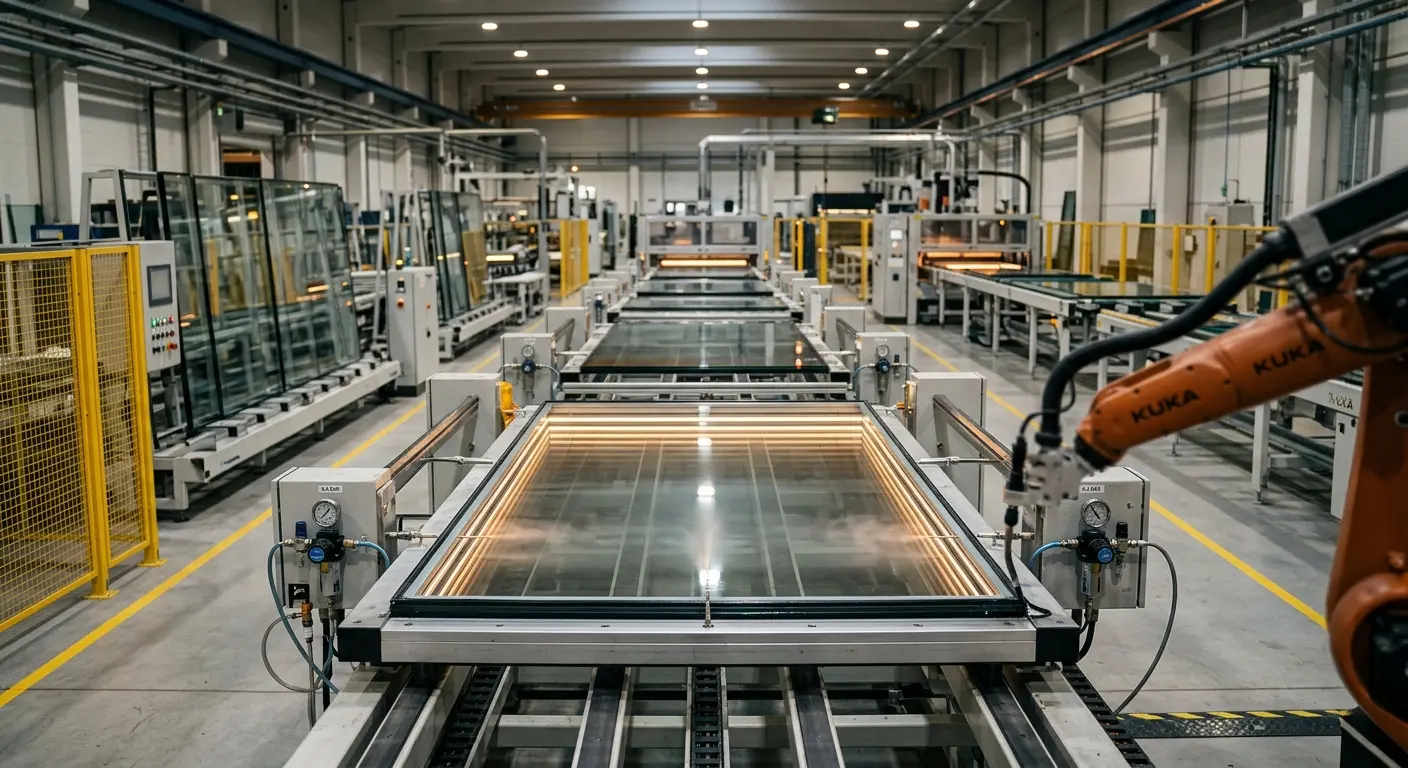
Most buyer-facing content treats architectural glass as a product — tempered, laminated, Low-E, IGU. But every one of those products is defined by the fabrication process that creates it. Understanding the three processes matters for two reasons: it tells you which supplier capabilities to look for, and it explains why some products are cheap and others are expensive.
This guide is the entry point to our Technical Guides series on glass manufacturing. Three in-depth articles walk through each process in detail; this guide maps them to the buyer's decision — what you need to buy, which process creates it, and what to look for in a supplier. For a parallel framework on product selection rather than fabrication, see our complete architectural glass types guide.
Start Here: Which Process Does Your Glass Need?
If you want the fastest answer without reading the full guide, use the selector below. One question, four possible paths — each links to the deep-dive article and the relevant product page.
Fabrication Process Selector
What are you ultimately buying?
The four options map to the four most common architectural glass orders: single-process tempered (safety only), single-process laminated (fragment retention), single-process IGU (thermal only), or the combined laminated-IGU that premium facades need. The selector tells you which production lines must be involved — which, in turn, tells you which suppliers can actually make it.
The 3 Fabrication Processes
Each process addresses a fundamentally different engineering problem. Understanding what each one does — and does not do — is the foundation for every glass specification decision.
1. Tempering — Thermal Strengthening
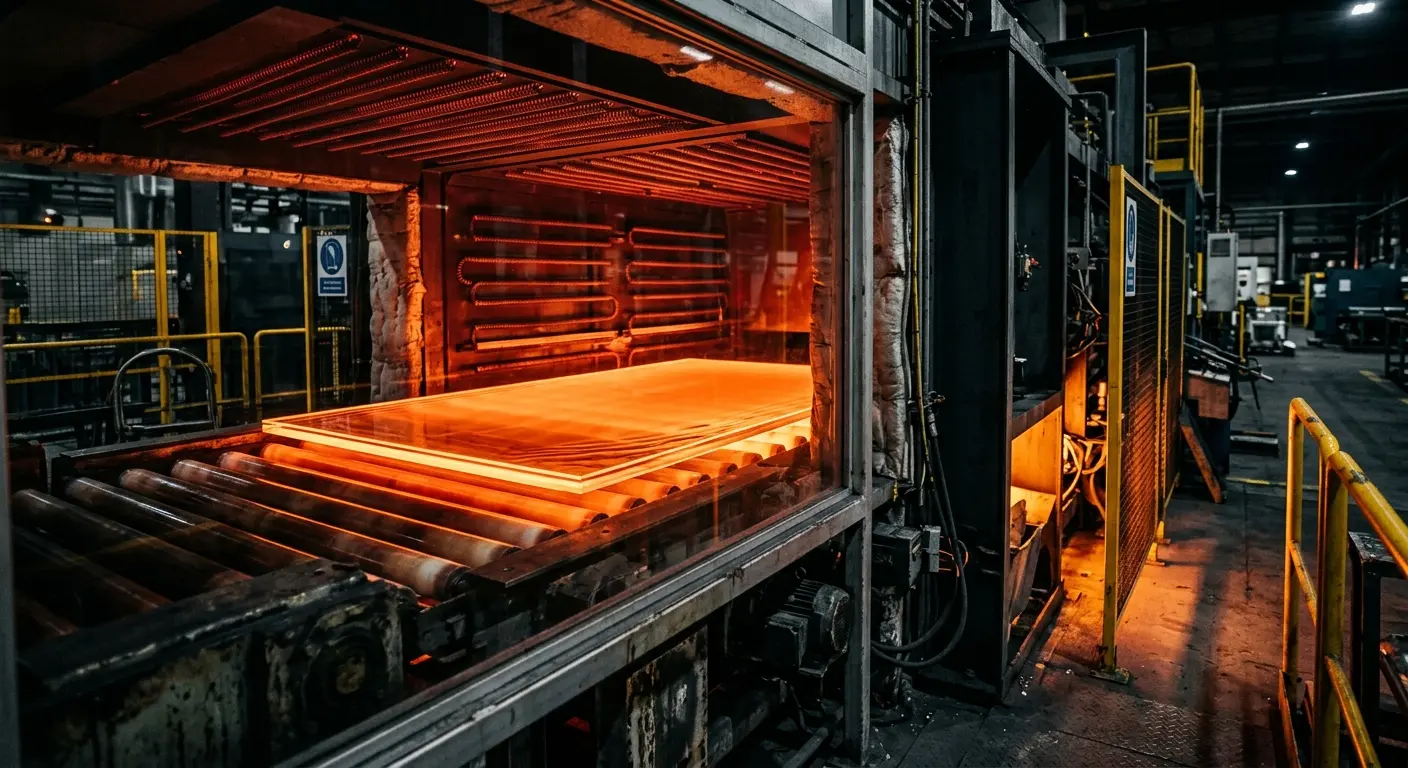
Tempering takes ordinary annealed float glass and gives it 4-5× the strength plus a safe granular breakage pattern. The process: heat the glass to approximately 620°C in a horizontal roller furnace, then quench both surfaces simultaneously with high-pressure air jets. The surface freezes while the core remains hot; when the core finishes contracting, it pulls against the frozen surface, locking in compressive stress of 100-180 MPa.
This stress profile is why tempered glass is "safety glass" — any external force must first overcome the surface compression before the glass can fail, and when it does finally break, it fragments into small granules instead of large shards. Required by building codes in nearly every country for doors, shower enclosures, low windows, railings, and other impact-prone locations.
Deep dive: How Is Tempered Glass Made? A Factory-Floor Walk-Through of the 7-Phase Production Line
2. Lamination — Chemical Bonding
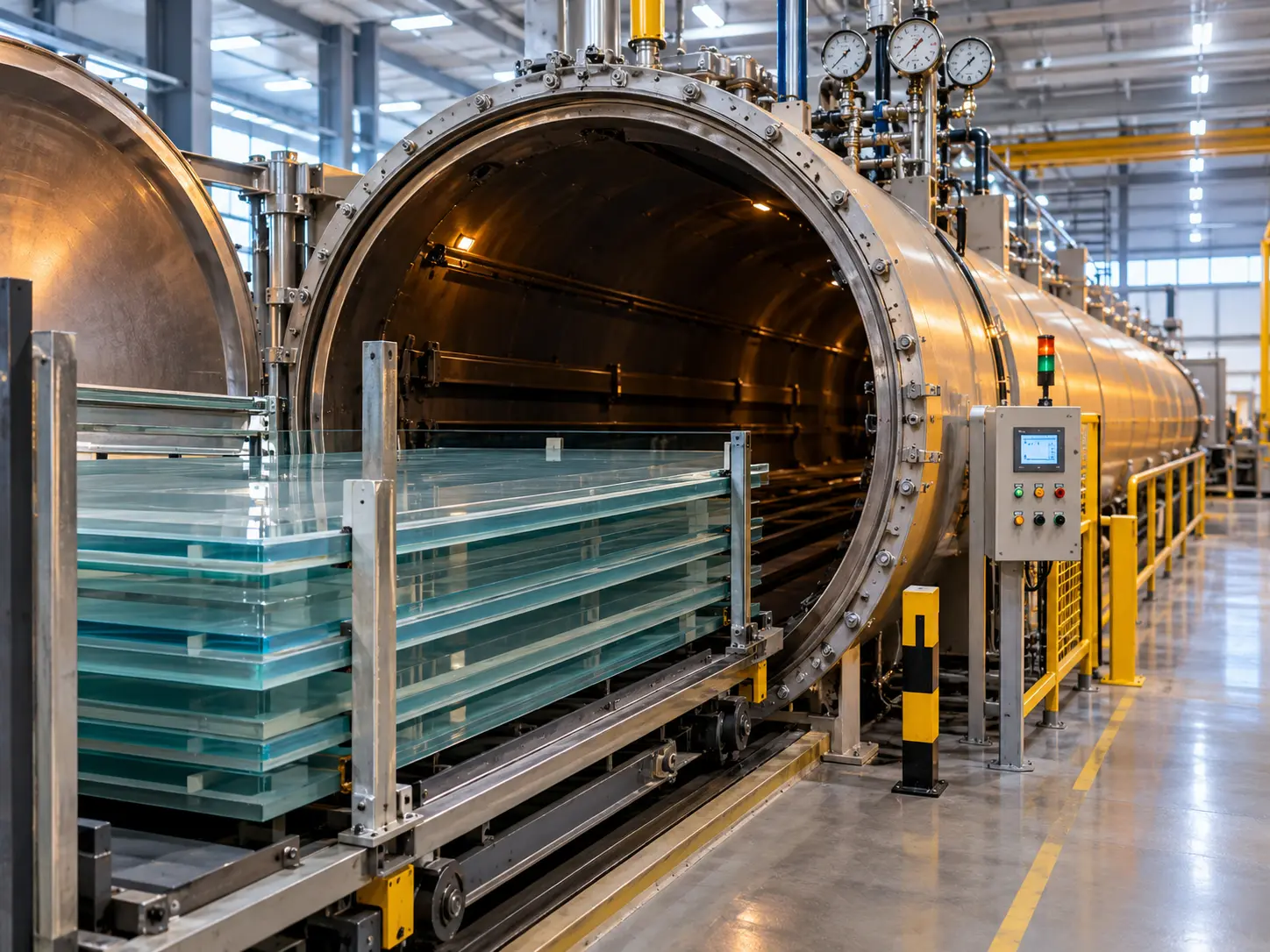
Lamination permanently bonds two or more glass lites with a polymer interlayer — most commonly PVB (polyvinyl butyral) or SGP (SentryGlas ionoplast). The process runs in an autoclave: a cylindrical pressure vessel that holds the assembled sandwich at approximately 140°C and 12 bar for 30-40 minutes. During this hold, the PVB flows into every micro-cavity between the glass surfaces and forms a chemical bond with the hydroxyl groups on the glass.
The resulting panel has two critical properties beyond plain glass: when broken, fragments stay adhered to the interlayer (no falling shards), and the interlayer dampens airborne sound. Required by code for overhead glazing, structural glass floors, and most storefronts. SGP variant is standard for hurricane and cyclone-prone regions.
Deep dive: How Is Laminated Glass Made? Inside the Autoclave That Chemically Fuses Glass to PVB
Free Download: Global Glass Building Codes Comparison
A side-by-side reference for architectural glass regulations across US IBC, EU EN, China GB, and Australia AS — free PDF for architects and specifiers.
3. IGU Assembly — Sealed-System Engineering
IGU assembly builds an insulated glass unit: two or more glass lites separated by a sealed cavity filled with inert gas (typically argon), bounded by a desiccant-filled spacer bar and a dual-seal perimeter. The process runs on an 8-station assembly line — glass prep, spacer frame assembly, primary butyl seal, assembly press, gas fill, fill-hole sealing, secondary silicone seal, and cure.
Unlike tempering or lamination (both single thermal events), IGU assembly is a sequential discipline where five components must work together over 25+ years in a sealed system that can never be opened for maintenance. The thermal performance comes from the gas fill and Low-E coating; the lifespan comes from the dual seal system. Baseline specification for commercial office towers, residential windows in temperate and cold climates, and any building with meaningful HVAC loads.
Deep dive: How Is Insulated Glass Made? Inside the 25-Year Sealed System That Cuts Heat Loss by 70%
How 3 Processes Create 5 Product Families
The three processes combine in different sequences to produce the five families of architectural glass. Click any process pill below to see which products flow from it:
How 3 Fabrication Processes Create 5 Product Families
Click any process pill above to highlight its product branch. Click any node to drill into the deep-dive article or product page.
Two observations worth drawing out:
- Tempering touches almost everything. Even products that look like they are about something else (laminated glass, enameled glass, Low-E IGU) usually start with tempered lites — because safety glass is code-required in most architectural applications.
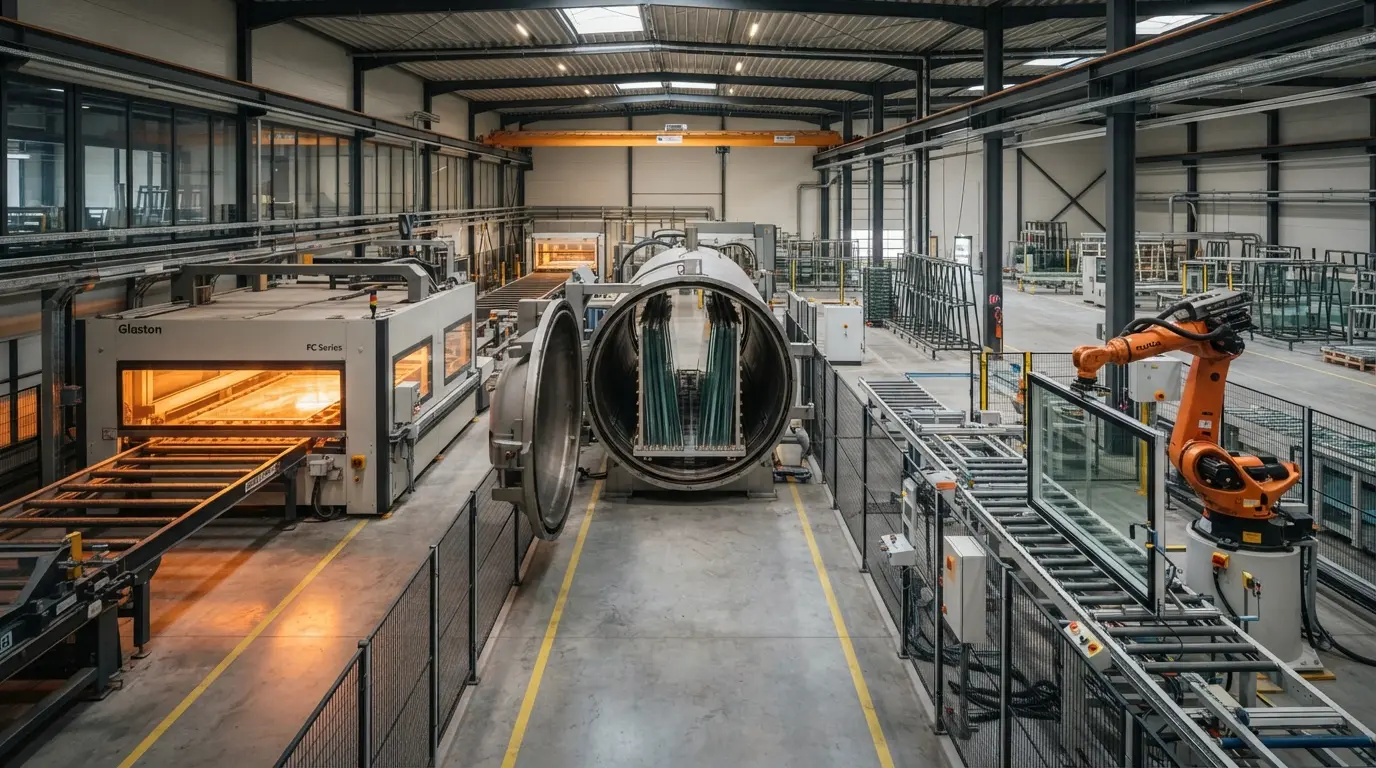
- Combined products need all three lines. A laminated-IGU — the premium facade specification for high-end projects — runs through tempering first (both lites tempered), then lamination (outer lite laminated), then IGU assembly (laminated outer + Low-E tempered inner assembled into the final unit). A supplier without all three lines cannot make this product in-house.
Three Lines, One Factory
Here is what matters about producing all three processes under one roof, and why we invested in it:
- Combined products stay in one facility. Our laminated-IGU workflow goes tempering → lamination → IGU assembly on panels sized for all three lines, with full batch traceability. Cross-factory handling introduces handling damage risk, timing uncertainty, and finger-pointing when quality issues arise.
- Jumbo capability across all three. Our tempering furnace handles panels up to 3m × 15m. Our lamination autoclave handles panels up to 3m × 15m. Our ultra-large automatic argon-fill IGU line can accommodate the resulting jumbo laminated panels. Mid-tier factories typically have jumbo capability in one process but not all three.
- Single-source quality accountability. If a laminated-IGU fails in the field, we can trace the issue to a specific batch, cycle, and raw material lot across all three processes. A multi-factory supply chain cannot provide this.
- 15+ years domestic track record. Our two facilities (武汉欣城 and 湖北欣之城) have operated these lines for the Chinese domestic market since the early 2010s. The export-market offering is new, but the production capability is mature.
Supplier Audit Checklist
When evaluating any architectural glass supplier — including us — these are the questions whose answers separate a real factory from a trading company subcontracting production:
- How many tempering furnaces do you operate, and what is the maximum panel size? A real factory can answer immediately with specific numbers. A trading company gives vague answers or quotes "any size."
- Do you produce laminated glass in-house, or subcontract it? If subcontracted, who is the subcontractor and what is their quality system?
- Can you produce combined laminated-IGU in one facility? If yes, which production lines are involved and what is the typical lead time?
- What certifications ship with export orders? Minimum expected: 3C (CCC) certification per Chinese national standards, with test reports per the relevant GB standards (15763.2 for tempered, 15763.3 for laminated, 11944 for IGU). For export, test reports suitable for ASTM C1048, EN 12150, or AS/NZS 2208 compliance review.
- Can you provide batch records for a representative recent order? This is the diagnostic test — a real factory maintains production records; a trading company cannot produce them because they didn't produce the glass.
- What is your QC process for IGU gas fill percentage? Any factory claiming "argon-filled IGUs" without a measurement capability is guessing.
- What is the standard dual-seal system? PIB + silicone is the premium standard; PIB + polysulfide is mid-tier; single-seal is budget residential only.
- Do you offer heat-soak testing for tempered glass? Required for high-rise curtain wall applications to mitigate spontaneous NiS breakage risk.
- What is the MOQ, lead time, and shipping terms? A real factory can quote these per product category without consulting a third party.
Watch for: inability to specify tempering furnace size, vague answers about "any production capability," no test reports available, no batch records available, no QC data for IGU gas fill, no willingness to accept facility visits, prices dramatically below market, or quotes that mix "FOB any port in China" (suggests trader, not factory). Any of these should prompt a deeper audit before placing orders.
Frequently Asked Questions
Three primary processes convert raw annealed float glass into finished architectural products: (1) tempering — thermal strengthening by heating to 620°C and quenching; (2) lamination — chemical bonding of two glass lites with a polymer interlayer in an autoclave at 140°C and 12 bar; (3) IGU assembly — building sealed insulated glass units with argon-filled cavities and dual-seal perimeters. Most modern architectural glass combines two or three of these processes.
Yes, but it is less common than buyers assume. Many mid-tier factories specialize in one or two processes and subcontract the rest, which creates handling damage risk and extended lead times. Our 20,000 m² Wuhan facility runs all three processes on dedicated lines in parallel — 2 tempering furnaces (largest 3m × 15m), 2 lamination autoclaves (largest 3m × 15m), and 2 IGU assembly lines (one with ultra-large automatic argon fill). This matters most for combined products like laminated-IGU, where cross-handling between factories would introduce quality risk.
Standard production cycles from order confirmation at our facility: annealed cuts 3-7 working days, tempered 7-12 days, laminated 10-15 days, insulated glass units 10-15 days, combined laminated-IGU 15-20 days. Low-E coating availability for specialty variants can add 5-7 days. These exclude ocean freight transit time to international destinations.
The supplier audit checklist later in this guide covers it, but the short version: (1) ask for recent batch records with autoclave or furnace cycle data; (2) ask for test reports per GB 15763.2 (tempered), GB 15763.3 (laminated), and GB/T 11944 (IGU); (3) if possible, visit the facility and confirm the production lines match the capability claimed. Beware of 'factories' that are actually trading companies subcontracting production — they cannot answer production detail questions.
This is where factory-vs-trader matters most. A trading company cannot guarantee process compatibility across subcontracted lines. A full-service factory like ours runs the processes in sequence on compatible production lines — our tempered-laminated-IGU workflow goes tempering → lamination → IGU assembly on panels sized for all three lines, with full batch traceability. For high-performance facades, specify "single-source production" in your RFQ.
Products referenced in this article

Tempered Glass
4–5× stronger than annealed. Jumbo panels up to 3m × 15m.
View product \u2192

Laminated Glass
PVB or SGP interlayer. Fragment-retention safety glass.
View product \u2192

Insulated Glass (IGU)
Low-E coated, argon-filled. Energy-efficient glazing.
View product \u2192

Low-E Glass
Soft-coat and hard-coat options for thermal control.
View product \u2192

Enameled Glass
Ceramic frit for color, pattern, and solar control.
View product \u2192
Free Download: Global Glass Building Codes Comparison
A side-by-side reference for architectural glass regulations across US IBC, EU EN, China GB, and Australia AS — free PDF for architects and specifiers.

Li Cheng
CEO at Sincere Glass
CEO at Sincere Glass (欣城玻璃) with 10+ years in architectural glass. Oversees production and quality at our 20,000 m² Wuhan facility.
Technical review: Albar, Technical Lead
Need Custom Glass for Your Project?
Get a free quote from our engineering team. We'll help you choose the right glass type, thickness, and coating for your specific requirements.