The 15-Second Verdict
If you can see the edge of the glass, or if color fidelity through the glass matters, specify low iron.Otherwise clear glass is the honest choice. The premium ranges from 15 to 40%, driven almost entirely by raw substrate cost. Processing adders (tempering, lamination, IGU assembly) are the same for both.
Low iron matters most in two scenarios: when the viewer sees the edge (vitrines, balustrades, aquariums, floor glass), and when the glass is thick enough that the longer light path through it turns clear noticeably green (anything above roughly 10 mm monolithic, or any laminated build-up above 12 mm).
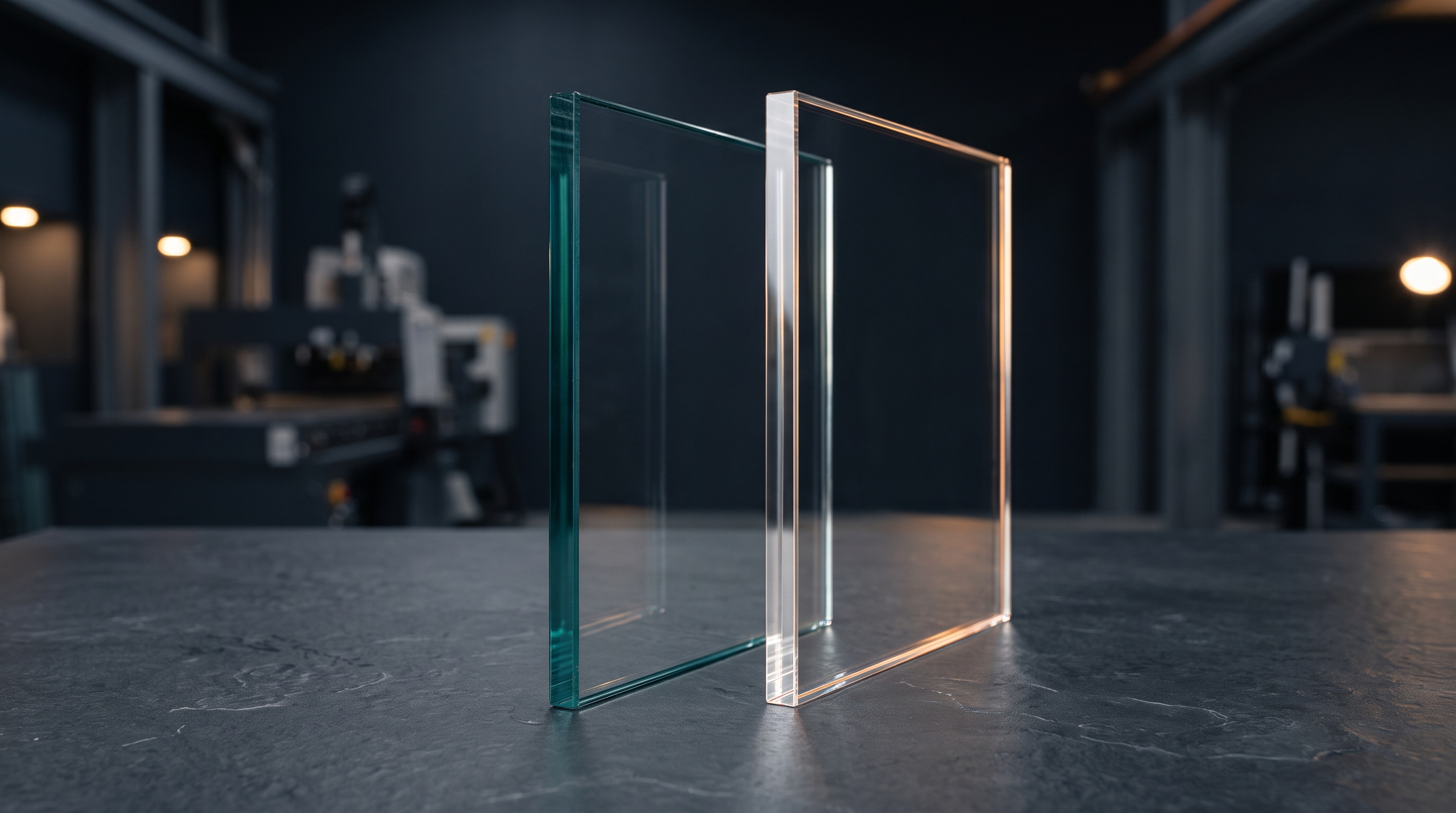
See It Side by Side: The Green Edge Test
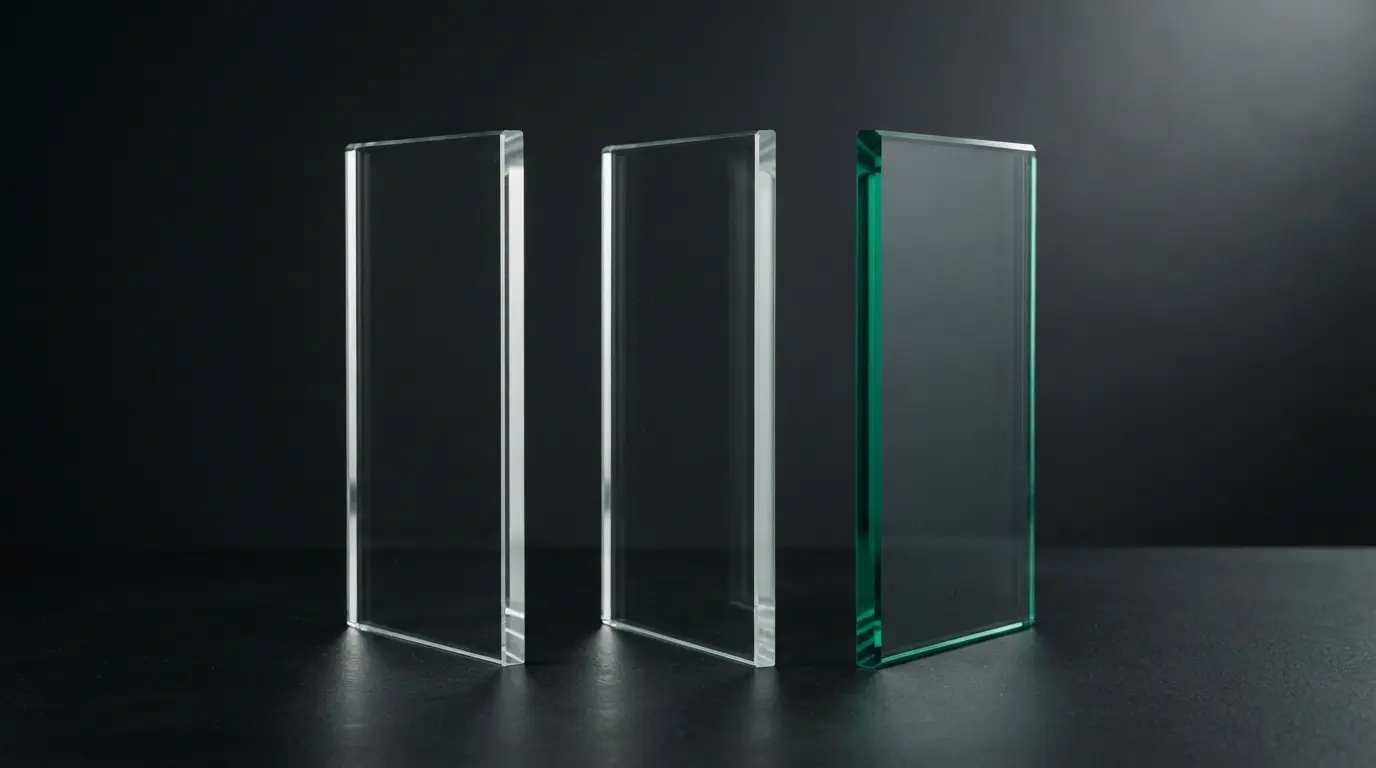
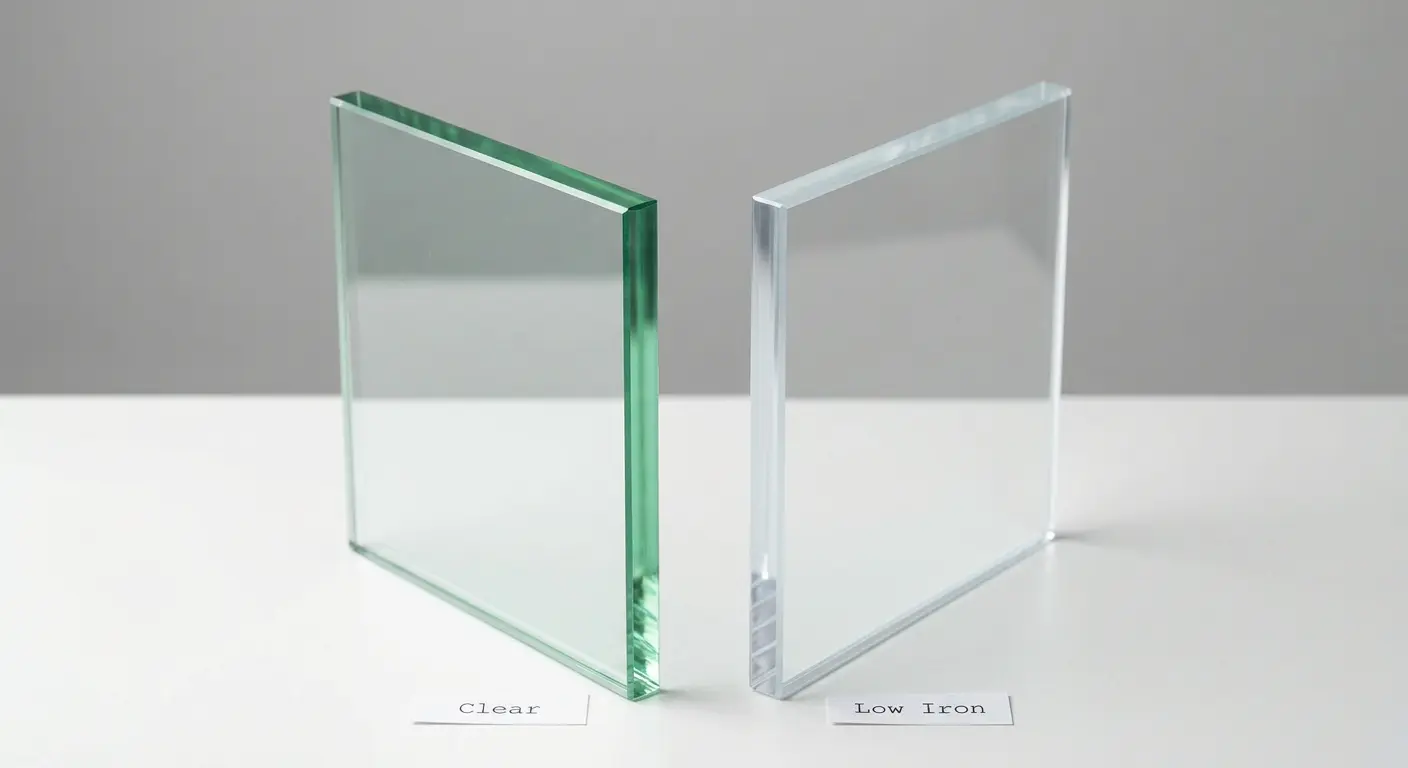
The fastest way to tell low iron from clear is the edge test. Stand both samples upright on a white surface, look at them from the side under daylight, and compare the color of light passing through the glass edge-on. Clear glass shows a progression from pale green at 6 mm to bottle-green at 19 mm. Low iron shows a near-colorless edge at every thickness, with only a faint cool tint at the thickest substrates.
The viewer below lets you flip through 6 mm, 10 mm, and 19 mm thicknesses and read how the edge color shifts for each. The 10 mm case is the one that trips up most interior designers who assumed clear was clear enough. Edge color at 10 mm is unmistakably green under showroom lighting and visibly degrades jewelry, cosmetic, and art displays.
Edge Color Viewer: Clear vs Low Iron
InteractiveChoose a glass thickness to see how the characteristic green edge of standard clear float glass intensifies with thickness, while low iron glass stays near-colorless at every thickness. Edge color comes from iron oxide (Fe2O3) in the glass; thicker glass means a longer light path and more absorbed red wavelengths.
Clear bottle-green edge, visible across a lit showroom
Very faint hint of blue-white at the edge
Why Clear Glass Is Not Actually Clear: The Iron Oxide Story
Soda-lime glass is roughly 72% silica (SiO2), 14% sodium oxide (Na2O), 10% calcium oxide (CaO), and a few percent of other oxides. Among those others is iron oxide (Fe2O3), present in standard clear float at roughly 0.08 to 0.12%. Iron is not added deliberately; it enters as a contaminant in the silica sand and other raw materials.
Iron oxide absorbs selectively in the red and near-infrared bands of the visible spectrum. The eye perceives this as a shift toward green. In a thin pane the shift is subtle. In a thick pane or a laminated stack the longer light path magnifies the absorption and the green becomes dominant at the edge.
Low iron glass solves this by starting from purified silica sand (iron content under 0.02%) and controlling other raw material inputs to keep total Fe2O3 under 0.015%. The result is a substrate with 2 to 6 percentage points higher visible light transmittance, a near-perfect color rendering index, and a near-colorless edge.
Light Transmittance: The 91% vs 83% Gap
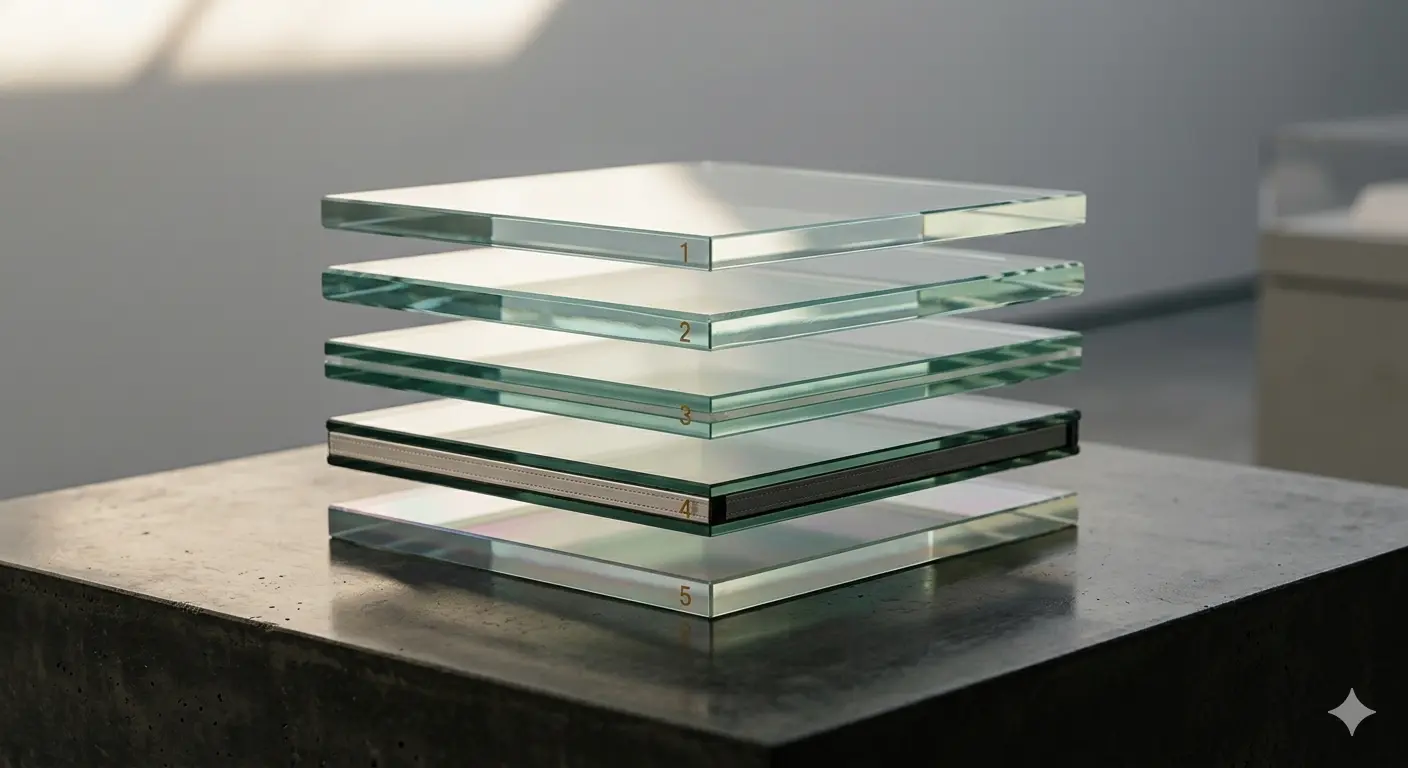
Visible light transmittance (VLT) is the single most-cited spec in low iron marketing. At 6 mm, standard clear is around 89% and low iron is around 91%. That 2-point gap sounds small until you add thickness or an interlayer. At a 10 mm monolithic pane the gap widens to roughly 4 points. At a 6-1.52-6 PVB laminated build-up (12.5 mm total) it is 5 points. At an IGU with soft-coat Low-E on surface 2, the Low-E coating dominates and the gap narrows again to around 4 points.
The comparator below walks through three representative constructions. Note how the Color Rendering Index (CRI) tracks the same pattern: low iron maintains CRI near 99 across constructions, which is why high-end retailers and museums specify it. For curtain-wall-grade IGUs with Low-E, the CRI gap narrows but is still perceptible to color-critical interior lighting designers.
Light Transmittance Comparator
InteractiveSwitch between a single pane, a PVB laminated build-up, and an IGU with Low-E. The low iron advantage shrinks when a Low-E coating is in the stack, because the coating dominates the optical story. The advantage grows in laminated glass because the longer light path magnifies the iron absorption.
Baseline comparison, no interlayer and no second lite.
Low iron gives roughly 2 percentage points more light at 6 mm.
Low iron hits near-perfect color fidelity; critical for displays and art.
Low iron lets slightly more solar heat through; a trade-off for warm climates without Low-E.
Reference values from factory QC datasheets. Actual numbers vary with coating supplier, batch, and measurement standard (EN 410 vs NFRC 300). Data verified: 2026-11.
Where Low Iron Earns Its 15 to 40% Premium
Low iron is the correct spec in these four scenarios:
- Edge-visible glass. Vitrines, display cases, museum frames, jewelry counters, back-painted spandrel used edge-first, floor glass, aquarium viewing panels. Anywhere the viewer sees the glass thickness, not just the glass face.
- Thick laminated or IGU build-ups. Any lami over 15 mm total, any IGU over 32 mm total. The compound thickness through two or three lites plus interlayers amplifies the green bias of clear.
- Color-critical displays. Luxury retail (handbags, cosmetics, watches), art galleries, high-end automotive showrooms, premium food retail (bakery, patisserie, meat counters). CRI below 97 shifts color on the goods.
- Transparent architecture. All-glass storefronts, glass fins, glass staircases, overhead glazing where the glass is seen edge-on from street level. In these builds low iron reads as a quality signal; clear reads as a cost cut.
Get a quote for this product
Where Clear Glass Is Still the Right Call
The industry has drifted toward specifying low iron by reflex. For a working factory selling into real projects, we think that is wasteful. Clear glass remains the honest choice in these cases:
- Spandrel glass with opaque back coating. The viewer never sees through the glass. Low iron is money burned.
- Standard commercial curtain wall with Low-E IGU. At 6 or 8 mm panes with a Low-E coating, the coating dominates the optical character and the iron content gap is barely perceptible from the sidewalk.
- Back-painted glass for kitchen or bath splashes. The paint reads through the glass face; iron edge color is not visible unless the installer chamfers the exposed edge.
- Industrial or warehouse glazing. Where the brief is daylight and weather closure, not aesthetic.
- Interior partitions with tempered 10 or 12 mm. If the design detail hides the edge in a floor shoe or ceiling channel, the green edge does not read; clear is 20 to 30% cheaper and performs identically.
The Real Cost Delta: Not Just Material
The low iron premium at the raw substrate is roughly 30 to 50% for a given thickness. In a finished panel the premium shrinks because processing adders (tempering, lamination, IGU assembly, edge polish, holes and notches) are the same for both substrates. A quick way to think about it: the thicker the glass and the simpler the processing, the closer the finished panel premium stays to the raw substrate premium. The thinner the glass and the heavier the processing, the more the premium gets diluted by shared process costs.
Try the calculator below with your real panel size, quantity, thickness, and processing to see the delta on your project. The numbers are FOB Wuhan benchmarks for Sincere Glass orders in late 2026; they will differ for other suppliers and other shipping terms, but the ratios are structural.
Cost Premium Calculator (Low Iron vs Clear)
InteractiveEnter panel size, quantity, thickness, and processing to see the absolute cost delta and percentage premium of specifying low iron instead of standard clear. Process adders (tempering, lamination) are the same for both products, so the premium is driven entirely by the raw substrate cost delta multiplied by total area.
- Panel area
- 2.88 m2
- Total area
- 144.0 m2
- Clear per m2
- $26.00
- Low iron per m2
- $33.00
- Clear total
- $3,744
- Low iron total
- $4,752
- Premium (USD)
- +$1,008
- Premium (percent)
- +26.9%
Reference pricing only; FOB Wuhan, 2026 Q3-Q4 benchmarks. Subject to spec, coating, order volume and FX. Not a formal quote. For a binding offer please request one through our contact form. Data verified: 2026-11.
Pricing note: All figures are 2026 reference pricing, FOB Wuhan factory, subject to formal quotation. Actual prices vary with glass thickness, coatings, panel size, order volume, and USD/CNY exchange rate at time of quotation.
Global Architectural Glass Building Codes Comparison
Download our 11-page reference covering US IBC/ASTM, EU EN, China GB, and Australia AS code requirements for tempered, laminated, insulated, and Low-E glass applications.
Procurement Reality: MOQ, Lead Time, Brand Tiers
Low iron glass procurement differs from standard clear in three practical ways that affect schedule and budget.
Brand tiers. The industry splits roughly into three price bands. Vitro Starphire and Pilkington Optiwhite sit at the top tier, priced at a 60 to 80% premium over the equivalent clear product and typically specified for North American and European flagship projects. Guardian UltraClear and NSG Pilkington Optiwhite sit in a middle tier at 40 to 60% premium. Chinese-sourced low iron (CSG, Xinyi, Taiwan Glass, and smaller fabricators who buy their raw substrate from these mills) sits at a 20 to 40% premium for equivalent optical performance. The spec sheet differences between tiers are measurable but small; the project brief dictates which tier is defensible.
MOQ and lead time. Standard clear is stocked almost everywhere. Low iron substrate is stocked by fewer mills and fewer fabricators carry it as inventory. Expect MOQ to be higher (typically a 20 ft container of processed panels, roughly 350 to 400 m2 of 10 mm) and lead time to be 1 to 2 weeks longer than clear. For jumbo sizes above our 3.3 m x 15 m furnace limit the lead time penalty grows further.
Verification. Because the price gap between low iron and clear is 15 to 40%, the temptation to substitute is real. Reputable factories (ours included) will supply the raw substrate mill test report (MTR) listing Fe2O3 content on request. For high-value projects the project team should specify MTR submission as a shipment release condition and keep sample panels on file for comparison.
| Attribute | Standard Clear | Low Iron |
|---|---|---|
| Raw substrate price delta | Baseline | +30 to 50% |
| Finished panel premium (typical) | Baseline | +15 to 40% |
| Practical MOQ (processed) | 1 pallet (roughly 20 m2) | 1 x 20 ft container (roughly 350 m2 of 10 mm) |
| Lead time (processed) | 3 to 4 weeks | 4 to 6 weeks |
| Jumbo panel availability | Up to 3.3 m x 15 m | Up to 3.3 m x 15 m (longer lead time) |
| Verification method | Not usually required | Request MTR; specify EN 410 VLT measurement as release condition |
Frequently Asked Questions
Already sold on low iron and now picking a brand? Compare Starphire against other low-iron options.
Frequently Asked Questions
Starphire (Vitro) and Optiwhite (Pilkington) are brand-name low iron glass products. The underlying material is the same category: soda-lime float glass with Fe2O3 content reduced to under 0.015% from the roughly 0.10% in standard clear. Chinese and other Asian producers (including Sincere Glass) supply low iron substrates that meet or beat the same optical specs at a different price tier.
Yes to both. Low iron glass tempers and laminates the same way as standard clear. The low iron substrate carries through the fabrication step, so a 10 mm low iron tempered panel has the same breakage behavior as a 10 mm clear tempered panel but keeps its near-colorless edge. Processing adders (tempering, PVB or SGP lamination) are identical to clear.
Low iron MOQ is typically higher than clear because fewer factories stock the raw substrate. For Sincere Glass the practical MOQ is a 20 ft container for processed low iron (approximately 350 m2 of 10 mm panels). Below that we can still quote but lead time stretches to 5 to 7 weeks while we batch with other low iron orders.
For in-stock substrates, lead time for processed clear glass is 3 to 4 weeks. Low iron typically runs 4 to 6 weeks because raw substrate inventory is thinner. For jumbo sizes above 3 m x 6 m, add 1 to 2 weeks to either timeline.
There is no dedicated ISO or ASTM standard for low iron glass. Low iron substrates are tested to the same optical and mechanical standards as standard clear: EN 410 for optical properties, EN 572 for soda-lime silicate float glass, and GB 11614 in China. The low iron designation refers specifically to iron oxide content; certifications cover the glass itself.
Three practical checks: compare the edge color of a sample to a known clear sample under daylight (clear shows green, low iron shows faint blue-white or near-colorless at 10 mm and up); request the raw substrate mill test report (MTR) from the factory, which lists Fe2O3 content; and if the project is high-value, specify third-party VLT and color measurement to EN 410 as a shipment release condition. Honest factories will provide the MTR without pushback.
Keep reading in the Low Iron cluster
- Low Iron Glass: The Complete Guide (Pillar) - what it is, where it belongs, when to specify it
- Architectural Glass Types: Buyer Guide - five families, nine products, one decision framework
- Sourcing Architectural Glass from China - supplier tiers, MOQ, QC, shipping
Products commonly specified with Low Iron substrate
Low Iron Glass
Ultra-clear float (<0.01% Fe2O3) up to 3.3m x 15m
View product →
Laminated Glass
PVB or SGP interlayer. Fragment-retention safety glass.
View product →
Tempered Glass
4–5× stronger than annealed. Jumbo panels up to 3m × 15m.
View product →
Insulated Glass (IGU)
Low-E coated, argon-filled. Energy-efficient glazing.
View product →

Li Cheng
CEO at Sincere Glass
CEO at Sincere Glass with 10+ years in architectural glass. Oversees production and quality at our 20,000 m2 Wuhan facility.
Technical review: Albar, Technical Lead
Need Custom Glass for Your Project?
Get a free quote from our engineering team. We'll help you choose the right glass type, thickness, and coating for your specific requirements.