Why interlayer selection is 15 to 40 percent of laminated glass cost
On a quote sheet, laminated glass looks like a single line item. In our Wuhan plant it is three line items glued together: two tempered glass lites and the interlayer in between. For a 6-0.76-6 clear laminate, the two glass lites account for roughly 85 percent of the FOB cost and the standard PVB interlayer carries the remaining 15 percent. Swap that same interlayer for a 1.52 mm SGP ionoplast and the interlayer share jumps to about 35-40 percent of the finished laminate. The glass has not changed; the economics have.
That is the practical reason buyers get burned on interlayer decisions. A specification that casually calls out "SGP interlayer" on a facade where standard PVB would meet every performance requirement can add 20 to 35 percent to the glass budget for zero project benefit. The reverse — specifying standard PVB on a frameless balustrade or a long-span overhead glass — can save 20 percent now and cost ten times that in year-three remedial work. The interlayer choice is small on paper and large on the invoice.
This article is the cost-driven decision chain we walk our export buyers through. We start with the raw material economics, then layer in the performance each type actually buys, then map specific project types to the right pick. If you want the manufacturing backstory first, read How laminated glass is made before coming back here.
The material economics of PVB vs SGP
PVB (polyvinyl butyral) has been the dominant architectural interlayer since the 1960s. The world's three main suppliers — Eastman (Saflex), Kuraray (Trosifol), and EVERLAM — produce it in multi-thousand-tonne annual volumes. Standard 0.76 mm PVB currently runs an FOB-China interlayer cost of around USD 3 per m² of laminate, with acoustic PVB (a trilayer with a softer core) running about USD 5 per m². Price moves with the resin index, not with the project.
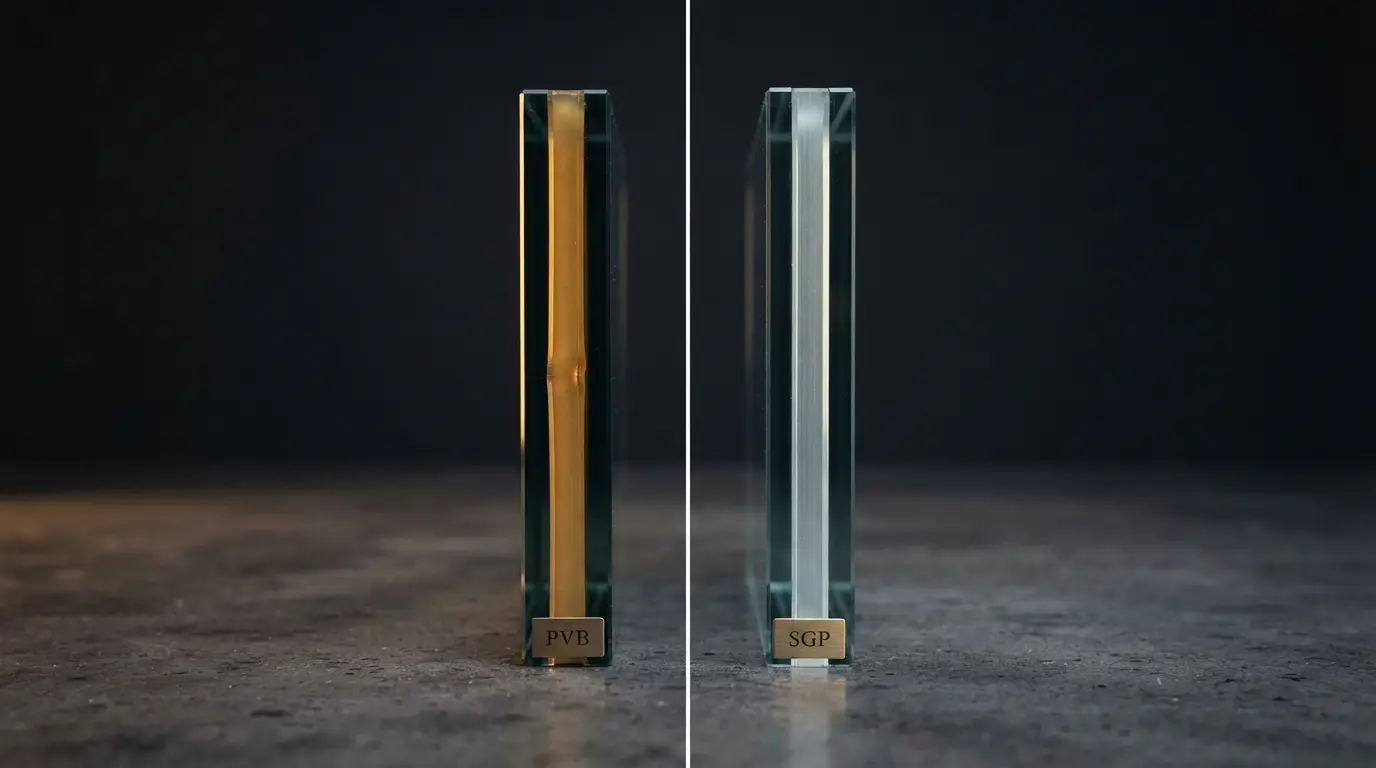
SGP (SentryGlas, now a Kuraray product line) is a different polymer family: an ionoplast rather than a vinyl. The chemistry gives it 100 times the shear modulus of PVB at 24-hour load, plus near-permanent chemical bonding to the glass. The trade-off is cost — around USD 13 per m² of laminate at 1.52 mm, roughly 4 times standard PVB — and stock. SGP is produced at far lower volumes than PVB, lead times to our Wuhan line can stretch to 3 weeks on uncommon thicknesses, and the autoclave cycle itself runs about 30 percent longer.
A quick way to orient yourself: the interlayer alone is PVB at USD 3, acoustic PVB at USD 5, and SGP at USD 13 per m². Those three numbers do more work than any datasheet.
Material cost reference
| Build-up | Glass (2 lites) | PVB | Acoustic PVB | SGP |
|---|---|---|---|---|
| 6+6 mm | $22 | $25 | $27 | $35 |
| 8+8 mm | $30 | $33 | $35 | $43 |
| 10+10 mm | $40 | $43 | $45 | $53 |
| 12+12 mm | $52 | $55 | $57 | $65 |
Calculate your interlayer cost delta
The calculator below sits on top of a simple model with three inputs: the glass build-up (two symmetric lites), the interlayer type, and the order area in square meters. It multiplies the FOB per-m² glass index by two, adds the FOB per-m² interlayer index for the type you pick, and compares that number against a standard-PVB baseline at the same build-up. The output tells you both the per-m² subtotal and the dollar premium — or saving — across the whole order. It is a planning estimate, not a quotation; actual contract prices depend on panel size, order volume, specification detail, and the current float-glass and interlayer markets.
Calculate your FOB interlayer cost and SGP premium
Estimates based on 2026 Wuhan FOB float-glass and interlayer indices. Switch any input to see the delta against a standard PVB baseline.
Typical container: 300-400 m² of 10+10 laminated.
- Glass (2 lites)
- $40.00 /m²
- Interlayer
- $3.00 /m²
- FOB subtotal
- $43.00 /m²
- Order total (300 m²)
- $12,900
Standard PVB is the reference. Switch to Acoustic PVB or SGP on the left to see the exact cost delta for this build-up and order size.
Default safety interlayer. Nonstructural at long duration.
Pricing note: All figures are 2026 reference pricing, FOB Wuhan factory, subject to formal quotation. Actual prices vary with glass thickness, coatings, panel size, order volume, and USD/CNY exchange rate at time of quotation.
What SGP actually delivers for the premium
The question we get most often is: why would anyone pay 4 times the interlayer cost? The short answer is three things that PVB cannot deliver at any thickness.
Composite action under long load. At 24-hour load and room temperature, PVB has a shear modulus of roughly 0.6 MPa — soft enough that the two glass lites behave almost independently. SGP sits at 65 to 100 MPa, nearly two orders of magnitude stiffer, and the laminate acts as a single composite plate. For a given thickness, that composite action can halve the deflection of a structural glass fin, a canopy, or a frameless balustrade. The analysis method is spelled out in ASTM E1300's effective thickness approach.
Post-breakage retention. When both lites of a PVB laminate crack, the PVB stretches and the panel sags visibly within minutes — the fragments stay in place but the panel is structurally finished. SGP, bonded chemically to the glass surface, keeps a cracked panel standing rigid for hours. In our bench tests at the Wuhan plant a 10-1.52-10 SGP balustrade panel, broken on both lites with a center-impact test, stayed cantilevered within its base shoe for the duration of the inspection — more than 4 hours. The same panel in PVB had sagged visibly before we finished taking photos.
Edge durability. PVB is hygroscopic — it absorbs moisture — and at an exposed edge in a humid or coastal climate it will cloud and then delaminate within 3 to 7 years. SGP is hydrophobic. Open-edge SGP details have been in service in tropical Asia for 15 to 20 years without visible edge degradation. If the spec includes exposed edges or the climate is humid, SGP is often not a performance upgrade — it is the only option that will survive the warranty period.
What SGP does not do: it is not an acoustic upgrade. Standard PVB outperforms SGP at the same build-up on STC rating; acoustic PVB outperforms both. If the driving requirement is noise, SGP is the wrong tool.
Performance per dollar, side by side
Five metrics decide most interlayer specifications in practice: post-breakage retention, long-duration shear modulus, edge weathering, STC rating at a reference 6+6 build-up, and interlayer material cost itself. The matrix below plots all five across the three interlayer types using indicative values from our Wuhan line and published supplier datasheets. SGP wins decisively on retention, stiffness, and edge durability. Standard PVB wins on cost. Acoustic PVB wins on STC. No interlayer wins on everything — which is why this article exists.
What each interlayer actually delivers for its price
Five metrics on one axis, three interlayers on the other. SGP wins on structural and durability metrics by a factor of 10 to 100; acoustic PVB wins on STC; standard PVB wins on cost. Click a column header to highlight that interlayer across every row.
How long a doubly-cracked panel stays rigid without sagging, bench test at 23 °C.
Long-duration stiffness. Decides whether the laminate acts as a composite plate or two slipped sheets.
Open-edge service life before delamination becomes visible, humid or coastal exposure.
Sound Transmission Class at the reference 6+6 build-up. Higher = quieter.
FOB China 2026 index, interlayer material only (not finished laminate).
Shear modulus bar uses log scaling so PVB values remain visible against SGP. All other metrics are linearly scaled against the row maximum. Values are typical factory bench references, not design values.
Six real-world specification scenarios
Abstract trade-offs land better against concrete projects. Here are six scenarios from the last two years of our export work, with the interlayer we specified and the reason.
- Office tower facade, 6 to 12 story commercial. Standard PVB laminated outer lite in Low-E IGU. Driving reason: safety glazing with no structural or acoustic premium required. SGP would add roughly 25 percent to the facade glass budget for no measurable project benefit.
- Frameless mezzanine balustrade, public building. 10-1.52-10 SGP laminated, heat-soaked. Driving reasons: cantilever load case plus EN 12600 Class 1(B)1 impact plus open-top edge detail plus 15-year warranty requirement. Standard PVB would meet none of these. Read our balustrade specification guide for the full load-case math.
- Overhead glass canopy, 2.4 m span. 8-1.52-8 SGP, heat-soaked. Driving reasons: overhead safety requires both lites fully retained post-breakage, and the span is too long for PVB composite action under snow load. SGP is the default for overhead structural glass in every code we work to.
- Airport-adjacent office partition. 6-0.76-6 acoustic PVB. Driving reason: STC 40 target drove the choice. Standard PVB maxed out at STC 36 in the mock-up test; SGP tested at 35 and failed; acoustic PVB delivered 39-40 on the specific glass build-up. Pure acoustic-driven selection, cost difference was secondary.
- Coastal villa frameless shower enclosure. 10 mm monolithic tempered, not laminated. Driving reason: enclosed edge-sealed detail with gaskets removed the humidity issue, and a single-ply tempered meets the thickness and safety spec. This is a case where neither PVB nor SGP are the answer — a reminder that not every project needs a laminate. See our shower glass thickness guide for the full decision tree.
- Museum display case, high-value exhibit. 12-1.52-12 SGP laminated, low-iron glass. Driving reasons: curator required a 20-year warranty against delamination and the specification called for structural glass fins supporting cross-panels at open-edge joints. Standard PVB would have failed the warranty requirement and the open-edge detail.
Match your project to the right interlayer
The matcher below takes those six scenarios and generalizes them into a weighted question flow. Each of the six questions — application type, panel span, load case, long-term edge exposure, acoustic target, and warranty period — contributes points to the score of each interlayer. The matcher does not let any single question decide; the final recommendation is the highest-scoring interlayer across all six answers. If you want to challenge the output, change one answer at a time and watch the score band shift.
Match your project to the right interlayer
Answer six scoped questions and the matcher returns Standard PVB, Acoustic PVB, or SGP based on a weighted score across all answers. No single question decides the result on its own.
What is the primary application?
What is the free span of the panel?
What governs the load case?
What is the long-term edge exposure?
What is the acoustic requirement?
What edge warranty does the spec require?
Answer all six questions above to see the recommendation. Currently 0 of 6 answered.
Hidden costs most buyers miss
The interlayer line on a quotation is the visible part of the cost. Three line items that rarely appear on the quote matter just as much:
Edge sealing. A PVB laminate at an exposed edge in a humid environment typically needs a structural silicone edge seal to delay delamination — add roughly USD 2 to 4 per linear meter of edge, plus the labor to apply it on site, plus the inspection regime. An SGP laminate at the same edge needs no sealant. On a project with 300 linear meters of exposed-edge glass, that is a USD 600 to 1,200 line item that silently disappears in the SGP scenario. Spec it in the comparison or you will under-price PVB.
Delamination risk and warranty remediation. We have replaced open-edge PVB balustrade panels in year 4 to 6 of service on three projects. The replacement glass is a small fraction of the all-in cost — removal, replacement, scaffolding, downtime, and consultant fees typically run 3 to 5 times the glass itself. Baking in a reasonable probability of early PVB replacement in a humid open-edge detail usually swings the lifetime cost toward SGP.
Panel-size uplift from thinner build-ups. SGP composite action often lets you specify a thinner laminate for the same deflection target. A 10-1.52-10 PVB balustrade may need to become 12-1.52-12 to meet the deflection limit; the same panel in SGP can stay at 10-1.52-10 and still pass. The thinner SGP panel weighs less, costs less to ship, and sometimes allows slimmer hardware. Add this effect to your comparison when the glass is structurally loaded, not just safety-glazed.
A lifecycle ROI framework
A fair cost comparison looks at year 0 (purchase and install), year 5 (first likely PVB edge issue in a humid detail), and year 15 (SGP warranty horizon). On a frameless balustrade project with exposed edges, the typical ten-year cost math our export buyers see is:
- PVB laminate year 0: lowest cost. Year 5: likely edge delamination on a fraction of panels; remediation cost often matches 30-50 percent of original glass budget. Year 10: full re-glaze increasingly likely.
- SGP laminate year 0: 20-30 percent cost premium at the glass line item, offset partly by thinner build-up and no edge sealant. Year 5: no edge issue. Year 10: no edge issue, well inside the warranty horizon.
The framework we use with clients is simple: if the application is structural or safety-critical, or if the edge is exposed or the climate is humid, or if the warranty is 10 years or longer, SGP nearly always wins on lifecycle cost even where PVB wins on day 0. Everywhere else — framed facade IGUs, interior partitions, dry-interior safety glazing — standard PVB is the right call. The grey zone is the 1.5 to 2.5 m span, medium-load, moderate-exposure project; that is exactly where the matcher above earns its keep.
Free: Global Architectural Glass Building Codes Comparison
A side-by-side 11-page PDF covering US IBC, EU EN, China GB, and Australia AS requirements for laminated glass across all common applications. Free for architects, specifiers, and procurement teams.
For the pillar view of how this product-level decision fits into a complete architectural glass specification, see our architectural glass specification guide.
Frequently Asked Questions
Yes, and we recommend it. On a typical commercial project the balustrade and overhead glass need SGP for structural and safety reasons, while facade IGU and interior partitions are better served by standard PVB on cost grounds. Our Wuhan line runs both daily, and consolidating the order under one supplier means matched glass tint across marks, consistent certification paperwork, and a single bill of lading.
SGP material is often stock-limited and the autoclave cycle is longer, so our standard MOQ for SGP export orders is 200 m². Standard PVB laminated runs at 100 m² MOQ. Below those thresholds, interlayer material lead time or line-change-over cost makes the per-m² price step up noticeably.
Standard PVB laminated ships 25-35 days from PO. SGP typically runs 35-45 days: SGP material lead time at the supplier (Kuraray or Trosifol) is 2-3 weeks longer, and the SGP autoclave cycle is approximately 30 percent longer than PVB. For time-critical orders we recommend placing the SGP material reservation at PO signing rather than at production start.
For balustrade, overhead, and any safety-critical application, yes. Heat-soak (EN 14179) does not change the SGP decision but is non-negotiable for the glass itself in those applications. Spontaneous NiS failure in a bonded SGP laminate takes a structural panel out of service with no warning, and the ~15 percent heat-soak cost premium eliminates that risk.
Both PVB and SGP laminated architectural glass classify under HTSUS 7007.29 (laminated safety glass, other). The MFN duty rate is 4.9 percent at the time of writing. The interlayer type does not change the HTS classification. Always verify the current rate at hts.usitc.gov before building a landed-cost estimate.
No. Standard PVB laminates can be de-laminated and the glass recycled with established industrial processes. SGP ionoplast forms a near-permanent chemical bond with the glass surface; a cracked SGP laminate goes to landfill or construction aggregate rather than back into the float-glass stream. This matters for projects with embodied-carbon or circular-economy specifications — raise it with your sustainability consultant early.
Products referenced in this article


Li Cheng
CEO at Sincere Glass
CEO at Sincere Glass (欣城玻璃) with 10+ years in architectural glass. Oversees production and quality at our 20,000 m² Wuhan facility.
Technical review: Albar, Technical Lead
Need Custom Glass for Your Project?
Get a free quote from our engineering team. We'll help you choose the right glass type, thickness, and coating for your specific requirements.