Twelve-millimeter tempered is the default on more balustrade, storefront, and canopy drawings than any other single thickness. Not because it is the strongest glass we make, but because it sits at a specific intersection of structural capability, panel-size envelope, and cost that is hard to beat for mid-weight architectural work. This guide pulls together, from our Wuhan production line, what buyers need to decide and specify when they land on 12mm: the panel-size limits that depend on how the glass is supported, the tolerance and quality markers that separate a code-compliant 12mm from a borderline one, and the cost factors that move a quotation by 30 to 50% before the raw-glass price has changed.
Why 12mm is the specification sweet spot
Thickness in architectural glass is not a smooth dial. It is a step function governed by standard float production (3, 4, 5, 6, 8, 10, 12, 15, 19 mm) and by the span limits each thickness clears. In our 20,000 m^2 Wuhan facility, 12mm is where three thresholds converge at once: it clears the National Glass Association (NGA) and GB 15763.2 structural minimums for 1,100 mm free-standing balustrades under typical infill-load conditions, it stays within comfortable deflection for storefront spans up to about 3 m without laminating, and it keeps panel weight at 30 kg/m^2 - heavy but still within reach of a two-person installation crew without lifting equipment.
Below 12mm the structural envelope narrows quickly. 10mm tempered glass handles smaller balustrades and standard storefronts but needs assistance (laminating, interlayers, or additional support) once panels exceed roughly 2.4 m in free span. Above 12mm the glass handles more load but doubles handling cost, requires roughly 25% more energy per tempering cycle, and ships in fewer panels per container. 12mm earns its default-choice status by covering the widest range of common architectural specifications before any of these cost or logistics penalties kick in.
The 12mm performance envelope
Tempered glass is specified by the surface compressive stress locked in during the quench, a measure of how much energy is stored in the surface layer that resists tension. GB 15763.2-2005 §5.2.1 requires a minimum of 90 MPa for architectural tempered. Our standard 12mm cycle delivers 95 to 110 MPa, verified with a differential surface refractometer on sampled panels. That stress level is what gives 12mm tempered a break load of roughly 36 kN/m^2 (about 4 to 5x annealed glass of the same thickness) and what produces the characteristic small-cuboid fragmentation pattern when the panel does break.
Weight at 12mm is 30 kg/m^2 (float glass density is 2,500 kg/m^3). This matters more than most spec sheets suggest: a 2 x 3 m 12mm panel weighs 180 kg, which is the practical ceiling for two-person installation without a vacuum lifter. Larger-area 12mm projects should budget suction-cup lift equipment on site, which affects the installer quote as much as the glass itself.
How the comparator works: the component below lets you cycle through five metrics - break load, maximum panel area, weight per square meter, relative cost index, and acoustic STC - across six standard tempered thicknesses (6, 8, 10, 12, 15, and 19 mm). Each bar scales to the maximum value in the current metric. Clicking a thickness pins its row, with the detail card showing the exact figure and the typical architectural use at that thickness. Values are indicative based on GB 15763.2 physics (density 2,500 kg/m^3, 90 MPa minimum surface stress) and horizontal 4-edge support with no wind load for max-area. Real project limits are driven by the specific support condition and load case.
Thickness performance comparator
Pick a thickness and a metric to compare across the full range we temper.
Typical use at this thickness: 1.1 m balustrades, canopies, large storefronts
Indicative values based on GB 15763.2-2005 physics (density 2500 kg/m^3, 90 MPa minimum surface compressive stress) and horizontal 4-edge support with no wind load for max-area. Real project limits are driven by the specific support condition and load case.
Maximum panel size at 12mm
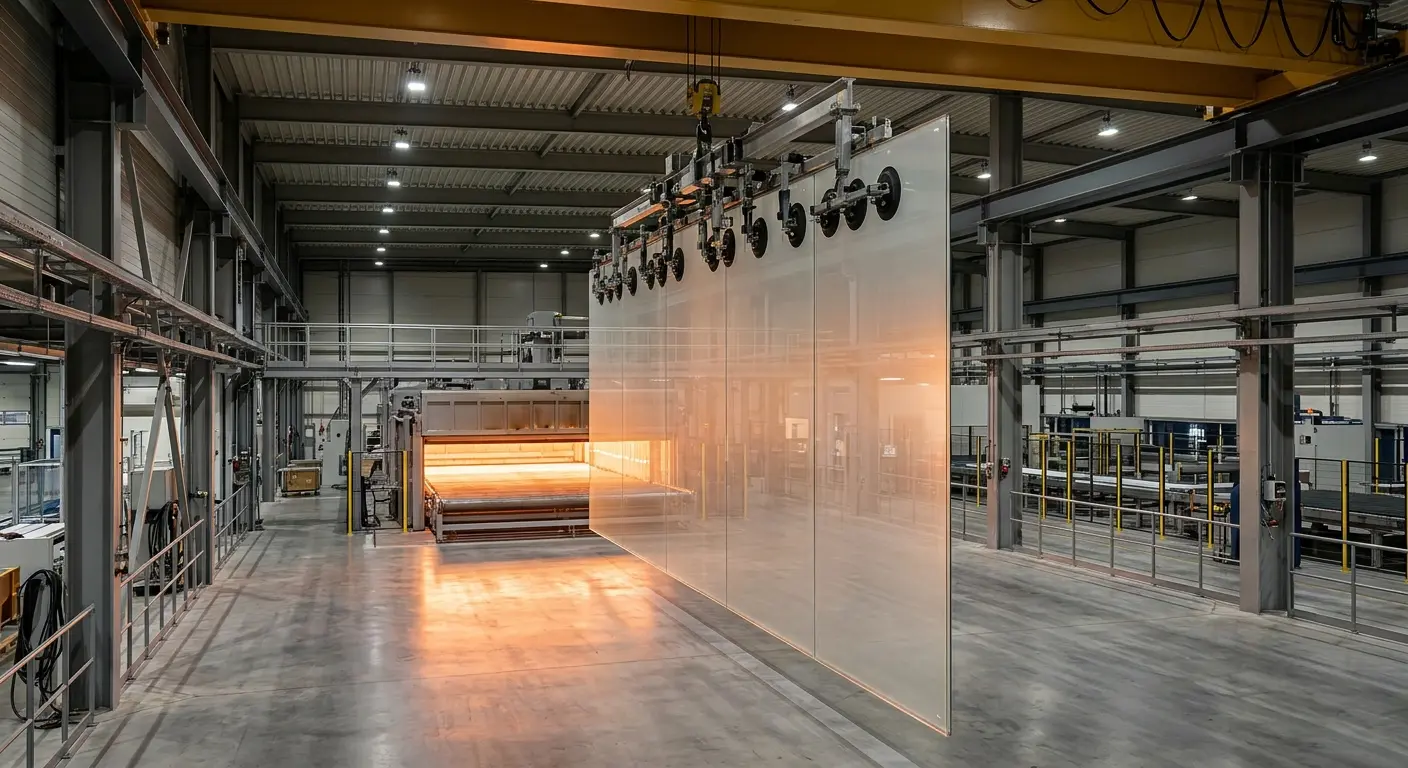
Our tempering furnace envelope is 3,000 x 15,000 mm, among the largest in Hubei province and matched on the laminating side by a 3 x 15 m autoclave for projects that combine jumbo tempering with safety lamination. What the physical envelope allows and what a specific project should actually specify are different numbers, though. Panel-size limits for 12mm tempered depend on three things: how the glass is supported at the edges, the wind-load class of the installation, and the acceptable deflection limit (typically span/60 for infill, span/175 for edge-supported curtain-wall glass per GB 50113 and EN 13830).
How the calculator works: the component below holds thickness at 12mm and takes two inputs: the support condition (4-edge framed, 2-edge clamped, or point-fixed via spider fittings) and the wind-load class (low below 1.0 kPa, medium 1.0 to 2.5 kPa, high above 2.5 kPa typical of coastal and high-rise installations). It returns the indicative maximum width, height, and panel area for that combination, flags whether the result stays within our 3,000 x 15,000 mm production envelope, and surfaces a short note on the governing failure mode (deflection, edge-to-hole spacing, or rotation at fixings). Values follow GB 15763.2-2005 §5 and ASTM E1300 principles. A structural engineer should still verify the specific wind, support, and deflection limits of your project.
Max panel size calculator (12mm tempered)
Pick a support condition and wind-load class to see the indicative dimensional envelope for 12mm single-pane tempered.
Our 3,000 x 15,000 mm jumbo envelope (tempering furnace and lamination autoclave both support this size).
Indicative only, based on GB 15763.2-2005 §5 and ASTM E1300 principles. A structural engineer should verify the specific wind, support, and deflection limits for your project before procurement.
Thickness tolerance and surface quality
"12mm" from a reputable factory is not exactly 12 mm. It is 12 mm within a defined tolerance band. GB 15763.2 inherits the thickness tolerance from GB 11614 (float glass), which allows plus/minus 0.3 mm for 10 to 12 mm nominal thickness and plus/minus 0.5 mm for 15 to 19 mm. EN 572-2 is tighter at plus/minus 0.2 mm for 12 mm float. If you are specifying for a tight glazing pocket, confirm which standard the quotation references. Our export shipments default to EN tolerance for European and Middle-Eastern destinations, GB tolerance for projects where domestic Chinese code applies.
| Standard | Tolerance | Clause reference |
|---|---|---|
| GB 11614-2009 (China float, inherited by GB 15763.2) | plus/minus 0.3 mm | GB 11614 §4.2 Table 2 |
| EN 572-2:2012 (European float) | plus/minus 0.2 mm | EN 572-2 §5.2 Table 2 |
| ASTM C1036-21 (US flat glass) | plus/minus 0.4 mm (Class 1) | ASTM C1036 §4.2 Table 4 |
Surface quality on tempered glass is governed by the same visual-inspection standards as float: GB 11614 §5 for China, EN 572-8 for Europe. The two defects we see most often on 12mm shipments inspected before loading are roller-wave distortion (an optical ripple from the tempering furnace rollers, worse at thicker gauges) and edge nickel-sulfide inclusions. In our 20,000 m^2 Wuhan plant we accept roller-wave peak-to-valley within 0.1 mm per EN 12150-2 §5.2, and we heat-soak 12mm destined for frameless structural installations (overhead canopies, balustrades, point-fixed) to pre-fail panels carrying NiS inclusions on the ground rather than in the field.
Thermal and acoustic performance
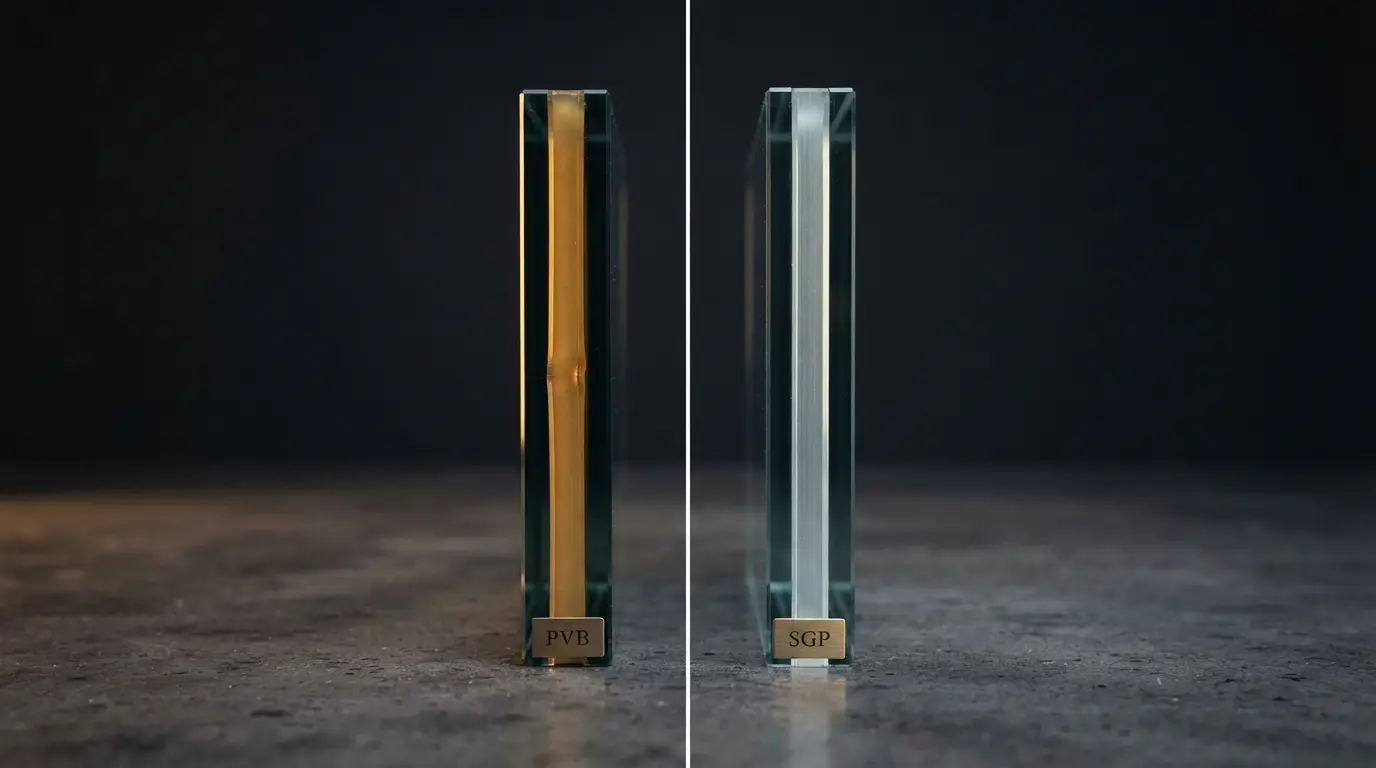
Monolithic 12mm tempered has essentially the same thermal and acoustic performance as 12mm annealed. Tempering changes the glass's structural behavior, not its heat-transfer or sound-transmission properties. U-value for monolithic 12mm is approximately 5.6 W/m^2.K (per EN 673), and single-pane STC is around 34 (per ASTM E90 lab testing). These numbers only improve substantially when 12mm is used as a component in an insulated glass unit (IGU) with a Low-E coating and argon fill, or when it is laminated with a PVB or acoustic PVB interlayer in a laminated glass assembly.
For projects where thermal insulation matters, 12mm tempered is typically specified as the outer or inner lite of an IGU rather than monolithic. A 12 + 12A + 6 IGU with Low-E on surface 2 can push U-value below 1.6 W/m^2.K. For acoustic-critical applications, 10mm tempered laminated with 1.52 mm acoustic PVB on top of 12mm tempered reaches STC 42 to 45, which is the practical ceiling without going to triple glazing.
Where 12mm is specified
The applications we see 12mm tempered specified for most often in our export order book:
- Frameless balustrades up to 1,100 mm high — code-compliant to GB 50352 and most IBC jurisdictions for infill load. See our balustrade glass specification guide for load cases and tier selection.
- Long-span canopies and awnings — single-pane 12mm up to 2.5 x 4 m with proper point-fixing hardware.
- Large-area storefronts and display windows — single-pane up to about 2.4 x 3 m without laminating.
- Shower doors and bath partitions over 2 m tall — stepping up from the typical 10mm shower spec when height or width demands more stiffness.
- Glass fins and structural glazing — as a component in laminated fin build-ups, where 12 + 12 or 12 + 15 laminates handle wind loads on curtain-wall fins.
- Jumbo single-pane display walls — our 3 x 15 m envelope at 12mm covers luxury retail flagships, auto showrooms, and museum vitrines in a single pane.
- IGU outer or inner lite — for projects where the outer glass carries wind load and the inner lite is thinner or laminated.
Edges, holes, and cutouts
Everything that modifies the glass must happen before tempering. The surface compressive stress locked in by the quench cannot be re-shaped. For 12mm, three processing categories drive both cost and lead time.
Edges. As-cut edges are not acceptable for architectural tempered. The micro-cracks from scoring become stress concentrators in the quench and raise in-furnace breakage risk. Standard edge treatment is ground (seamed and chamfered, typical for framed glass), with polished edges (flat-polished, pencil-polished, or beveled) for exposed-edge applications like frameless balustrades and shower doors. Ground edges add roughly 8% to the base cost, polished add roughly 18%.
Holes and cutouts. Point-fixing holes, hinge cutouts, and lock holes are drilled before tempering. GB 15763.2 §5.5 and FGIA industry guidance require edge-to-hole distance greater than or equal to 2x glass thickness (minimum 24 mm for 12mm) and hole-to-hole spacing greater than or equal to 2x thickness. Hole diameter should not exceed one-third of panel width. Each additional hole adds machining time and raises the risk of in-furnace breakage, so holes directly affect both the per-panel price and the yield assumption we build into project pricing.
CNC shapes. Curved cuts, notches, and non-rectangular shapes require CNC water-jet or diamond-wheel profiling before tempering. Shape complexity does not scale linearly. A simple arc adds about 12% to the baseline, while complex radii and interior cutouts can double the processing time per panel. We quote these from your DWG shop drawings, not from written descriptions.
Free: 12mm tempered edge and hole detail reference
A printable DWG-compatible reference showing GB, EN, and ASTM edge-to-hole clearances, hinge-cutout templates, and standard point-fixing dimensions for 12mm tempered glass projects.
Certifications for 12mm tempered
Every 12mm tempered panel we ship carries a certificate of conformity to GB 15763.2-2005, the Chinese national standard for architectural safety glass, backed by our factory's China 3C (CCC) certification. For export destinations we can arrange additional conformity marking at the time of order:
- CE marking to EN 12150-2:2019 — required for construction products placed on the EU market under Regulation (EU) No 305/2011 (CPR). Includes AVCP System 3 documentation (manufacturer DoP plus notified-body initial type testing).
- ANSI Z97.1-2015 Class A — US safety glazing voluntary standard for architectural tempered. Required by reference in IBC 2021 §2406.1 for hazardous locations.
- CPSC 16 CFR 1201 Category II — mandatory US federal safety glazing standard for shower doors, railings, and glass in the slide path of doors.
- AS/NZS 2208:1996 — Australian/New Zealand safety glazing standard, verified by SAI Global certification.
- SGS or BV third-party inspection reports — pre-shipment verification of fragment count, surface stress, and dimensional compliance (buyer-paid service).
Cost drivers for 12mm orders
The quoted price per square meter for 12mm tempered is roughly 2x that of 6mm tempered, but the raw-glass cost explains less than half of the gap. The rest sits in the processing and handling line items that buyers often skim past on quotations. Three categories drive 90% of the variance between a cheap 12mm quote and an expensive one: edge treatment (as-cut vs ground vs polished), hole and cutout count, and shape complexity.
How the breakdown works: the component below shows the cost structure of a standard 12mm tempered panel as a stacked bar - raw 12mm float at 42% of baseline, tempering cycle at 28%, QC and packaging at 16%, and factory handling and overhead at 14%. Three toggles let you add typical processing surcharges: edge treatment (as-cut 0%, ground +8%, polished +18%), hole or cutout count (none 0%, 1 to 4 holes +6%, 5+ or cutouts +15%), and shape (rectangle 0%, CNC or curved +12%). The output is a relative multiplier against a plain-rectangle baseline, not a currency figure. Real pricing moves with panel size, order volume, and the current float-glass market.
Cost factor breakdown (12mm tempered)
Relative cost structure. Plain rectangle with ground edges and no holes = baseline 1.00. Toggle options to see the multiplier.
Shown as a cost index, not currency. Actual pricing depends on panel size, order volume, and the current float-glass market. Baseline uses our 2026 standard tempering line cycle at the Wuhan facility.
Pricing note: All figures are 2026 reference pricing, FOB Wuhan factory, subject to formal quotation. Actual prices vary with glass thickness, coatings, panel size, order volume, and USD/CNY exchange rate at time of quotation.
When to go thinner or thicker
12mm tempered is a strong default, not an only answer. Four scenarios where we routinely recommend buyers specify something other than monolithic 12mm:
- Downsize to 10mm tempered-laminated (10.76 or 11.52 mm overall) for overhead glazing, balustrades, and shower doors. The lamination adds fragment retention that monolithic 12mm does not have. In many jurisdictions this is required by code for overhead use, not optional. See our tempered vs laminated comparison for the full decision matrix.
- Downsize to 10mm tempered for storefronts under 2.2 m free span and balustrades at 900 mm or lower. Lighter, cheaper, and structurally sufficient.
- Upsize to 15mm tempered for structural glass fins, pool fencing over 1.2 m, and point-fixed canopies with wind load above 2.5 kPa. The step in bending stiffness is non-linear and worth the cost at these spans.
- Upsize to 19mm tempered for walk-on floor glass, long-span structural fins, and heavy balustrades at exposed-edge heights. 19mm is the standard for structural glass flooring, usually laminated for fragment retention.
The tempered vs annealed comparison covers when any tempered thickness is overkill (small decorative applications, interior partitions below code hazard-location thresholds) and when a thinner heat-strengthened or annealed panel is actually the correct choice.
For the pillar view of how this product-level decision fits into a complete architectural glass specification, see our architectural glass specification guide.
Frequently Asked Questions
Our standard MOQ for export is one 20-foot container, which fits approximately 18 to 22 tonnes of 12mm tempered depending on panel sizes and crating. Mixed-thickness orders are accepted. For projects under one container, we can quote LCL (less-than-container) consolidation to common ocean hubs.
Standard production cycle for 12mm tempered is 10 to 15 working days from order confirmation and deposit, assuming raw float is in stock (which it typically is for 12mm clear). Add 3 to 5 days for polished edges, 2 to 4 days for holes or cutouts, and 7 to 10 days for inland transport and port handling before loading. A single-container order to Shanghai or Ningbo port is usually ready to sail within 25 to 30 days of PO.
Yes, within tempering constraints. CNC-cut shapes, countersunk holes, notches, and cutouts are all processed before the tempering cycle. Tempered glass cannot be modified after the quench. Per GB 15763.2 §5.5, edge-to-hole distance must be at least 2x the glass thickness (24 mm minimum for 12mm), and hole-to-hole spacing must also be at least 2x thickness. We confirm feasibility against shop drawings before cutting.
Every shipment is accompanied by a certificate of conformity to GB 15763.2-2005 (Chinese safety glazing standard) and a copy of our China 3C (CCC) certificate. On request, we provide fragment-count test photos per sampled lot, surface compressive stress readings, SGS or BV third-party inspection reports (buyer-paid), and CE marking documentation to EN 12150-2 when the destination requires it. ANSI Z97.1 and CPSC 16 CFR 1201 certification can be arranged with additional lead time.
We quote per square meter for the glass itself, with surcharges itemized by edge treatment, holes, CNC shapes, and packaging class. Every quotation includes an itemized breakdown so you can see what each option adds. Volume breaks apply at full-container, two-container, and project-scale orders. Request a quotation through our contact form and we return it within one working day.
Free: Global Architectural Glass Building Codes Comparison
A side-by-side 11-page PDF comparing US IBC, EU EN, China GB, and Australia AS requirements for tempered glass across all common applications. Free for architects, specifiers, and procurement teams.
Products referenced in this article


Li Cheng
CEO at Sincere Glass
CEO at Sincere Glass (欣城玻璃) with 10+ years in architectural glass. Oversees production and quality at our 20,000 m² Wuhan facility.
Technical review: Albar, Technical Lead
Need Custom Glass for Your Project?
Get a free quote from our engineering team. We'll help you choose the right glass type, thickness, and coating for your specific requirements.