The 30-second verdict
If you are heating the building more than you are cooling it, triple pane pays off. Specifically: if your location sits in IECC climate zone 5 or colder (roughly 5,000+ heating degree days per year), the 55-70% factory-gate premium over double pane pays back in 10-15 years through reduced heating load, and permanently solves window-side condensation.
If you are cooling more than heating, do not buy triple pane. Spend the same premium on a solar-control Low-E coating, external shading, and better frames - all three deliver more cooling performance per dollar than a third pane.
This article walks through the actual numbers behind that verdict - thermal, cost, climate, and the trade-offs nobody writes in brochures.
What "double pane" and "triple pane" really mean
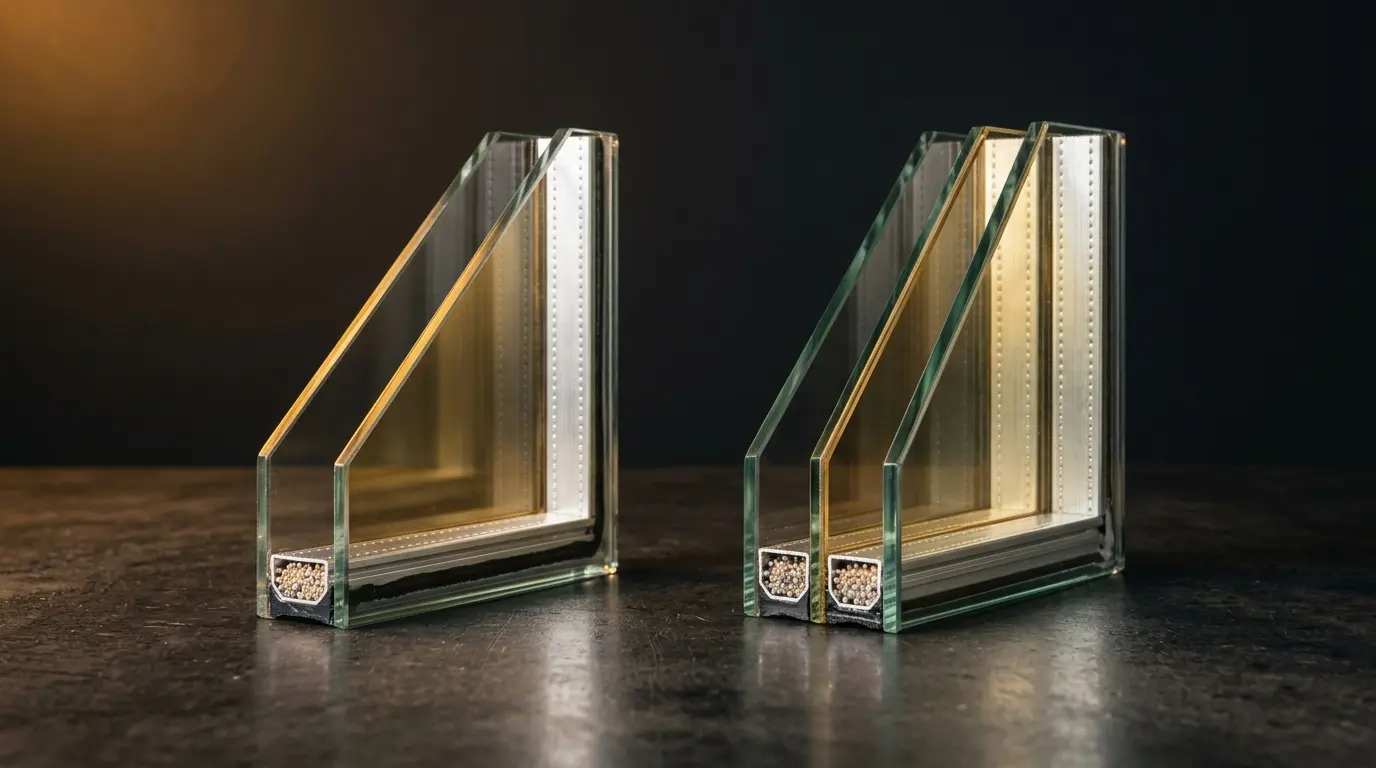
A pane count alone tells you almost nothing. Two IGUs with the same pane count can differ by a factor of two on thermal performance depending on coating, gas fill, and spacer. Here is what is actually inside each:
| Configuration | Build-up | U-factor (W/m2K) | Weight (kg/m2) | Thickness |
|---|---|---|---|---|
| Standard double pane | 4 - 12 air - 4 (clear, no Low-E) | 2.7 | 20 | 20mm |
| Premium double pane | 4 - 12 Ar - 4 (Low-E on surface 3) | 1.4 - 1.6 | 20 | 20mm |
| Standard triple pane | 4 - 12 Ar - 4 - 12 Ar - 4 (2x Low-E) | 0.7 - 0.9 | 30 | 36mm |
| Passive House triple | 4 - 16 Kr - 4 - 16 Kr - 4 (2x Low-E, warm-edge) | 0.5 - 0.6 | 30 | 44mm |
Values are center-of-glass under EN 673 boundary conditions. Whole-window U will be 0.1-0.3 higher depending on frame construction and edge seal.
The thermal performance gap
Put a pane in the middle of an IGU and you add a second insulating cavity. The second cavity delivers about the same thermal resistance as the first - roughly another R-2 - but it does so while the marginal cost of adding it is relatively high because you need a second coated lite and a second spacer assembly.
The comparator below lets you cycle through the four metrics that actually matter when choosing between configurations. Pick a metric and the panel highlights which configuration wins.
Double vs Triple Pane: Build-up Comparator
Notice the thermal advantage is real and large - a 50% cut in center-of-glass U means about half the conductive heat loss through the glazed area. But the weight, thickness, and cost penalties are also real and need somewhere to go in your frame design and budget.
Cost reality: factory-gate and installed premium
Factory-gate premium for triple over double on a like-for-like basis (same panel size, same Low-E grade, same spacer) is typically 55-70%. The drivers:
- Third pane of glass - about +15% raw material
- Second Low-E coating - about +15% (sputter-coated Low-E glass is a priced input)
- Second spacer, desiccant, and seal set - about +10%
- Extra argon fill and QC time - about +5%
- Lower throughput on the IGU line (longer cycle time per unit) - about +10-15%
Installed premium is lower because frame, labor, and shipping per window scale with window count, not IGU complexity. In residential retrofit pricing you typically see 35-50% premium per window for triple over double.
| Project type | Double pane (USD/m2 IGU) | Triple pane (USD/m2 IGU) | Premium |
|---|---|---|---|
| Volume residential (clear + Low-E) | $85 - $110 | $145 - $185 | +65-70% |
| Mid-rise commercial (laminated + Low-E) | $140 - $180 | $230 - $290 | +60-65% |
| Passive House (krypton, warm-edge) | $160 - $220 | $320 - $420 | +90-100% |
Pricing note: All figures are 2026 reference pricing, FOB Wuhan factory, subject to formal quotation. Actual prices vary with glass thickness, coatings, panel size, order volume, and USD/CNY exchange rate at time of quotation.
When triple pane is worth the premium
The honest answer: it depends on your heating fuel cost, your climate, and your discount rate. The calculator below asks for those inputs and spits out payback. Try your zone with your actual utility rates.
Triple Pane ROI Calculator
Estimate payback period and lifetime savings for upgrading from double to triple pane, by climate zone.
Rules of thumb emerging from a few hundred of these calculations:
- Zone 6 or colder, gas heat at USD 1.50/therm or higher: payback under 10 years. Specify triple.
- Zone 5, electric resistance heat: payback 8-12 years. Specify triple.
- Zone 4, mixed fuel: payback 15-22 years. Consider for comfort or condensation reasons; not for pure ROI.
- Zone 3 or warmer: payback usually exceeds window lifetime. Stick with premium double pane.
Climate zone decision guide
ROI is only one reason to spec triple pane. For some projects, the deciding factor is condensation (northern European humid-cold winters), comfort (large glass areas occupied in winter), or a code target like Passive House that mandates U below 0.8. Pick your zone and priority:
Triple Pane: Climate Zone x Priority Decision Matrix
Pick your climate zone and your top priority. Verdict reflects the dominant reason to spend (or not spend) the triple-pane premium.
Approx. 5,200 heating degree days.
In practice, Passive House and net-zero energy targets push triple pane into zones where ROI alone would not justify it - because the whole-building energy budget leaves no room for a window with U above 0.8.
Spec sheet template: triple pane IGU for international projects
A fillable PO spec sheet covering build-up, coatings, gas fill, spacer, seal system, QC, and shipping. Download free.
The 7 hidden trade-offs nobody lists
Beyond the obvious cost and weight, triple pane brings a set of second-order consequences that often get discovered during installation or the first winter. In order of how often they bite:
- Reduced visible light transmittance. Each extra lite + Low-E coating cuts VT by 8-10%. A premium double pane at VT 0.78 becomes a triple pane at VT 0.65-0.70. In north-facing rooms this is noticeable; occupants may reach for lights earlier in the day.
- Lower SHGC in cooling-dominated hours. Great in winter heating. In shoulder seasons it means you also lose the free solar heat you would have gotten.
- Frame U often becomes the weak link. Once center-of-glass U drops below 1.0, the whole-window U is dominated by frame conduction and edge effects. A mediocre aluminum frame with triple pane can perform worse than a thermally-broken frame with premium double pane.
- Weight loads the hardware. 50% more mass per square meter can exceed hinge, pivot, or operator load limits. Casement windows with large sashes are especially affected.
- Edge deflection and bowing. Triple pane IGUs have two sealed cavities. Altitude change, temperature swing, or barometric pressure change can deflect the panes inward or outward, raising edge-seal stress and in extreme cases causing contact between the middle lite and outer lites. Capillary tubes solve this for shipping; capillary-free IGUs must stay within tight altitude bands.
- Field-replaceable glass goes away. A broken triple pane IGU is a factory order, not a stock item. Lead time for replacement is 4-8 weeks vs 2-3 weeks for standard double pane.
- Harder to recycle. Two cavities, two seals, two desiccant beds. End-of-life material recovery is lower per square meter.
Weight, frames, and retrofit feasibility
The thickness jump from 20mm (standard double) to 36mm (standard triple) is the single biggest constraint on whether you can retrofit triple into an existing building. Common frame pockets handle 24-28mm max - fine for premium double pane with slightly wider spacers, nowhere near enough for triple.
Weight matters more than most specs admit. A typical casement window sash at 0.8 x 1.5 m (1.2 m2) carries:
- Double pane IGU: about 24 kg of glass
- Triple pane IGU: about 36 kg of glass
Multiply by a 3-meter commercial casement and you are looking at 90+ kg of glass per sash. Standard cam-action handles and friction stays are rated for 25-35 kg. You need heavy-duty hardware or operable geometry changes.
Get a quote for this product
Noise, condensation, and the comfort case
Noise
Adding a third pane of the same thickness does very little for sound transmission. The acoustic weakness is the coincidence frequency where panes of identical mass resonate together. A typical triple pane with three 4mm lites moves STC from about 32 to 35 - a difference most people cannot hear.
If noise reduction is a real goal, the right approach is asymmetric laminated glass:
- 6mm laminated (two 3mm panes + 0.76mm acoustic PVB) + 12mm air + 4mm: STC 38-40
- 8.76mm laminated + 16mm air + 6mm: STC 40-42
- For city-center residential facing highways, this is the right spec - not triple pane.
Condensation
This is where triple pane shines in cold climates. On the coldest winter nights, the interior pane of a double-pane IGU can drop to 3-5 C - below the dew point for a humid interior. The result is water running down windows, mold around the frame, and a conversation with the architect.
Triple pane keeps the interior pane 3-5 C warmer. In practice this moves the dew-point crossover from common (double pane in a humid winter residence) to very rare (triple pane in the same conditions).
Comfort
A warm interior pane surface has a second effect that does not show in U-factor numbers: it stops the cold-wall radiant discomfort you feel when sitting near a large window in winter. Occupants can place seating and desks at the glass line. In open-plan offices with floor-to-ceiling glazing in cold climates, this is often the deciding factor.
How to specify triple pane in your PO
A spec sheet that just says "triple pane IGU" gets you a wide range of quality. Here is what the PO should actually call out:
- Build-up: e.g. "4mm clear + 12mm Ar + 4mm Low-E + 12mm Ar + 4mm clear; Low-E on surfaces 2 and 5; overall thickness 36mm nominal."
- Low-E coating spec: softcoat (sputtered), emissivity below 0.04, specify the target U-factor and SHGC range. Name the coating if you have a preference (Guardian ClimaGuard, Saint-Gobain Planitherm, or equivalent).
- Gas fill: argon 90% minimum fill at time of production, verified by sampling. Krypton only if explicitly needed for a thin-cavity Passive House build.
- Spacer system: warm-edge (stainless steel or thermoplastic) for Passive House / cold climates. Standard aluminum acceptable in Zone 4-5 if cost is the constraint.
- Seal system: dual seal - PIB primary, silicone or polysulfide secondary. Reject any single-seal offer for triple pane.
- Edge seal depth: 10-12mm minimum.
- QC: gas-fill sampling per lot, dew point test for desiccant performance, EN 1279 or ASTM E2190 durability class.
- Capillary tubes: required for air freight or shipment across significant altitude differences. Sealed off before glazing on arrival.
- Shipping: A-frame crates, edge-protected, arrows for lite orientation. Specify handling stress limits.
For a project-specific spec sheet with your climate zone and performance targets filled in, request a quote - we will build the full data sheet including whole-window U and SHGC for your frame system.
Products referenced in this article
FAQ
Decoding U-Factor, SHGC, and G-Value Targets
Before deciding whether triple glazing pays back in your region, check how U-factor and SHGC targets shift across climate zones.
Frequently Asked Questions
If heating degree days exceed 5,000 per year (IECC zone 5 and colder), yes - triple pane typically pays back in 10-15 years and permanently eliminates window-side condensation. In zones 3 and below, no - the premium is better spent on solar-control Low-E, shading, or better frames.
At the factory gate, a 4-12Ar-4-12Ar-4 double-Low-E triple IGU runs about 55-70% more per square meter than a 4-12Ar-4 single-Low-E double IGU of the same size. Installed premium is lower - roughly 35-50% - because frame and labor cost per window is only marginally higher.
Barely. Triple pane moves STC from about 32 to 35 - imperceptible to most ears. For noise, a laminated-glass IGU with dissimilar pane thicknesses and an acoustic PVB interlayer hits STC 38-42. Do not buy triple pane for noise.
Rarely. Triple pane IGUs are typically 32-40mm thick vs 20-24mm for double. The sash and pocket depth must accommodate the extra thickness, and the heavier unit (about 50% more kg per square meter) often exceeds the hinge or operator load limit. Plan for new sashes or full window replacement.
Center-of-glass U is typically 0.7 to 1.0 W/m2K (0.12 to 0.18 BTU/h.ft2.F) for a 4-12Ar-4-12Ar-4 with two Low-E coatings. Whole-window U will be 0.1 to 0.3 higher depending on frame and edge seal. Krypton fill in narrower cavities can push U to 0.5-0.6.
Argon by default - 90% argon fill is standard, cheap, and delivers most of the thermal benefit. Krypton is worth the premium only when the cavity width must shrink below 10mm (overall thickness constraints) - krypton is less sensitive to cavity width, argon needs 12-16mm to perform.
Yes, modestly. Each extra lite and Low-E coating cuts SHGC by about 5-10%. Typical triple pane SHGC is 0.30-0.35 vs 0.35-0.40 for similar double pane. In cooling-dominated climates this helps - but a solar-control coating on double pane is more cost-effective.
Properly specified dual-seal triple pane IGU with warm-edge spacer should hit 25-30 years before seal failure. The same construction principles as double pane apply - PIB primary seal, silicone or polysulfide secondary, molecular sieve desiccant, and automated argon fill with QC gas sampling.

Li Cheng
CEO at Sincere Glass
CEO at Sincere Glass (欣城玻璃) with 10+ years in architectural glass. Oversees production and quality at our 20,000 m² Wuhan facility.
Technical review: Albar, Technical Lead
Need Custom Glass for Your Project?
Get a free quote from our engineering team. We'll help you choose the right glass type, thickness, and coating for your specific requirements.