The 30-second verdict
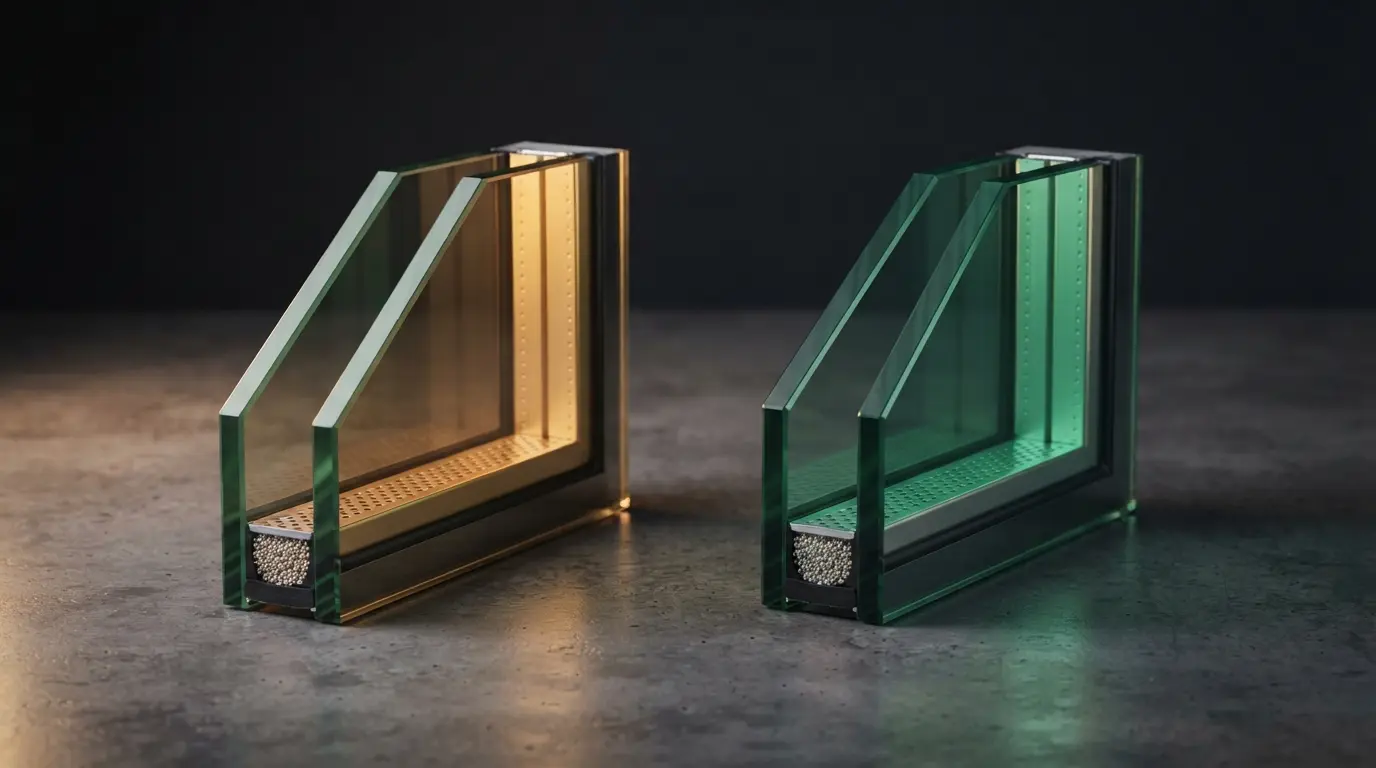
For 95% of insulated glass orders, argon is the right answer. Spec it as 90% minimum fill, in a 12-16mm cavity with one Low-E coating, and you capture almost all of the thermal benefit at a premium that disappears into rounding. Krypton wins in exactly one scenario: when overall IGU thickness has to stay under 24-28mm and you still need Passive House-grade U-values. Everywhere else, the krypton premium goes further on a better Low-E coating, a warm-edge spacer, or - for cold-climate buildings - a triple-pane IGU.
What gas fill actually does
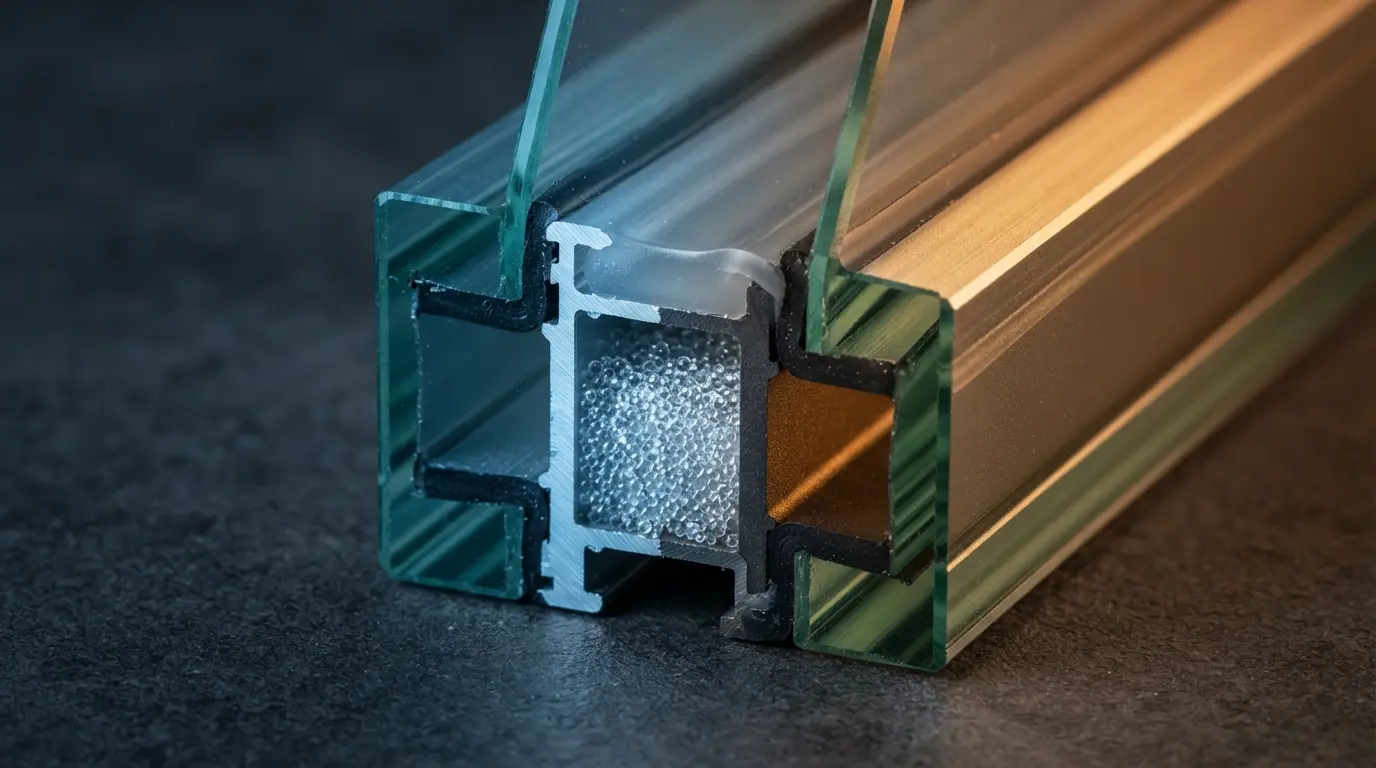
A sealed cavity between two glass lites transfers heat three ways: conduction through the gas, convection currents inside the cavity, and radiation between the two glass surfaces. Low-E coatings handle radiation. The gas fill handles conduction and convection together.
Air works, but air is a relatively conductive gas. Swap it for a denser, slower-moving noble gas and both conduction and convection drop. That is the whole mechanism. Everything else - which gas, at what width, with which coating, at what fill rate - is engineering trade-off around that core idea.
The question "argon or krypton?" is really the question "how much does each extra unit of thermal performance cost me?" That answer depends on cavity width, climate, energy price, and whether the project has a hard thickness budget.
Thermal conductivity: the raw numbers
Lower conductivity means less heat transfer through the gas layer, so a lower U-value for the IGU. Krypton is roughly half as conductive as argon, and argon is roughly two-thirds as conductive as air. Xenon is better still, but prices it out of commercial architectural glazing.
Thermal conductivity: the raw numbers
Lower is better. Click a bar to see the U-value that gas delivers in a standard 4-12-4 Low-E IGU.
The industry standard. A 90% argon fill delivers almost all the practical benefit of gas filling, at a cost that disappears into rounding.
Reference conductivity values at 283 K per ISO 15099 and EN 673 Annex A. U-value approximations assume ideal fill rate; real production fill rates run 88-95%, so real U-values track 2-5% higher.
The gap between air and argon is where most of the practical benefit lives. The gap between argon and krypton is smaller in absolute terms and - crucially - only materializes when the cavity is narrow enough that the gas itself is the bottleneck. The next section explains why.
Why cavity width changes the answer
Each gas has a thermal sweet spot that depends on cavity width. Too narrow and conduction through the gas dominates: a denser gas (krypton, xenon) wins. Too wide and convection currents start forming inside the cavity, which transfers heat by moving warm gas to the cold side - widening the gap no longer helps, and may hurt.
Cavity width changes the answer
Every gas has a sweet spot. Below it, conduction dominates. Above it, convection dominates. Krypton peaks narrow, argon medium, air wide.
Cavity is too narrow for Argon. Conduction through the gas is the bottleneck; widen to 16mm or switch to a denser gas.
Optimum for Argon: 16mm giving 1.1 W/m2.K.
Values are engineering approximations for a 4-X-4 Low-E IGU with one soft coating at e = 0.04, calculated per EN 673 Annex A. Whole-window U-value with frame will be 0.2-0.4 higher.
Reading the chart in practical terms:
- Air is nearly flat past 14mm. Anything wider is wasted space.
- Argon optimizes around 14-16mm. This is why standard IGU build-ups specify 12mm or 16mm cavities with argon - both are close enough to the sweet spot to be defensible.
- Krypton optimizes around 8-10mm. Beyond that, convection kicks in sooner because krypton is denser and settles faster. This is the physical reason krypton is specified for thin IGUs, not fat ones.
A 20mm argon cavity and a 10mm krypton cavity deliver nearly the same U-value. If total IGU thickness is not constrained, argon wins on cost. If it is constrained (slim frame, retrofit pocket, triple-pane with two cavities), krypton earns its premium.
Argon: the 90% industry standard
Argon is cheap, abundant (it is 0.93% of the atmosphere, extracted as a byproduct of liquid oxygen production), and well-characterized. Every major architectural glass standard - EN 673, EN 1279, ASTM E2190, GB/T 11944 - assumes argon as the default commercial fill.
What "90% fill" means on a PO. The gas-fill machine purges the cavity with argon before sealing. A 90% fill rate means 90% of the cavity volume is argon, 10% is residual air. Well-tuned automated lines achieve 92-95%; manual or older lines may drift to 80-85%. Fill rates below 85% should be rejected at QC - the U-value math assumes 90%, so an 80% fill delivers measurably worse thermal performance than the data sheet promises.
Real-world fill decay. A properly sealed dual-seal IGU loses argon at 0.3-0.7% per year under EN 1279-3 accelerated testing. Over 25 years the fill rate drifts from 90% to roughly 75-82%, which costs you about 0.1-0.15 W/m2K on the U-value. Most occupants will not notice; most building audits will. Specify the leak rate explicitly on the PO (see the spec sheet section below).
Get a quote for this product
Krypton: when the premium actually pays back
Krypton exists in commercial architectural glazing for one reason: it lets a thin cavity deliver the same U-value a fat argon cavity does. Everything else about krypton (cost, availability, fill handling) is worse than argon. The question for any specific project is whether the narrow-cavity capability is actually worth USD 35-60 per m2.
Krypton upgrade: does it pay back?
Argon is the baseline. Krypton adds roughly USD 42 per m2 at the factory gate. Enter your project to see if the energy savings justify it over 25 years.
Payback is 7-15 years. If occupant comfort or Passive House certification matters, go krypton. On pure ROI, argon is defensible.
Model: degree-day approximation at the glazing (U * A * HDD * 24 / 1000). Ignores solar gain, shading, frame effects and future energy price inflation. Reference pricing only; subject to spec, coating, FX. Not a formal quote.
Three project archetypes where krypton earns its cost:
- Passive House retrofits with constrained sash depth. Existing window frames cannot accommodate a 44mm triple-pane IGU with three argon cavities. A triple pane with two 8mm krypton cavities hits 28mm total and fits the frame. This is the classic krypton use case.
- Slim-profile curtain walls where whole-system U is specified. When the architect has specified a 32mm nominal IGU for aesthetic reasons and the engineer needs U below 1.0 W/m2K, krypton in dual Low-E lets you hit the number without widening the sightline.
- High-value niche: cold-climate residential with tight budget on everything except energy. If energy prices are USD 0.25+/kWh and HDD is above 5,000, the 25-year payback math can favor krypton even on a wider-cavity design, because the marginal U-value reduction compounds annually. Verify with the calculator above.
Outside those archetypes, krypton is a line item an uninformed spec writer added from a Guardian Glass or Saint-Gobain product sheet without checking what the cavity width is. Argue it out at design review.
Need a spec check on your IGU build-up?
Send your cavity width, Low-E coating and U-value target. We will tell you whether argon is enough or krypton is justified - factory spec, no sales pitch.
Xenon: the exotic almost nobody uses
Xenon is the thermal champion among IGU gases - 21% the conductivity of air, 58% of krypton. On paper it would let a 6mm cavity hit Passive House U-values. In practice xenon costs USD 1,500-3,000 per cubic meter at bulk pricing, roughly 100x krypton. A typical 1m by 1m IGU holds 6-16 liters of fill gas; xenon adds USD 200-400 per m2 of IGU over argon. For almost every project, that money delivers more benefit as a better Low-E coating or an extra pane.
Where xenon does appear: vacuum-insulated glazing (VIG) prototypes, aerospace cabin glazing, and a handful of certified Passive House ultra-low-U projects where thickness budget is below 20mm and cost is unconstrained. None of that is commodity architectural glass. Treat xenon as a spec you will probably never encounter and move on.
The leak rate problem (EN 1279-3)
Every IGU leaks. The seal system (PIB primary, silicone or polysulfide secondary) slows diffusion to a crawl, but molecular-size noble gases will eventually migrate through any organic sealant. The question is how fast.
| Seal system | Argon loss (%/yr) | Krypton loss (%/yr) | Expected service life |
|---|---|---|---|
| Single seal (silicone only) | 2.5 - 4.0 | 1.8 - 2.8 | 5 - 10 years |
| Dual seal, PIB + polysulfide | 0.6 - 1.0 | 0.4 - 0.8 | 15 - 20 years |
| Dual seal, PIB + silicone | 0.3 - 0.7 | 0.2 - 0.5 | 25 - 30 years |
| Dual seal + warm-edge spacer, EN 1279 certified | 0.2 - 0.5 | 0.2 - 0.4 | 30+ years |
Data source: EN 1279-3 accelerated test, Sincere Glass production data 2024 Q1 - 2026 Q3.
Pricing note: All figures are 2026 reference pricing, FOB Wuhan factory, subject to formal quotation. Actual prices vary with glass thickness, coatings, panel size, order volume, and USD/CNY exchange rate at time of quotation.
Mixed Ar/Kr fills: real or marketing?
Some product sheets advertise "argon-krypton mix 50/50" or "optimized gas blend" as a middle option between argon and krypton. The physics is straightforward: a 50/50 Ar/Kr blend has conductivity about halfway between pure fills, so U-value lands halfway too.
The commercial case is weaker. A 50/50 blend costs roughly 60-70% of pure krypton because the krypton fraction dominates cost. A 70/30 argon-krypton blend costs about 40-50% of pure krypton. Both deliver smaller thermal gains than pure krypton without proportional cost savings. On our Wuhan line we offer blends on request but almost never specify them to customers - either argon is enough, or the project needs full krypton. The middle is rarely the right answer.
Writing the spec sheet
A clear PO prevents 90% of gas-fill disputes. For any IGU specification:
- Gas type: "Argon fill" or "Krypton fill" explicitly. Not "inert gas fill" - that phrase lets the factory choose air and claim compliance.
- Fill rate: "90% minimum at time of production, verified by sampling per lot." EN 1279-3 class 1 or ASTM E2190 class CBA.
- Cavity width: Nominal in mm. Specify the overall IGU build-up: "4mm clear + 12mm argon + 4mm Low-E (surface 3), e = 0.04."
- Seal system: "Dual seal: PIB primary, silicone secondary." Reject single-seal offers for any gas-filled IGU intended to last past 10 years.
- Spacer: Warm-edge (stainless steel or thermoplastic) for cold climates and Passive House. Standard aluminum acceptable in Zone 4-5 if cost is the constraint.
- Leak rate target: "EN 1279-3 class 1 (less than 1%/year argon loss)" for commercial projects. "Less than 0.5%/year" for PH-certified or 25-year-rated.
- QC documentation: Gas-fill sampling records per lot, dew point test for desiccant, visual inspection for bubbles or seal voids. Require the records as part of the shipment paperwork.
- Capillary tubes: Required for air freight or shipment across altitude differences above 500m. Tubes are sealed off before final glazing on arrival. Omit for sea freight within the same altitude band.
What we fill at our Wuhan line
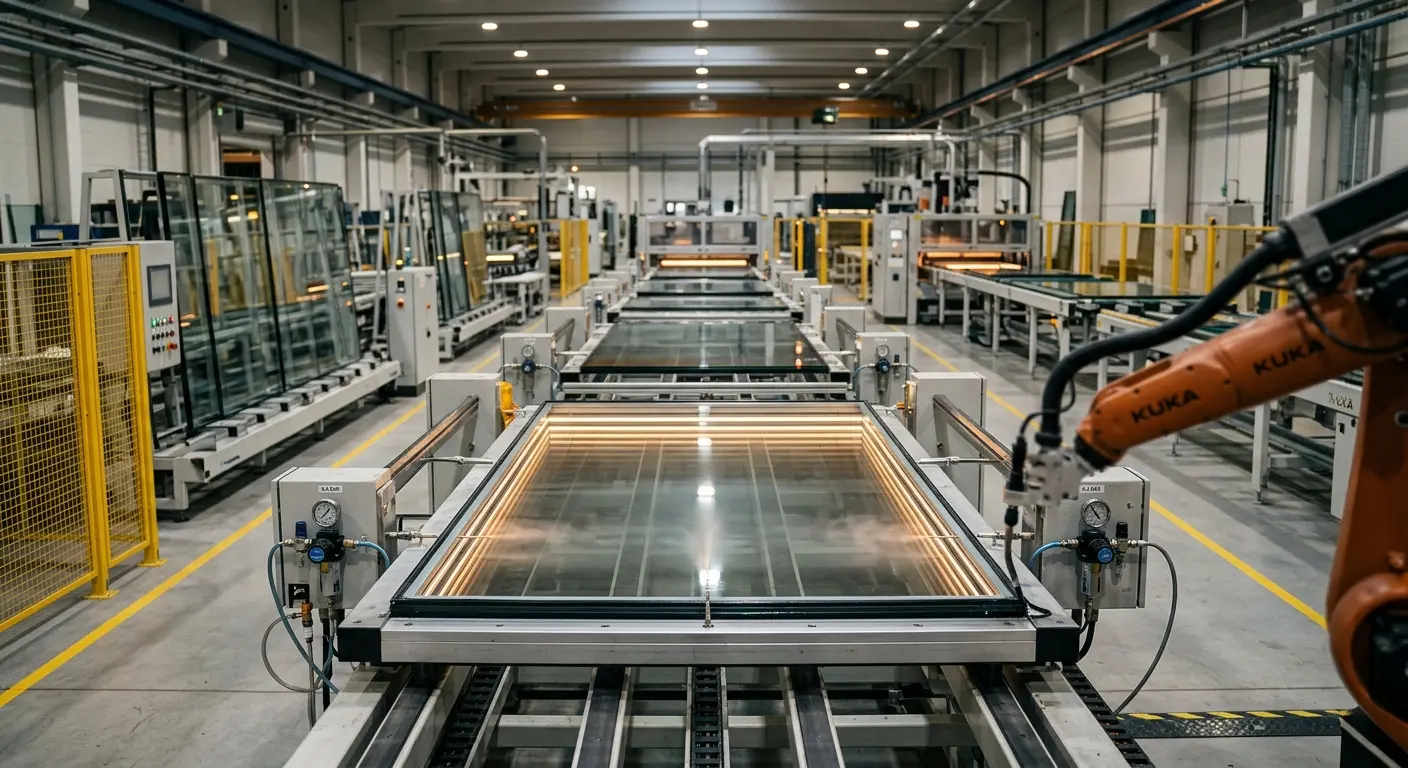
On our automated IGU assembly line we run two gas-fill configurations. The default is 90% argon with 12mm or 16mm cavity width (customer choice), dual seal with PIB primary and silicone secondary, warm-edge or aluminum spacer. We ship perhaps 95% of our IGU volume this way; it hits EN 1279-3 class 1 with margin and holds through the full 25-year specification for European and North American curtain-wall projects.
The exception is krypton on request - typically 2-5% of project volume, specified by customers on Passive House retrofits or slim-sightline curtain walls. We run krypton as a dedicated batch once per week to minimize gas waste (krypton costs make partial-fill cycles painful). Minimum order for krypton fill: 50 m2 per spec to justify a dedicated batch. Below that we quote but recommend argon.
For both fills, QC sampling pulls one unit per 50 m2 of production and measures residual fill rate via gas chromatography. Units failing the fill-rate threshold go back for rework, not shipment. Records travel with the container. Full walk-through of our IGU assembly line covers the gas-fill station in context.
Products referenced in this article
FAQ
Frequently Asked Questions
Argon is better for almost every project. It delivers 85-90% of krypton thermal benefit at 5-10% of the cost premium. Krypton only wins when overall IGU thickness constraints force the cavity below 10mm - a narrow Passive House retrofit, for example. At 12mm or wider, argon matches or beats krypton on cost per U-value reduction.
At the factory gate, krypton fill adds roughly USD 35-60 per m2 of IGU over argon in 2026 pricing. Argon itself adds only USD 2-4 per m2 over air. The absolute krypton gas cost is about 100-150x argon per unit volume.
14-16mm is the thermal optimum for 90% argon with one Low-E coating. Below 10mm, conduction through the gas dominates and argon loses to krypton. Above 18mm, convection currents inside the cavity start adding heat transfer back, so wider is not better.
8-10mm is krypton thermal optimum. Krypton lower conductivity lets a narrow cavity deliver the same U-value an argon 14mm cavity does. This is exactly why krypton exists commercially - to let total IGU thickness stay under 24mm for retrofit frames and Passive House budgets.
EN 1279-3 caps argon loss at 1% per year averaged over the testing period, measured on a sealed-edge sample. Dual-seal IGUs with PIB primary and silicone or polysulfide secondary routinely hit 0.3-0.7% per year when assembled correctly. Single-seal units typically fail the 1% ceiling within 5 years.
Yes, technically. Mixed Ar/Kr fills (typically 50/50 or 70/30) are offered commercially but deliver marginal thermal gains over 90% argon at 2-3x the premium. In production we rarely see them specified; most krypton projects use 90% krypton or stay on argon.
90% is the industry spec and what any reputable factory should deliver. 95% is possible with automated gas-fill machines and vacuum-assisted fill. Our Wuhan line runs 92-95% typical with QC sampling per lot. Fill rates below 85% are a sign of manual fill or a leaking seal.
Yes, modestly. Higher ambient temperatures accelerate the diffusion of gas through sealants and edge seal defects. An IGU rated for 1% annual loss at 20 C may drift to 1.5-2% per year averaged over a Phoenix summer. Spec dual-seal with silicone secondary for hot climates; polysulfide secondary degrades faster above 40 C.

Li Cheng
CEO at Sincere Glass
CEO at Sincere Glass (欣城玻璃) with 10+ years in architectural glass. Oversees production and quality at our 20,000 m² Wuhan facility.
Technical review: Albar, Technical Lead
Need Custom Glass for Your Project?
Get a free quote from our engineering team. We'll help you choose the right glass type, thickness, and coating for your specific requirements.