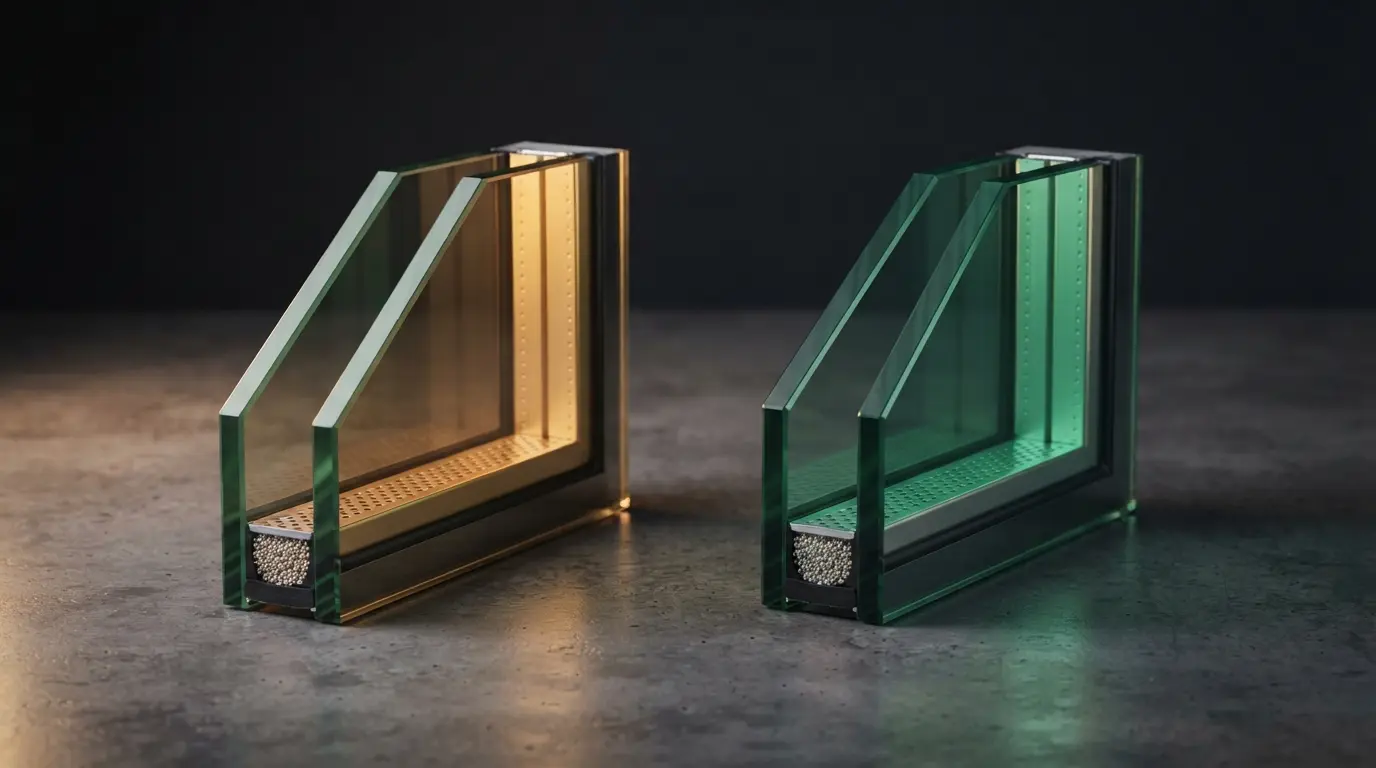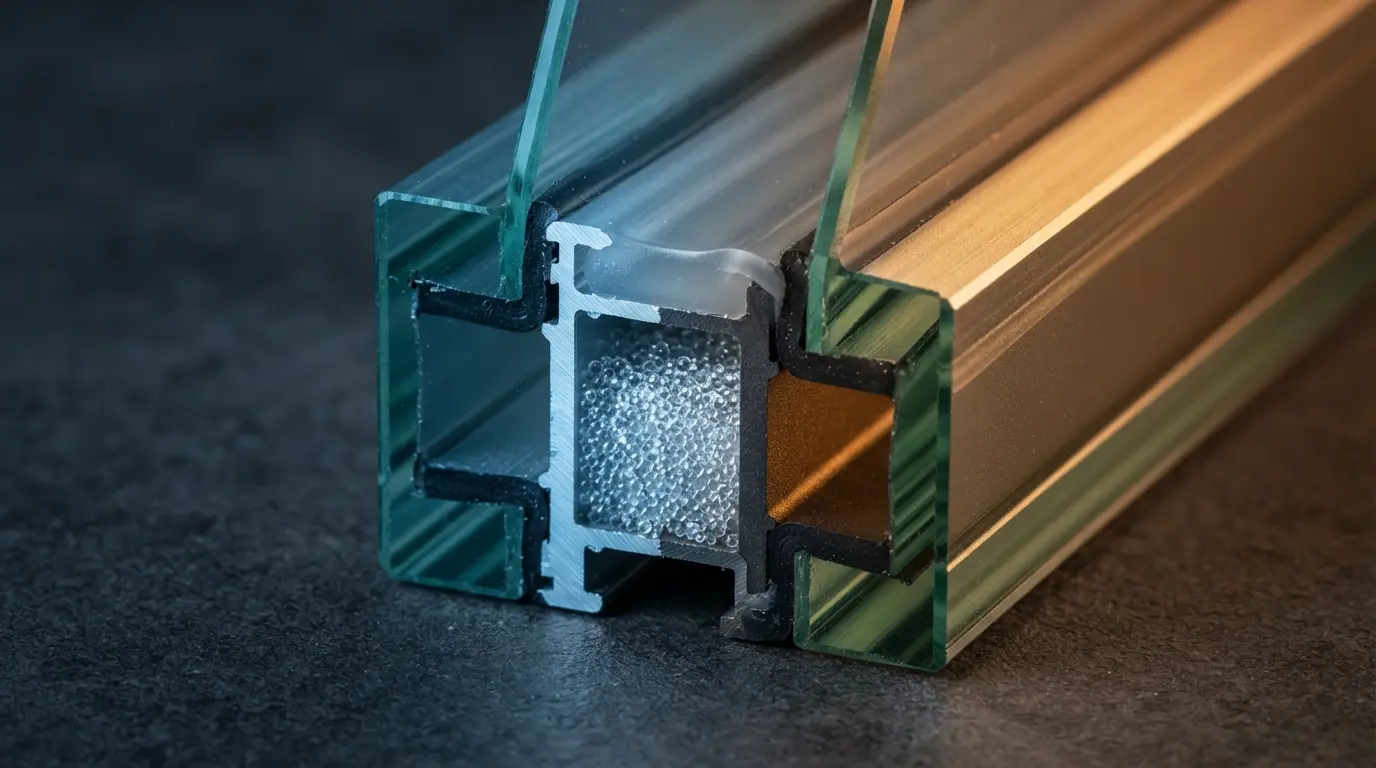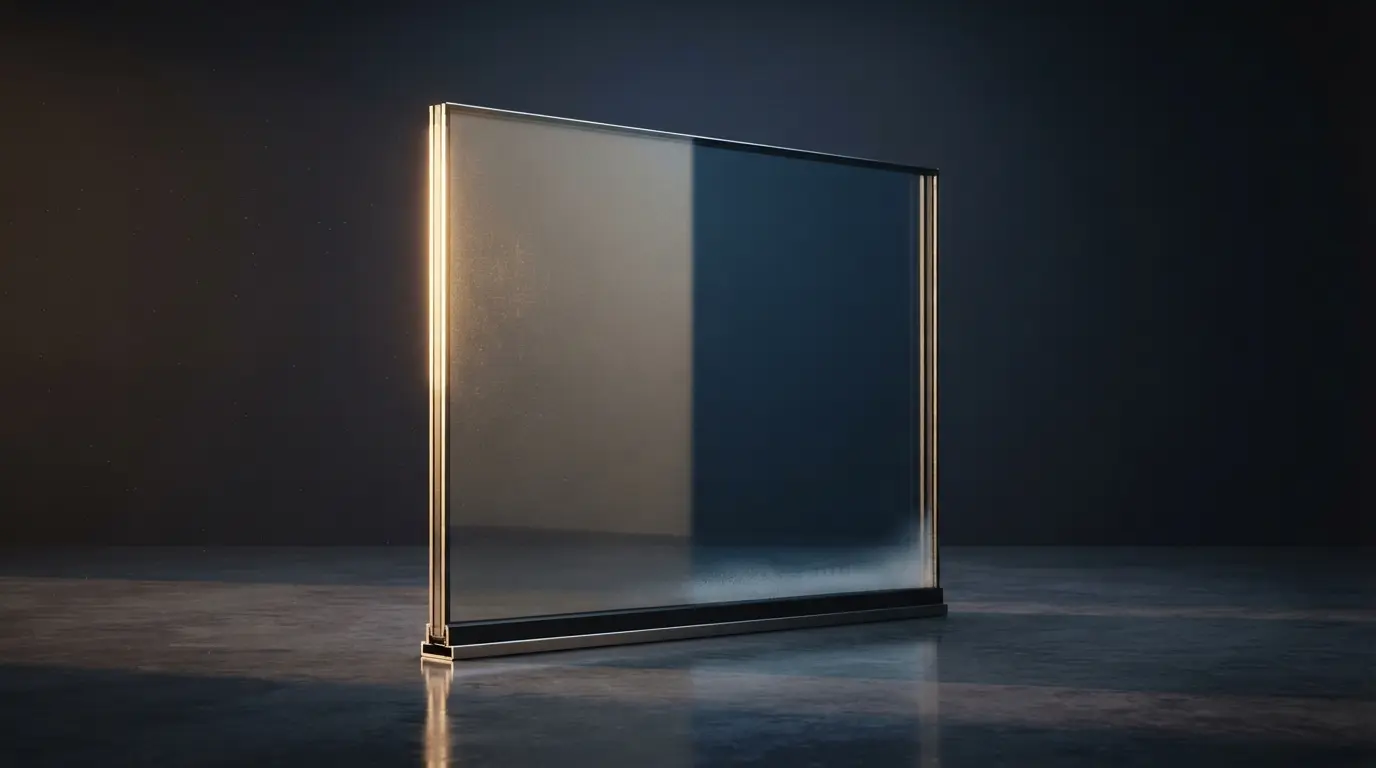
The 30-second verdict
If you only read two numbers on a window, read U-factor and SHGC: U-factor is heat lost through the glass (lower is better everywhere), and SHGC is solar heat let in (low for hot climates, higher for cold ones). U-factor decides how big your heating bill is in winter. SHGC decides whether a south-facing room bakes in summer or stays comfortable. They are controlled separately by the Low-E coating, so a good insulated glass unit can give you a low U-factor and whatever SHGC your climate needs at the same time.
What U-factor actually measures
U-factor measures how fast heat escapes through the window by conduction. It is the rate of heat flow per unit area per degree of temperature difference, so a lower U-factor means a better insulator. In US units it is expressed in Btu/(h.ft2.F) and usually runs from about 0.10 for the best triple glazing to 1.04 for a single pane.
The number you see on a label is for the assembled unit, not the raw glass. Three things move it: the number of panes, the Low-E coating, and the gas in the cavity. A plain double pane sits near 0.48; add a Low-E coating and argon fill and the same unit drops to roughly 0.28, because the coating reflects radiant heat back into the room. The gas matters too - see how argon and krypton fills compare.
What SHGC actually measures
SHGC, the Solar Heat Gain Coefficient, measures the fraction of the sun's heat that passes through the window. It runs from 0 to 1: an SHGC of 0.25 means a quarter of the incident solar energy ends up inside as heat. Unlike U-factor, there is no universally better direction - the right SHGC depends entirely on climate.
In a hot climate a low SHGC is a cooling-bill saver. In a cold climate a higher SHGC on the south face is free winter heat. The Low-E coating is again the lever: a solar-control coating can cut SHGC to 0.25 while barely touching how much daylight gets through.
U-factor vs SHGC: the two numbers together
U-factor and SHGC answer two different questions, and reading one without the other is the most common spec mistake. Think of U-factor as the insulation rating and SHGC as the sunglasses rating. The table below shows how four typical build-ups separate the two.
| Glass build-up | U-factor (US) | SHGC | Best for |
|---|---|---|---|
| Double pane, clear | 0.48 | 0.70 | Mild zones, little sun |
| Double pane, solar-control Low-E + argon | 0.28 | 0.25 | Hot, cooling-dominated zones |
| Double pane, high-gain Low-E + argon | 0.28 | 0.45 | Cold zones, south glass |
| Triple pane, 2x Low-E + argon | 0.15 | 0.25 | Passive House, severe cold |
Notice rows two and three share a U-factor but differ in SHGC: same insulation, opposite solar strategy, set purely by which Low-E coating we laminate in. A third pane is a bigger jump than most projects need; we lay out when it pays in double pane vs triple pane.
U-factor, R-value, and metric U-value
R-value and U-factor are the same information inverted: R-value is 1 divided by U-factor, so a U-factor of 0.30 is an R-value of about 3.3. Builders talk in R-value for walls and U-factor for windows, which trips people up. The converter below moves between them and between US and metric units in one place.
Code-plus performance. A double pane Low-E argon IGU reaches this range and satisfies most IECC climate zones.
| Glass build-up | U-factor (US) | R-value |
|---|---|---|
| Single pane, clear | 1.04 | 0.96 |
| Double pane, clear air | 0.48 | 2.08 |
| Double pane, Low-E + argon | 0.28 | 3.57 |
| Triple pane, 2x Low-E + argon | 0.15 | 6.67 |
| Passive House target | 0.14 | 7.14 |
Reference values only; whole-window U-factor varies with frame and size. Sincere Glass center-of-glass data, 2024 Q1 - 2026 Q3.
The unit trap is real: a US U-factor of 0.30 is a metric U-value of 1.7 W/m2.K (multiply by 5.678). A European spec sheet quoting "Ug 1.1" is far better than a US sheet quoting "0.30", not worse, once you convert.
Choosing SHGC by climate zone
SHGC should be chosen from the climate zone and the facade orientation, not copied from a brochure. Cooling-dominated zones want a low SHGC on every face; heating-dominated zones want a higher SHGC on the south face and a low one everywhere else. Set your zone and orientation below for a target range.
If the zone is mixed and the glass faces south, then a moderate SHGC lets in useful winter sun while a Low-E coating still holds down summer gain.
| Climate band | South face | N / E / W faces |
|---|---|---|
| Zones 1-3 (hot / cooling) | 0.20 - 0.25 | 0.20 - 0.25 |
| Zones 4-5 (mixed) | 0.30 - 0.40 | 0.25 - 0.35 |
| Zones 6-8 (cold / heating) | 0.40 - 0.55 | 0.25 - 0.35 |
General guidance aligned to IECC zoning and ENERGY STAR direction; confirm against local energy code and the project energy model before specifying.
Glass Performance Spec Sheet
Download our U-factor and SHGC reference table for every coating and build-up we run, with metric and US units side by side.
Reading the whole window label
A window label carries up to five numbers, and the two that every energy code checks first are U-factor and SHGC. The rest - VT, air leakage, and condensation resistance - round out the picture. Click any number below to see what it means and what a good value looks like.
How fast the whole window loses heat. Lower is better. This is the number that decides winter comfort and heating bills.
Scale 0.10 (best) to 1.20 (single pane). Code minimum in cold US zones is near 0.30.
Sample values shown for a typical double pane Low-E argon IGU. U-Factor and SHGC are the two ratings every energy code checks first.
Center-of-glass vs whole-window numbers
A glass supplier quotes the center-of-glass number; a window label quotes the whole-window number, and they are not the same. The center-of-glass U-factor describes the insulated glass unit itself. The whole-window U-factor blends in the frame and the edge of the glass, which are usually worse, so the whole-window figure is a little higher (less good).
This matters when you compare quotes. If your fabricator quotes a center-of-glass U-factor of 0.24 and the finished window is rated 0.30, nobody is lying - the frame moved the number. When you buy glass from us, you are buying to the center-of-glass spec; the whole-window result depends on who makes the frame.
What better numbers cost
Better U-factor and SHGC come from the coating, the gas fill, and the pane count, and each step has a rough cost premium over clear double glazing. The table is a planning reference, not a quote.
| Upgrade | Typical U-factor (US) | Premium over clear double |
|---|---|---|
| Clear double pane, air | 0.48 | Baseline |
| Add Low-E coating | 0.33 | +10 to 20 percent |
| Low-E + argon fill | 0.28 | +15 to 25 percent |
| Triple pane, 2x Low-E + argon | 0.15 | +60 to 90 percent |
2026 reference pricing, FOB Wuhan factory. Subject to formal quotation.
Five mistakes buyers make
These are the errors we correct most often on incoming specs.
- Specifying a low SHGC everywhere in a cold climate, which throws away free winter solar heat on the south face.
- Comparing a US U-factor against a metric U-value without converting, and picking the wrong glass by a factor of five.
- Chasing a lower U-factor with a third pane in a mild climate, where the payback runs past 20 years.
- Comparing a center-of-glass number from one supplier against a whole-window number from another.
- Assuming low SHGC means a dark room; VT, not SHGC, controls daylight.
How we spec glass at the factory
At our Wuhan line we build the IGU to a stated center-of-glass U-factor and SHGC, then back it with test data. We pick the Low-E coating for the SHGC the climate needs, set the cavity width and gas fill for the U-factor, and confirm both against EN 673 (U-value) and EN 410 (solar and light). If you send the target numbers and the climate zone, we return the build-up that hits them.
Get a quote for this product
FAQ
Frequently Asked Questions
For heat loss, yes: lower U-factor means less heat escapes. But past a point the cost of a third pane outweighs the saving in mild climates, so match the number to the zone.
A double pane Low-E argon IGU reaches about 0.28 to 0.30 (US units), which satisfies most cold US zones. Passive House targets 0.14 or below with triple glazing.
Hot, cooling-dominated climates want 0.25 or less. Cold climates can use 0.40 or more on south-facing glass to capture passive solar heat.
U-factor rates heat loss by conduction; SHGC rates how much solar heat passes through. One controls winter bills, the other controls summer overheating.
R-value is 1 divided by U-factor in the same unit system. A U-factor of 0.30 (US) equals an R-value of about 3.3.
Metric U-value (W/m2.K) is the US U-factor multiplied by 5.678. A US 0.30 is a metric 1.7, so always confirm which unit a spec sheet uses.
No. Daylight is measured by VT, not SHGC. A good Low-E coating can keep VT high while pushing SHGC down, so a room stays bright without overheating.
Yes. We build the IGU to a stated center-of-glass U-factor and SHGC by choosing the Low-E coating, cavity width, and gas fill, with test data on request.
SHGC (Solar Heat Gain Coefficient, NFRC 200) and European g-value (EN 410) measure the same property: the fraction of incident solar radiation admitted through glazing, expressed from 0 to 1. Because NFRC 200 and EN 410 use slightly different standard boundary temperatures and solar spectra, a unit's SHGC and g-value typically differ by 0.01 to 0.03.
Products referenced in this article

Li Cheng
CEO at Sincere Glass
CEO at Sincere Glass (欣城玻璃) with 10+ years in architectural glass. Oversees production and quality at our 20,000 m² Wuhan facility.
Technical review: Albar, Technical Lead
Need Custom Glass for Your Project?
Get a free quote from our engineering team. We'll help you choose the right glass type, thickness, and coating for your specific requirements.